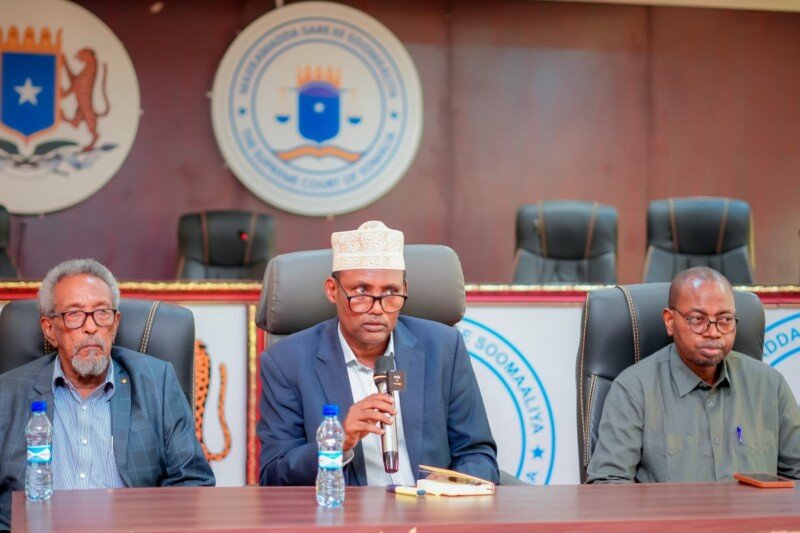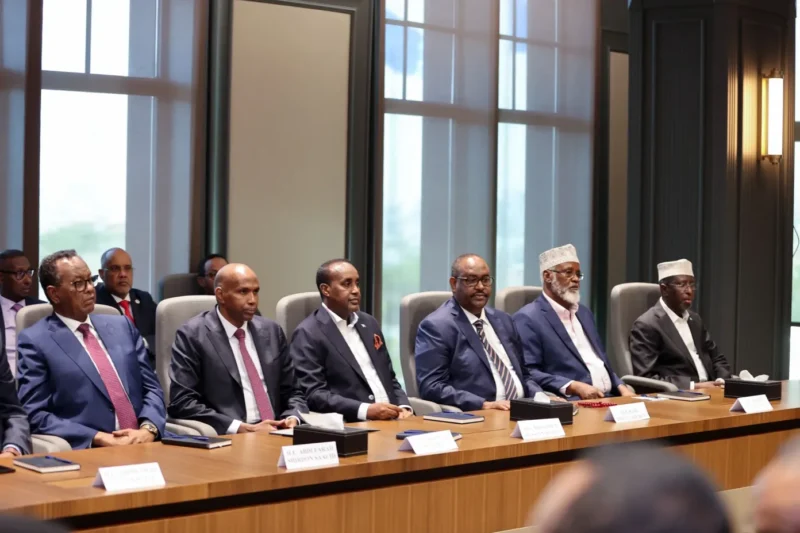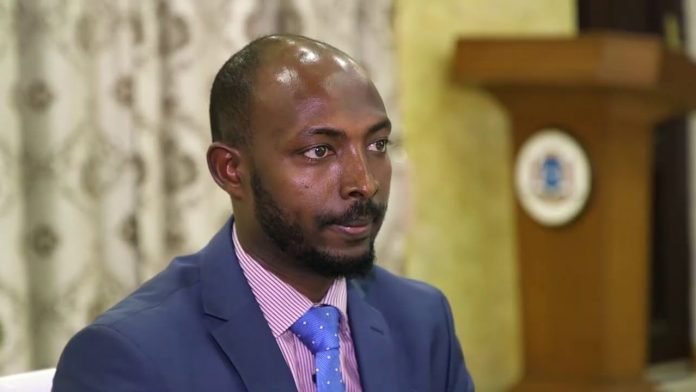
MOGADISHU, Somalia’s Supreme Court has declared the dismissal of Chief Justice Baashe Yusuf Ahmed by President Hassan Sheikh Mohamud “null and void,” ruling that the President lacked the constitutional authority to remove the head of the judiciary unilaterally, in a direct confrontation that deepens the country’s political crisis.
In a statement issued today, November 5, the court said the President’s decision, announced via a Facebook post from Villa Somalia, violated the principles of the rule of law, the separation of powers, and judicial independence enshrined in both the 2012 Provisional Constitution and the contested 2026 Constitution. The court argued that the removal of a Chief Justice requires a recommendation from the Supreme Judicial Council followed by approval from both houses of Parliament, and that no constitutional provision grants the President the power to dismiss the Chief Justice on his own.
The ruling is a direct rebuke to President Mohamud, who on Wednesday removed Baashe and appointed Ibrahim Idle Suleiman, a close associate and former legal adviser, to replace him. As FTL Somalia reported on the dismissal, the move was part of a coordinated exercise of executive authority that unfolded against the backdrop of a contested electoral transition, a looming security vacuum, and a shrinking budget, and it came on the same day the Prime Minister dismissed two junior government officials.
The Court’s Reasoning
The Supreme Court’s statement laid out a detailed constitutional argument. It cited Article 135(1) of the 2026 Constitution, which mandates that the Chief Justice be appointed following a proposal from the Supreme Judicial Council and approval by both chambers of Parliament with an absolute majority, before the President issues the appointment decree. It then cited Article 138(4), which states that the removal of the Chief Justice must be initiated by the Supreme Judicial Council and approved by a joint session of Parliament with a one-vote majority.
The court concluded that “there is no constitutional provision that gives the President the power to remove the Chief Justice.” It further stated that the complaints from judges and legal professionals cited by the presidency as the justification for the dismissal were “baseless,” and that during Baashe’s tenure, the judiciary had achieved significant progress in training, transparency, and the fight against corruption and bias.
The statement also alleged that the President’s move was intended to obstruct a pending constitutional case before the Supreme Court concerning the constitutional amendments, the terms of the President, the government, and both houses of Parliament. The court ordered the President to respect the Constitution and protect the independence of the judiciary.
A Politically Charged Dismissal
The Supreme Court’s ruling confirms what analysts and opposition figures had suspected: that the dismissal of Chief Justice Baashe was linked to his handling of a politically sensitive case. As detailed in FTL Somalia’s reporting, Baashe had recently taken up an opposition petition challenging the government’s new constitution and had ordered the government to submit its defence. He was reportedly on the verge of delivering a verdict when he was removed.
Garowe Online, citing sources, reported that Baashe had been expected to travel to Mogadishu to announce a Supreme Court decision on the constitutional amendments, a ruling that was expected to deal a significant blow to the President’s administration. The sources said the President’s decision to remove Baashe was intended to pre-empt that ruling.
The dismissal also followed Baashe’s earlier ruling that annulled the Galmudug regional elections, compelling the authorities to hold a rerun, a decision that had already strained relations between the judiciary and the executive. As the Galmudug electoral process had already raised questions about the commission’s credibility, Baashe’s ruling was a further assertion of judicial independence.
The new Chief Justice, Ibrahim Idle Suleiman, is a member of the ruling party and a close associate of the President. He previously served as Chief Justice from 2016 until his dismissal in May 2018 by then-President Mohamed Abdullahi Farmaajo. After President Mohamud returned to power in 2022, he appointed Suleiman as his special legal adviser.
The Standoff Ahead
The Supreme Court’s declaration that the dismissal is “null and void” creates an unprecedented constitutional standoff. The court has effectively ruled that Baashe remains the legitimate Chief Justice, while the President has installed Ibrahim Idle Suleiman in the role and directed a sweeping overhaul of the judiciary.
It is not yet clear how the standoff will be resolved. The court’s statement is a legal opinion, not an enforcement mechanism. The President controls the security apparatus and the executive branch. The judiciary has no police force to enforce its rulings. The opposition, however, now has a powerful legal argument to challenge the legitimacy of the President’s judicial appointments and, by extension, any rulings that flow from them.
The crisis also intersects with the broader political dispute over the electoral calendar. As former President Farmaajo has warned of parallel elections and former President Sharif Sheikh Ahmed has challenged the constitutional amendments, the Supreme Court was the venue where that dispute was being litigated. With the court now openly at odds with the President, the legal pathway for resolving the electoral impasse has been thrown into uncertainty.
The standoff also unfolds against a deteriorating security and fiscal backdrop. The unravelling of Somalia’s security architecture as Ugandan troops withdraw, and the gap between petroleum promises and fiscal realities, have created a sense of urgency that makes the judicial confrontation even more destabilizing.
Critical Note
The Supreme Court’s ruling is a remarkable act of institutional defiance. A judiciary that has often been criticized for its deference to executive power has, in this instance, drawn a clear line and refused to accept the President’s authority to remake it at will. The court’s reasoning is grounded in the text of the constitution, and its conclusion is unambiguous: the President acted beyond his powers.
But a ruling is not a resolution. The President has already appointed a replacement, and he has shown no sign that he intends to reverse course. The court’s declaration that the dismissal is “null and void” does not change the reality on the ground, where Ibrahim Idle Suleiman is now sitting in the Chief Justice’s chair. The standoff is a test of whether Somalia’s institutions can resolve a constitutional crisis through law, or whether the outcome will be determined by whoever controls the guns and the money.
The timing is deeply troubling. Somalia is facing a contested election, a security vacuum as Ugandan troops withdraw, and a fiscal crisis that shows no sign of easing. The last thing the country needs is a confrontation between the presidency and the judiciary. But that is precisely what it has. The President’s decision to remove the Chief Justice was a calculated move to clear a legal obstacle. The court’s decision to declare that removal void is a refusal to be cleared. The question now is whether either side is prepared to de-escalate, or whether the standoff will become another front in a conflict that Somalia can ill afford.
Recommended Reading On ftlsomalia.com
- Somalia’s President Fires Chief Justice on Same Day Prime Minister Dismisses Two Officials
- Former President Farmaajo Rejects Election Timetable, Warns of Parallel Elections
- The First Domino: Uganda’s Withdrawal and the Unravelling of Somalia’s Security Architecture
- Petroleum Promises and Fiscal Realities: The Gap Somalia Cannot Afford to Ignore
- Electoral Commission Clears 12 Groups for Galmudug Vote as September 30 Deadline Nears