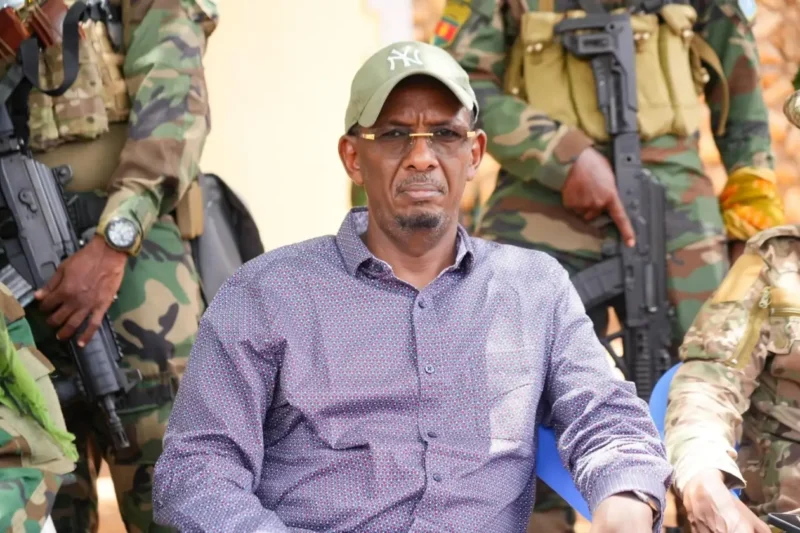
MOGADISHU — Abdinasir Abdulle, a presidential candidate backed by a significant number of opposition figures, has issued a public warning to the federal government over any move against former President Sharif Sheikh Ahmed, stating that he lives next door to Sharif and asking what would be expected of him if Sharif is attacked.
The statement was delivered in the presence of former Prime Minister Abdi Farah Shirdon and other opposition figures, according to video footage circulating on social media. The presence of Shirdon, who served as Somalia’s prime minister from 2012 to 2013, and the gathering of opposition members behind Abdulle, signals that the warning is not an isolated intervention by a private citizen but a coordinated political message to the government.
Abdulle’s statement adds a new dimension to the ongoing standoff between the government and the former president. By identifying himself as Sharif’s neighbour and appearing alongside senior opposition figures, Abdulle is framing the confrontation not merely as a dispute between the government and one man, but as a broader political confrontation that affects an entire community and the opposition as a whole.
The warning comes as the crisis between the government and Sharif has intensified over the past week. As reported in FTL Somalia’s coverage of the crisis, Sharif has documented what he describes as a siege of his residence, including road closures, blocked supplies, and the abduction of his staff, and has warned against the use of state security institutions to settle political disputes.
The National Intelligence and Security Agency (NISA) has accused armed militias loyal to Sharif of attacking its forces in Wadajir district, allegations Sharif categorically denies. On Saturday night, fighting erupted at Sharif’s residence, with gunfire heard in the vicinity of his home.
A Coordinated Opposition Message
Abdulle’s statement is significant not only for its content but for its political context. He is a declared presidential candidate, and his appearance alongside Shirdon and other opposition figures suggests that the opposition is closing ranks around Sharif in the face of government pressure.
The question Abdulle posed, what would be expected of him if Sharif is attacked, carries an implicit warning. If the government attacks Sharif, his neighbours may feel compelled to defend him. That could draw in a broader circle of actors, including clan militias, opposition supporters, and ordinary residents who might see the attack as an assault on their community rather than on one individual.
Clan Support and the Government’s Strategic Calculus
Abdulle is from the Habar Gidir, Sacad clan, a constituency with significant political weight and a history of mobilisation in Mogadishu. The fact that he is associated with this clan and selected to deliver the message is not incidental. It is central to understanding why his intervention matters and why the federal government may view him and other opposition figures with local clan support as a particular concern.
The government’s confrontation with Sharif has unfolded against a broader pattern in which the federal government has targeted opposition figures who command support from organised clan militias or community networks in the capital. Former South West State President Abdiaziz Hassan Mohamed Laftagareen, whose power base rested on local clan support, was removed from office after opposing federal constitutional reforms and later faced military confrontation. As reported in FTL Somalia’s coverage of the Marinayo standoff, the same dynamic has shaped the confrontation with Sharif and Khaire, both of whom have the capacity to mobilise supporters.
The government’s apparent strategy is to pressure opposition figures with lcoal and clan-based support while prioritizing those who can mobilise militias. Abdulle’s Sacad affiliation fits into that pattern.
This is not a minor detail. In Mogadishu’s political landscape, clan support is a form of political capital that can translate into armed mobilisation. A presidential candidate who belongs to a clan with a history of militia organisation, and who publicly declares that he lives next door to a targeted former president and would feel obliged to defend him, presents the government with a difficult calculus: escalating against Sharif could draw in Abdulle’s supporters and escalate the confrontation beyond the government’s control.
The June 2026 Precedent
The current confrontation echoes the events of June 2026, when federal forces loyal to President Hassan Sheikh Mohamud encircled and shelled the residences of Sharif and Khaire for more than 20 hours. As reported in FTL Somalia’s coverage of the June de-escalation, Khaire described a “sustained and indiscriminate military assault” that deployed heavy weaponry “more commonly associated with conventional battlefield operations than densely populated urban areas.”
That standoff was eventually defused through mediation involving elders, NISA Director Mahad Mohamed Salad, and international pressure. But the underlying political disputes were never resolved.
Critical Note
Abdinasir Abdulle’s intervention is a reminder that political crises in Mogadishu do not unfold in isolation. When government forces surround the home of a former president, they are not operating in a vacuum. They are deploying armored vehicles and armed personnel into a residential neighbourhood where families live, businesses operate, and neighbours know each other.
The presence of former Prime Minister Abdi Farah Shirdon and other opposition figures at Abdulle’s side elevates the warning from a neighbourhood or clan dispute to a national political confrontation. It signals that the opposition is prepared to present a united front against the government’s actions, and that the government’s pressure campaign against Sharif is being interpreted as an attack on the opposition as a whole.
Abdulle’s Sacad clan affiliation adds a critical layer of significance. Abdulle’s public warning, combined with his clan background and his status as a presidential candidate, signals that the opposition is not without the means to resist. The government may have calculated that Sharif and Khaire could be pressured without significant risk of armed resistance. Abdulle’s intervention suggests that calculation may be flawed.
Under Somali customary law and clan norms, a neighbour or fellow clan member may feel obliged to defend someone under attack. That is precisely the dynamic that has made previous standoffs so dangerous. When the government uses force against a political figure in a residential area, it risks turning a political dispute into a clan or community confrontation.
The government has not responded to Abdulle’s statement. But the fact that a presidential candidate from a powerful clan, flanked by a former prime minister and opposition members, felt compelled to issue such a warning publicly suggests that the tension in Sharif’s neighbourhood is palpable and that the political stakes are rising. Whether that tension escalates into violence or is defused through mediation may depend on whether the government continues its current trajectory or steps back.
Share your story. FTL Somalia is continuing to investigate the political crisis in Mogadishu and the role of clan dynamics in political confrontations. If you have information or insights to share, contact us at info@ftlsomalia.com. Your identity will be protected.
Recommended Reading On ftlsomalia.com
- President Sharif Documents Siege of His Home, Denies NISA Claims, Warns Against Justifying Opposition Bloodshed and Urges International Community to Act
- Reports of Troops Encircling Opposition Homes as NISA Escalates Standoff with Sharif
- Gunfire Erupts at Sharif’s Residence as Mogadishu Braces for Renewed Conflict
- From Badbaado Qaran to Marinayo 2.0: Somalia’s Never-Ending Cycle of Term Disputes and Electoral Violence Returns to Mogadishu