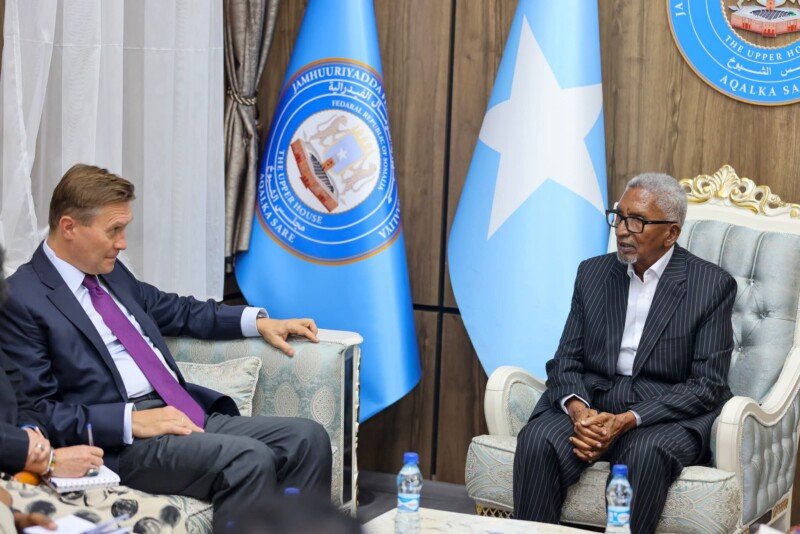
MOGADISHU, The newly appointed European Union Ambassador to Somalia, László Eduárd Máthé, held separate meetings with the Speakers of both houses of the Federal Parliament on Tuesday, signaling a concerted EU effort to deepen engagement with Somalia’s legislative institutions.
In his meeting with Speaker of the House of the People, Abdulkadir Mohamed Nur (Jaamac), the discussions focused on enhancing cooperation between the Somali parliament and the EU’s legislative bodies. The goal is to strengthen the capacity of the House of the People and expand the exchange of knowledge and expertise.
Speaker Nur thanked the European Union for its continued support for Somalia in the fields of security and state-building, emphasizing the importance of further solidifying the partnership between the two sides.
Engaging the Upper House
In a parallel meeting on the same day, Ambassador Máthé met with Speaker of the Upper House Abdi Hashi Abdullahi. That discussion centered on the EU’s ongoing support for infrastructure development and Somalia’s various government institutions. Máthé confirmed that the EU will continue its support for development projects across both the federal government and the Federal Member States.
The two officials also discussed the general situation in the country, electoral matters, and opportunities to strengthen cooperation and improve the work of the Upper House.
A Comprehensive Diplomatic Push
Meeting both speakers on the same day reflects a deliberate strategy by the new EU envoy to establish a comprehensive relationship with Somalia’s federal legislative branch. The EU has long been one of Somalia’s most significant partners, with engagement spanning security, governance, and development.
As reported in FTL Somalia’s coverage of EU security support, the bloc approved a €75 million contribution to the African Union Support and Stabilisation Mission in Somalia (AUSSOM) in April 2026, maintaining its position as the mission’s largest financial supporter. The EU also supports Somali security forces through EUTM Somalia.
On the political front, the EU has been closely engaged with Somalia’s constitutional review and electoral transition. In May 2026, Justice Minister Hassan Moallim Mahmoud met with EU ambassadors to discuss the completion of the provisional constitution and the government’s push toward a one-person, one-vote system, as reported in FTL Somalia’s coverage of the constitutional talks.
However, the bloc has also expressed concerns about the political impasse. The EU’s diplomatic service publicly urged Somalia’s political actors in June to de-escalate, respect the constitutional order, and refrain from unilateral actions regarding the electoral process, as reported in FTL Somalia’s coverage of the EU’s call for dialogue.
Critical Note
Ambassador Máthé’s dual meetings with Speakers Nur and Abdi Hashi are routine diplomatic engagements, but they take place at a moment when the Somali parliament’s legitimacy is deeply contested. The House of the People recently approved constitutional amendments extending the presidential term, a move the opposition has challenged in the Supreme Court. The Upper House is the chamber through which those amendments passed.
When the EU ambassador discusses “institutional capacity” and “exchange of knowledge” with the speakers of these chambers, he is engaging with institutions that the opposition views as compromised. The EU has positioned itself as a steadfast supporter of the federal government, funding security missions and budget support tied to governance reforms. Its Partnership Dialogue framework explicitly links continued engagement to progress on democratisation, rule of law, and inclusive political processes.
The challenge for Máthé is to reconcile the EU’s support for Somalia’s institutions with its stated commitment to democratic principles. Engaging the speakers is necessary, but it is not sufficient. If the EU’s support for parliamentary capacity-building proceeds without corresponding pressure for an inclusive electoral process, it risks being perceived as endorsing the very institutional capture that the opposition decries. The ambassador’s next steps will determine whether the EU’s engagement is seen as a genuine partnership or as a diplomatic rubber stamp.