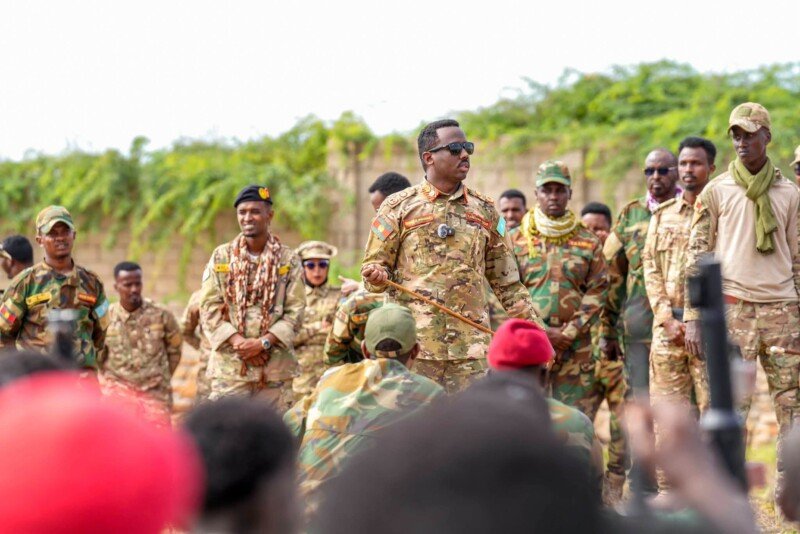
BARAAWE, The Commander of the Somali National Army, Brigadier General Ibrahim Mohamed Mohamud, addressed troops from the 8th Brigade of the 60th Division and the 21st Brigade of the 1st Gorgor Commando Division on the outskirts of Baraawe on Thursday, urging them to maintain vigilance and intensify operations against the Khawaarij Al-Shabaab.
The commander delivered a message of encouragement and a directive on the national duty entrusted to the forces, emphasizing the importance of alertness, courage, cohesion, and the protection of the country and its people. He called on the troops to demonstrate full readiness, to exploit every opportunity to degrade the militants’ capabilities, and to maintain security in areas being liberated.
He further urged the soldiers to strengthen their efforts and to demonstrate capability, resilience, and patriotism in pursuit of a Somalia that is peaceful, secure, united, and free of the Khawaarij.
Baraawe and the Lower Shabelle Front
The visit to Baraawe is significant because the town and the surrounding Lower Shabelle region have become a critical front in the campaign against Al-Shabaab. The army chief’s operational inspection was aimed at evaluating troop readiness and operational posture as Ugandan contingents prepare to draw down their presence in the region. Baraawe has been identified as one of the positions affected by the Ugandan withdrawal, with troops expected to vacate their bases in the town and nearby areas.
The 8th Brigade of the 60th Division and the Gorgor Commandos are among the units expected to fill the gap left by departing Ugandan forces. The commander’s message of readiness and vigilance is, in this context, not merely a morale-boosting exercise. It is a direct response to the security vacuum that the Ugandan withdrawal has created. As the National Security Adviser clarified, the current drawdown applies primarily to bilateral forces, while the larger AUSSOM contingent will be withdrawn in a phased process stretching to the end of 2027.
The Ugandan drawdown has raised concerns about the ability of Somali forces to hold territory in Lower Shabelle. AUSSOM has warned that the withdrawal could leave parts of the region vulnerable to Al-Shabaab attacks, and Somali officials have privately acknowledged that national forces may not be ready to assume full responsibility. The commander’s emphasis on “every opportunity to degrade the militants’ capabilities” reflects the pressure the SNA is under to demonstrate that it can hold the line.
The Gorgor Dimension
The presence of the 21st Brigade of the 1st Gorgor Commando Division at the meeting underscores the role that elite units are expected to play in the transition. Gorgor forces have been at the forefront of offensive operations against Al-Shabaab, and they are among the most capable units in the Somali National Army. The 21st Battalion recently completed advanced military training in Manisa, Türkiye, focusing on combat skills, military discipline, unit cohesion, and operational readiness.
Their deployment to Lower Shabelle is a signal that the government intends to defend the region as Ugandan troops depart. But the Gorgor units are limited in number and are already stretched across multiple frontlines. The commander’s appeal to their “capability, resilience, and patriotism” is a recognition that the SNA is being asked to do more with less as the international footprint shrinks.
The challenges extend beyond the battlefield. Lower Shabelle has long been the site of recurring governance vacuums when security presence recedes. As clan disputes over administrative control and authority resurface in areas where Al-Shabaab’s grip has weakened, the military’s ability to hold territory is complicated by local political dynamics that no amount of training can resolve.
Critical Note
Brigadier General Ibrahim’s visit to Baraawe is a good gesture and much needed for moral support. But the timing and the location are telling. He went to the front line as Ugandan troops were preparing to leave it. He told his soldiers to be ready, to be vigilant, and to exploit every opportunity against the Khawaarij. These are the words of a commander who knows that the burden of security is shifting to his forces, and that the resources available to them are not increasing.
The SNA has made progress in recent years. The Gorgor units are professional and motivated. The government’s offensive operations have pushed Al-Shabaab out of some areas. But the withdrawal of Ugandan troops from Lower Shabelle is a test that the SNA cannot afford to fail. If the militants exploit the gap, the consequences will be measured in lost territory, displaced civilians, and a government that cannot protect its own people.
The commander’s message was one of confidence. The reality is more complicated. The SNA is being asked to assume full responsibility for security in a region that has been held by foreign forces for years, at a time when the funding that sustained those forces is drying up. As the unravelling security architecture shows, the logistical backbone of the international mission is being dismantled, and Somali forces are expected to fill a vacuum they may not be equipped to hold. Brigadier General Ibrahim knows this. His soldiers know it too. The question is whether the government’s political leadership understands what it will take to succeed, and whether it is prepared to provide the resources that the commander’s words do not mention.
Recommended Reading On ftlsomalia.com
- Security Concerns Mount in Barawe as Army Chief Reviews Positions Ahead of Ugandan Troop Exit
- The First Domino: Uganda’s Withdrawal and the Unravelling of Somalia’s Security Architecture
- National Security Adviser Clarifies Ugandan Troop Movements, Chairs Tripartite Meeting
- Elite Gorgor Commandos Complete Historic Joint Training in Manisa, Turkey
- Governance Vacuum Fuels Clan Mobilisation in Lower Shabelle Following Al-Shabaab Withdrawal