MOGADISHU, Three of Somalia’s largest electricity providers have announced a five-cent increase per kilowatt-hour, effective Sunday, citing the sustained rise in global fuel prices caused by the Strait of Hormuz closure. But the decision is only the latest symptom of a deeper, structural crisis: the consolidation of Mogadishu’s power market into an unregulated oligopoly that has been driving prices upward for years.
According to a joint statement from BECO, Mogadishu Power, and Blue Sky Energy, fuel costs have climbed by more than 70 percent over the past eight months, reaching their highest levels in history. The providers described the increase as “much lower than the rise in fuel costs,” acknowledging the difficult circumstances facing the Somali public, as reported by Dawan Africa.
The New Rates
Mogadishu Power previously sold electricity at 33 cents per kilowatt-hour. Following this increase, the new price will be 38 cents. BECO previously charged 41 cents and will now charge 46 cents per kilowatt-hour. Blue Sky Energy was also at 41 cents before the increase, bringing its price to 46 cents.
The increase underscores Somalia’s acute vulnerability to external energy shocks. The country relies almost entirely on imported refined petroleum products for its electricity generation, with diesel-powered generators supplying the vast majority of power in Mogadishu and other urban centers. As reported in FTL Somalia’s coverage of the fuel crisis, gasoline prices in Mogadishu jumped from $0.65 to $1.15 per litre in a single night in March 2026, a 77 percent increase directly linked to the Iran-U.S. confrontation, as detailed by the World Economic Forum.
The Cartel That Was Already Squeezing Households
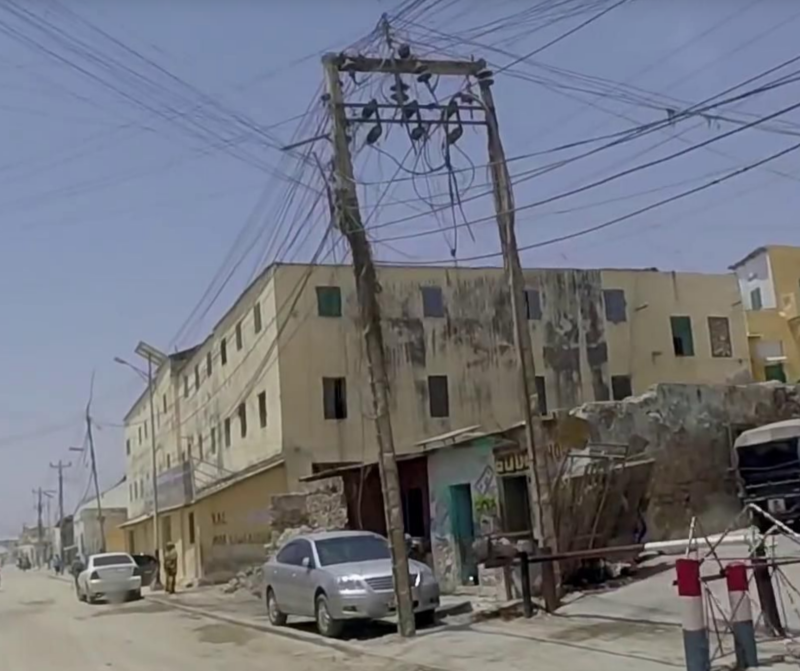
The focus on fuel prices obscures a more troubling reality. Somalia’s electricity sector has operated without meaningful regulation since the collapse of the central state in 1991. In Mogadishu, three companies have carved up the market, each maintaining its own parallel network of poles, wires, and transformers. On many streets, three sets of power lines and transformers, each belonging to a different company, illustrate the waste caused by market fragmentation, according to a BGS report on non-technical barriers to affordable electricity.
This fragmentation was supposed to be addressed by the National Electricity Act of 2023, which established the National Electricity Authority (NEA) to regulate tariffs, licensing, and technical standards. But the NEA’s institutional capacity remains in its “early development stages,” and it is attempting to regulate a sector that has operated autonomously for over three decades with minimal government intervention. In practice, the companies set their own prices.
The result has been a steady erosion of affordability. Even before the Hormuz crisis, a survey found that 69 percent of Mogadishu households reported increases in electricity tariffs during the past year. Over half of households (56 percent) said electricity consumed an excessive share of their income, and 63 percent reported cutting back on essential expenditures such as food, health, or education because of high electricity bills, according to the same BGS report.
The World Bank has documented the consequences. Somalia’s average electricity cost was about $0.61 per kilowatt-hour in 2023, among the highest in the world. Prices exceeded $1 per kilowatt-hour in some areas supplied by private diesel generators, as reported by BGS’s 2025 energy sector report. The Bank has conditioned future support on “better coordination and potential consolidation of private electricity providers,” but consolidation has been slow due to “political sensitivity, commercial rivalries, and the lack of a strong regulatory framework capable of mediating among private actors.”
The experience in other Somali cities offers a warning. In Bosaso, a business owner described what happened when the two local electricity companies merged: “Before, the two electricity companies were competing, but since the companies merged, it has become an additional challenge for us, and we don’t have an alternative but to accept it,” as documented by the Somali Public Agenda. Consolidation, in the absence of regulation, does not automatically produce efficiency. It can simply produce a more effective cartel.
A Cascading Economic Burden
The electricity price hike is the latest in a series of cost-of-living pressures facing Somali households. The Hormuz closure has disrupted supply chains for fuel, food, and fertilizer, driving inflation across the board. As reported by Xinhua, citing Save the Children, fuel prices in Mogadishu surged 150 percent in March, with imported food items doubling in retail price within two weeks.
Doctors Without Borders has warned that rising transport costs are making it harder for Somalis to access healthcare, particularly in a country already grappling with drought and multiple health emergencies, as reported by EpiNews. The fertilizer crisis, driven by the fact that one-third of global seaborne fertilizer trade passes through Hormuz, threatens to reduce crop yields and deepen food insecurity, according to the World Economic Forum.
President Hassan Sheikh Mohamud told the UN General Assembly in September that the Strait of Hormuz disruption had caused Somalia’s customs revenue to drop by approximately 40 percent, compounding the fiscal pressure on a government already stretched by security and humanitarian obligations, as reported in FTL Somalia’s coverage of the revenue decline.
The Strategic Context
The electricity tariff increase is a direct consequence of the Red Sea and Hormuz crises, which have reshaped the regional economic landscape. As reported in FTL Somalia’s coverage of the regional fallout, Houthi attacks on shipping and the closure of the Strait of Hormuz have disrupted global trade routes and forced vessels to reroute around the African continent, driving up costs for import-dependent economies like Somalia.
The situation has been compounded by continued attacks on shipping in the Red Sea, as detailed in FTL Somalia’s coverage of the Red Sea security crisis. Each attack raises insurance premiums and freight costs, which are ultimately passed on to consumers in the form of higher prices for fuel, food, and electricity.
Critical Note
The five-cent increase is a modest adjustment relative to the scale of the fuel price shock, and the companies deserve some credit for absorbing most of the cost increase rather than passing it entirely to consumers. But the announcement also exposes the structural fragility of Somalia’s energy sector, and the failure of successive governments to impose meaningful regulation on it.
The companies are not villains. They operate in an environment where the state has abdicated its responsibility to regulate, where the World Bank’s push for consolidation has stalled, and where the only check on prices is the threat of losing customers to a competitor who may be no cheaper. But the absence of regulation has allowed a de facto cartel to emerge, and the Hormuz crisis has given that cartel a convenient justification for a price increase it may have pursued anyway.
The Somali government has set a target to reduce electricity costs in Mogadishu to $0.20 per unit and to ensure that at least 50 percent of the country’s power comes from renewable sources within three to four years, as noted in BGS’s energy sector assessment. Those are the right goals. But they will not be achieved by waiting for the market to correct itself. They will require the NEA to become a functioning regulator, the World Bank’s consolidation agenda to be implemented in a way that protects consumers rather than entrenching incumbents, and a government willing to confront the commercial interests that have profited from the status quo.
For now, the burden falls on ordinary Somalis. A five-cent increase may seem small on paper, but for a family already cutting back on food and healthcare to pay electricity bills, it is another blow in a crisis they did not create and cannot escape.