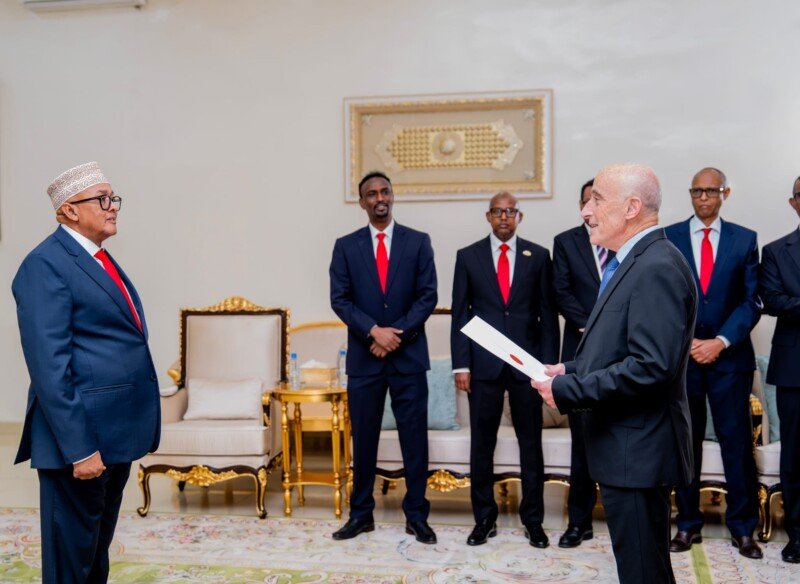
HARGEISA, Israel’s Ambassador to Somaliland, Michael Lotem, presented his credentials to Somaliland President Abdirahman Mohamed Abdullahi in a ceremony at the Presidential Palace in Hargeisa, marking the formalization of diplomatic ties that were established with Israel’s recognition of Somaliland on December 26, 2025.
Following the credentials ceremony, a cornerstone-laying ceremony was held for Israel’s new embassy in Hargeisa. Israeli Foreign Minister Gideon Sa’ar said the appointment of ambassadors, in accordance with the agreement reached during mutual recognition, was “another important layer in strengthening relations” between the two sides.
The recognition itself was a transformative shift. When Prime Minister Benjamin Netanyahu signed the declaration alongside Sa’ar and President Abdullahi, it ended decades of diplomatic isolation for Somaliland and aligned the territory with the framework of the Abraham Accords. It was immediately condemned by Mogadishu as a violation of sovereignty, and the African Union, Saudi Arabia, Türkiye, and Djibouti all issued statements in support of Somalia’s unity.
The relationship has since developed rapidly. Foreign Minister Sa’ar made a historic visit to Hargeisa in January 2026, and Somaliland opened its embassy in Jerusalem in June 2026 during President Abdullahi’s visit to Israel.
A Strategic Alignment with Regional Consequences
The credentials ceremony is not occurring in a vacuum. It follows a geopolitical map displayed by Netanyahu that categorized Somaliland and Puntland as “friendly” to Israel and the UAE. While Somaliland’s inclusion reflects its formal recognition, Puntland’s classification is factually misleading. Puntland has not established diplomatic relations with Israel, and its inclusion stems from its deep security and economic ties with the UAE, a signatory to the Abraham Accords.
The strategic logic behind the alignment with Somaliland is transparent. Israel views Somaliland’s location on the Gulf of Aden, near the Bab al-Mandab strait, as a potential forward base for intelligence monitoring and military operations against the Houthis in Yemen. President Hassan Sheikh Mohamud has accused Israel of planning to establish a naval base in Berbera and use the city’s airport, describing Israel as a “destabilising force.” Somaliland has rejected these claims, asserting that Mogadishu has no authority over its foreign relations and defending its ties with Israel as “the sovereign decisions of two states.”
The federal government’s opposition has been unequivocal. In a Sky News interview, Mohamud drew a red line on foreign bases, stating that Somalia would not give any country the opportunity to set up bases inside the country to pursue its own interests. He framed the rejection of foreign proxy bases as a matter of national sovereignty, aimed at preventing Somalia from becoming a pawn in the rivalry between Israel, Türkiye, and the Gulf states.
The Security and Domestic Dimension
The relationship is not purely diplomatic. Houthi leader Abdul-Malik al-Houthi has threatened to target any Israeli presence in Somaliland, whether “a military base or any permanent deployment.” Somaliland officials have said their diplomatic normalization with Israel was motivated in part by the need to counter Turkey’s military footprint in Somalia, with Hargeisa seeking Israeli air defense systems to offset Turkish drones and warplanes deployed in Mogadishu.
Within Somaliland, the recognition has exposed divisions. Protests broke out in Borama after the December announcement, with reports of arrests of religious scholars who condemned ties to Israel. The influential religious leadership in Somaliland has yet to release an official statement, and the reaction in contested territories like Awdal, Sool, and Sanaag is being closely monitored.
There is also a countervailing dynamic. Just days before the credentials ceremony, Banadir Regional Governor Hassan Mohamed Hussein welcomed a delegation of traditional elders from Hargeisa to Mogadishu, describing their visit as a gesture of unity. The elders said they had come “seeking unity and supporting the togetherness of the Federal Republic of Somalia.” Their presence does not change the political reality of Somaliland’s separate diplomatic path, but it suggests that social and cultural ties remain intact.
Critical Note
The credentials ceremony in Hargeisa is a milestone that Somaliland’s government has sought for over three decades. It represents the first formal diplomatic presence of a UN member state in the territory since 1991. That is not a small thing for a government that has operated without recognition for a generation.
But the ceremony also marks the moment when Somaliland’s diplomatic isolation has been replaced by a different kind of vulnerability. Israel is the only country that recognizes Somaliland. That singularity is both the achievement and the problem. It means Somaliland’s recognition is tied to a state that is itself increasingly isolated internationally over its conduct in Gaza, and whose strategic interests in the Red Sea may not align with Somaliland’s long-term stability.
The Houthi threat is real, and it is a direct consequence of this relationship. Somaliland’s coast, which was once merely a commercial gateway, is now a potential front line in a conflict it did not choose. The federal government in Mogadishu, which has never accepted Somaliland’s independence, now has a new grievance to mobilize against it, and it is using the map of “friendly” territories to portray its rivals as colluding with foreign interests.
Israel’s recognition was a diplomatic breakthrough. But breakthroughs can become liabilities if they come without broader international acceptance. Somaliland’s challenge now is to translate this single recognition into a wider opening, before the costs of the relationship outweigh its benefits. The traditional elders who traveled to Mogadishu seeking unity are a reminder that another path exists, even if the political leadership on both sides has shown little interest in walking it.
Recommended Reading On ftlsomalia.com
- Somaliland and Puntland Designated as “Friendly” in Israeli Security Framework
- Israel Officially Recognizes Somaliland as Independent Sovereign State
- Traditional Leaders from Hargeisa Visit Mogadishu Seeking “Unity”
- “Not Under Any Circumstances”: Somalia’s President Draws a Red Line on Foreign Bases and Israeli Presence
- Hargeisa Wants Israel to Shield It From Turkish Drones and Warplanes