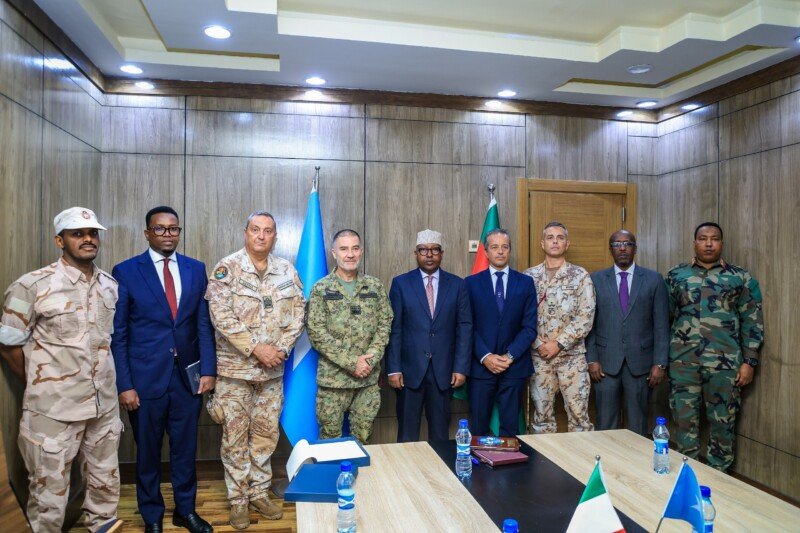
MOGADISHU — Somalia’s Minister of Defence, Ahmed Moallim Fiqi, received a senior delegation from Italy’s Ministry of Defence and Armed Forces at his office on Wednesday, led by the Commander of Italy’s Joint Operations Command, Lieutenant General Giovanni Maria Iannucci.
The delegation was accompanied by Italy’s Ambassador to Somalia, Pier Mario Daccò Coppi. The talks focused on strengthening relations between the two countries and developing bilateral cooperation on security and defence, according to a statement from the Somali Ministry of Defence.
Minister Fiqi commended the support of the European Union and of Italy in particular for the rebuilding of the Somali National Armed Forces. He said continuing that support matters for strengthening the capability and readiness of the Somali National Army.
A Deepening Defence Partnership
The visit is the latest in a series of high-level engagements between Somalia and Italy on defence and security matters. In October 2025, Minister Fiqi held talks in Rome with Italian Defence Minister Guido Crosetto, where discussions centred on expanding collaboration in maritime security, counter-terrorism operations, and military training, as reported in FTL Somalia’s coverage of the Rome meeting.
Italy has been a consistent partner in Somalia’s security sector reform, contributing through bilateral arrangements and the European Union Training Mission. In December 2025, Minister Fiqi met with Italian Defence Attaché Navy Captain Antonino Mazzocca to review the military partnership and discuss expanded specialized training conducted by Italian military personnel, as detailed in FTL Somalia’s report on the partnership review.
In February 2026, Somali National Army Commander Brigadier General Ibrahim Mohamed Mahmoud met with Captain Mazzocca, with the Italian side reaffirming its commitment to sustaining support in training and equipment.
Cooperation has also extended to Somalia’s special forces. In July 2026, the Commander of the Somali National Army’s Special Forces, Adam Mohamed Omar, held talks with the Commander of the Italian Special Operations Command, Admiral Paolo Pezzutti, in Rome on enhancing capabilities through advanced training and the exchange of expertise, as reported in FTL Somalia’s coverage of the special forces talks.
Italy’s Broader Role in Somalia
Italy’s engagement in Somalia extends beyond defence. Ambassador Daccò Coppi has been active across multiple sectors, meeting with Interior Minister Ali Yusuf Hosh in April 2026 to discuss political and electoral developments [citation:2], and with Trade Minister Gamal Mohamed Hassan in August 2026 on economic partnerships and investment opportunities.
In the maritime sector, Italy has supported Somalia through training programmes for port logistics, with 14 young Somalis selected for a two-year course at the Nautical Academy of the Adriatic in Trieste. The project also aims to foster cooperation between the ports of Trieste and Mogadishu.
Critical Note
Italy’s defence engagement with Somalia is part of a broader European effort to stabilise the Horn of Africa and support the Somali National Army’s transition to assuming full security responsibility. Italy’s role is particularly significant given its historical ties to Somalia and its leadership in EU training missions.
The frequency of high-level military consultations between Rome and Mogadishu reflects a sustained commitment. However, the practical impact of these engagements depends on whether the training and equipment provided translate into lasting improvements in the SNA’s operational capability. The Somali government’s own strategy emphasises the need for self-reliance, but the path from external support to autonomous capability remains long.
Italy’s involvement also carries geopolitical dimensions. As European partners diversify their security engagement in Somalia alongside Türkiye, Egypt, and Pakistan, the coordination among these partners becomes a critical variable. Fragmented external support can create parallel systems and competing priorities, while coherent engagement can reinforce Somalia’s institutional development. The challenge for Somalia is to manage these multiple partnerships in a way that strengthens rather than fragments its national security architecture.
Recommended Reading On ftlsomalia.com
- Somalia and Italy Deepen Defence Ties in High-Level Rome Meeting
- Somali Defense Minister and Italian Attaché Review Military Partnership
- Somali and Italian Special Forces Chiefs Strengthen Military Cooperation
- President Hassan Sheikh Receives Italian Interior Minister for Talks on Security and Migration