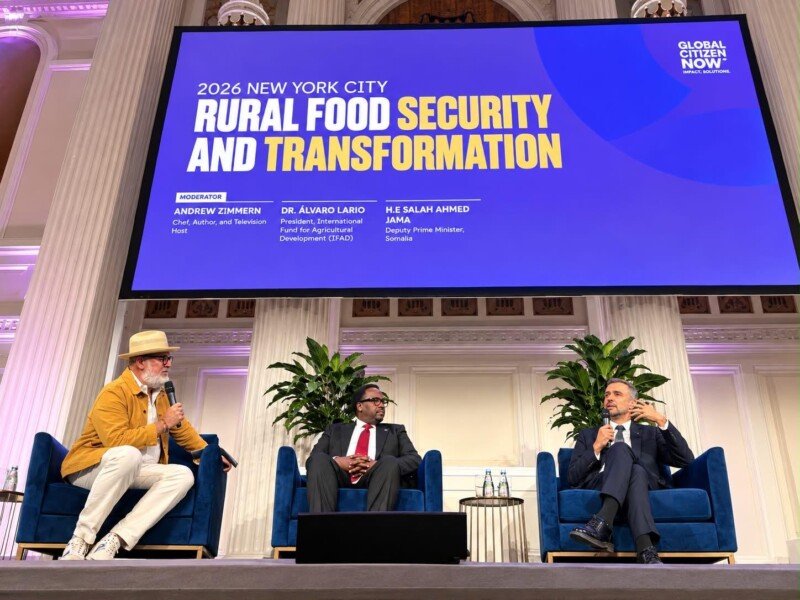
NEW YORK — On the margins of the 81st United Nations General Assembly, Deputy Prime Minister Salah Ahmed Jama joined the President of the International Fund for Agricultural Development (IFAD) and Global Citizen for a discussion on rural food security and transformation, highlighting the urgent need for investment in climate-resilient agriculture and rural value chains.
Speaking at the Global Citizen NOW event, Jama emphasized that much of Somalia depends on agriculture and livestock, and that climate shocks continue to threaten rural livelihoods and food security. The discussion focused on the importance of a strong fourteenth replenishment of IFAD (IFAD14) to scale up support for small-scale producers.
The Case for IFAD14
IFAD launched consultations for its 14th replenishment in February 2026, with President Alvaro Lario calling for deeper market integration for small-scale producers, expanded rural employment for young people, and stronger resilience to climate, conflict, and economic shocks.
The replenishment comes at a critical moment for Somalia. The country cleared its arrears with IFAD with support from Belgium, Germany, Italy, and Sweden, ending a three-decade suspension of direct financing. In August 2026, IFAD launched the $31.22 million Rural Livelihoods Resilience Programme in Mogadishu, its first direct investment in Somalia since the 1990s, as reported in FTL Somalia’s coverage of the IFAD partnership.
IFAD’s financing for Somalia has risen from $10 million to more than $100 million in recent years. The programme aims to reach over 125,000 rural households and mobilize more than $100 million in investment for agriculture and the rural economy.
Somalia’s Food Security Challenge
Somalia remains one of the world’s most food-insecure countries. Five consecutive failed rainy seasons, combined with conflict, desert locust outbreaks, and high food and fuel prices, have pushed millions into acute hunger. Agriculture accounts for roughly 65 percent of the economy, yet productivity remains far below potential due to limited irrigation, weak infrastructure, and climate vulnerability.
Nearly one-third of Somali households remain food insecure, with internally displaced persons and rural communities bearing the heaviest burden, according to the Somalia Comprehensive Food Security and Vulnerability Assessment. Among IDP households, only 9 per cent were classified as food secure, while 53 per cent were food insecure. Rural households also face elevated food insecurity.
President Hassan Sheikh Mohamud has previously described food security as a fundamental part of national security, linking hunger and rural marginalization to the recruitment efforts of Al-Shabaab.
Government Initiatives and International Support
The Somali government has launched several initiatives aimed at strengthening agricultural resilience. In May 2026, the Ministry of Livestock, Forestry and Range launched the Activating Climate Resilient Agricultural Livelihoods in Somalia (ACALS) project, funded by the African Development Bank and implemented jointly by the World Food Programme and UNOPS. The initiative targets 30,000 people in Hirshabelle and Puntland states.
In August 2026, Deputy Prime Minister Salah Ahmed Jama launched the WFP Somalia Country Strategic Plan for 2026-2030, a $1.5 billion framework aimed at strengthening food security and building resilience. The plan aligns with Somalia’s National Transformation Plan and marks a shift from project-based interventions to integrated, people-centred programming.
The government has also launched a $3.88 million drought insurance payout to pastoralists, part of an index-based livestock Takaful programme supported by the World Bank-backed DRIVE initiative. The payout was triggered by satellite data indicating declining vegetation levels, providing early financial support to vulnerable families.
Critical Note
Somalia’s appeal for a strong IFAD replenishment is grounded in a real and pressing need. The country’s rural communities have borne the brunt of repeated climate shocks, and the resumption of direct IFAD financing after three decades is a significant step. But the scale of the challenge far exceeds what any single institution can provide.
The IFAD14 replenishment is an opportunity to lock in predictable, long-term financing for rural transformation. The priorities outlined by IFAD, market access, rural jobs, and resilience, align closely with Somalia’s needs. The critical question is whether donor commitments will match the ambition, especially as many traditional donors face fiscal pressures and shifting political priorities.
For Somalia, the most important outcome is not the announcement of a new programme, but its implementation. The Rural Livelihoods Resilience Programme is designed to reach 30,000 households directly, with a focus on women and youth. Whether it can deliver on that promise, and whether it can be scaled up, will depend on whether the financing pledged at IFAD14 materializes and whether Somalia can absorb and deploy it effectively. The country has made progress on debt relief and financial governance. The next test is delivery on the ground.
Recommended Reading On ftlsomalia.com
- Somalia and IFAD Pledge Deeper Partnership to Support Farmers and Pastoralists
- Nearly One-Third of Somali Households Food Insecure, IDPs and Rural Communities Hit Hardest
- Somalia’s Livestock Ministry Launches ACALS Climate Resilience Project
- Somalia and WFP Unveil $1.5 Billion Food Security Strategy for 2026-2030
- Somalia Government Issues $3.88M in Drought Insurance to Pastoralists