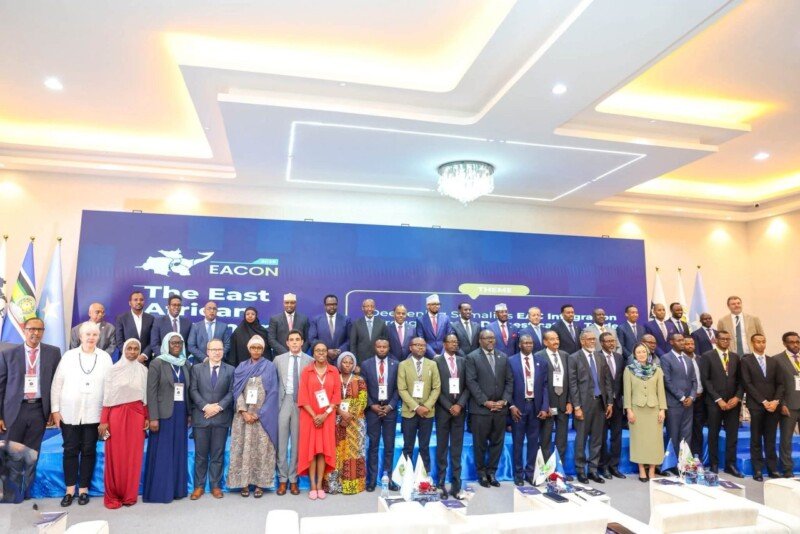
MOGADISHU — Deputy Prime Minister Salah Ahmed Jama opened the Third East African Community Conference (EACON 2026) in Mogadishu on Monday, a two-day forum focused on strengthening Somalia’s engagement with regional economic integration, implementing EAC agreements, promoting investment and developing human capital.
On the second day of the conference, Minister of Planning, Investment and Economic Development Mohamud A. Sheikh Farah (Beenebeene) addressed Somalia’s national investment agenda and the country’s investment plans within the East African Community. As reported in FTL Somalia’s coverage of Minister Beenebeene’s remarks, he said the federal government has created opportunities for Somali citizens who operate businesses in African countries, describing this as the primary reason Somalia joined the East African Community.
“The Somali government has created an opportunity for Somali people who had businesses in African countries, and that is why we joined the East African Community,” the Minister said.
A Historic Achievement
In his opening address, the Deputy Prime Minister described Somalia’s accession to the East African Community as a historic achievement reflecting the country’s recovery and strengthened regional relations. He said the government’s priority is to translate that membership into opportunities for trade, investment, job creation and economic development that benefit the Somali people.
Somalia formally joined the EAC in 2024, becoming the bloc’s eighth partner state alongside Kenya, Uganda, Tanzania, Rwanda, Burundi, South Sudan and the Democratic Republic of Congo. The EAC represents a combined market of over 300 million people and an economy exceeding $300 billion. As reported in FTL Somalia’s coverage of the Cabinet’s review of EAC benefits, Somali students can now attend universities in East Africa at fixed regional tuition rates, tourists are exempt from foreigner tourism fees, and Somali businesses and professionals have gained greater opportunities to operate in member states.
Implementation of EAC Agreements
The Deputy Prime Minister highlighted that implementing EAC agreements, facilitating trade and harmonising national laws and systems are central to the government’s initiatives to expand markets for Somali products and attract investment and job creation programmes. As detailed in FTL Somalia’s coverage of Somalia’s EAC staffing push, the country is expected to secure 11 staff positions within the bloc’s institutions, strengthening its representation in EAC governance structures.
Somalia has taken concrete steps to align its trade framework with regional commitments. In August 2026, the Cabinet approved a draft Rules of Origin Law designed to help Somali businesses gain greater access to regional and continental markets. Trade and Industry Minister Jamaal Mohamed Hassan said the law would allow Somali exporters to qualify for preferential tariff treatment under the EAC and the African Continental Free Trade Area.
Somalia has also deepened bilateral economic ties within the EAC framework. As reported in FTL Somalia’s coverage of Somalia-Tanzania trade talks, Commerce Minister Gamal Mohamed Hassan held discussions with Tanzania’s Minister of Industry and Trade Judith Silvio Kapinga on establishing a Joint Cooperation Commission and launching the East African Commercial and Logistics Centre in Dar es Salaam.
The AfCFTA Opportunity
The Deputy Prime Minister also emphasised the importance of African economic integration, particularly the African Continental Free Trade Area (AfCFTA), which offers African countries the opportunity to increase intra-African trade, develop industries and expand production.
As reported in FTL Somalia’s coverage of Somalia’s AI integration in the EAC, Somalia has positioned itself as a key innovator in the bloc’s digital transformation strategy, presenting a comprehensive plan for AI adoption at a recent EAC summit. The country’s engagement with both the EAC and AfCFTA reflects a broader strategy of regional economic integration.
Digital infrastructure has been a key focus of Somalia’s regional integration efforts. As detailed in FTL Somalia’s coverage of Somalia’s submarine networks, the country’s extensive submarine cable infrastructure is positioning it as the region’s digital gateway, supporting broader integration through improved connectivity.
EACON 2026 Agenda
EACON 2026 is organized around four strategic pillars: domesticating EAC integration and institutional readiness; competitive markets, trade and regional connectivity; strategic investments, bankable projects and economic transformation; and human capital, innovation and future workforce development.
The theme of this year’s conference, “Deepening Somalia’s EAC Integration Through Treaty Domestication, Trade Competitiveness and Human Capital Development,” reflects the shift from general dialogue on regional integration to the practical conditions required to turn Somalia’s EAC membership into measurable economic and institutional outcomes.
At a recent EAC Business Council CEOs Trade and Investment Roundtable in Mogadishu, Commerce Minister Jamal Mohamed Hassan reaffirmed Somalia’s commitment to translating its EAC membership into increased trade, investment, stronger businesses and job creation.
Somalia’s integration into the EAC has also advanced at the institutional level. As reported in FTL Somalia’s coverage of Somalia’s EAC judicial appointment, Advocate Abdiwahid Warsame Abdullahi was appointed as a judge to the First Instance Division of the East African Court of Justice during the 25th Ordinary Summit of EAC Heads of State. The appointment reflects Somalia’s growing role in regional governance structures.
Regional security cooperation has also deepened. As detailed in FTL Somalia’s coverage of the EAC intelligence meeting, Somali National Army Commander Brigadier General Ibrahim Mohamed Mahmoud inaugurated a two-day gathering of intelligence leaders from EAC member states in Mogadishu, reflecting a broader push within the bloc to harmonize security strategies.
Critical Note
Somalia’s EAC membership represents a significant strategic shift. For a country whose economy has long been characterized by informal cross-border trade and reliance on remittances, formal integration into a regional bloc with shared rules on trade, labour mobility and investment offers a pathway to institutionalise economic relationships that have historically operated outside formal frameworks.
The Minister’s emphasis on creating opportunities for Somali businesses operating across Africa is well-placed. Somali entrepreneurs have established commercial networks throughout East Africa and beyond, often navigating complex regulatory environments without the protections that formal trade agreements provide. EAC membership, if properly implemented, could give these businesses legal standing and preferential access that they have previously lacked.
However, the gap between accession and tangible benefits remains substantial. As Somalia’s National Trade Facilitation Committee has acknowledged, market access alone will not generate economic gains without urgent reforms to customs administration, border procedures and regulatory coordination. The Rules of Origin Law approved by the Cabinet is a necessary step, but its implementation will determine whether Somali exporters can actually claim the preferential treatment it promises.
The broader challenge for Somalia is institutional capacity. EAC membership requires alignment of laws, policies and institutions with regional commitments. For a federal government still building its administrative systems, meeting these obligations while managing domestic political crises and security challenges will not be straightforward. The EACON conference provides a platform for dialogue, but the real test will be whether the commitments made in Mogadishu translate into tangible improvements in the lives of Somali traders, workers and consumers.
Recommended Reading On ftlsomalia.com
- Somalia’s EAC Membership Is About Creating Opportunities for Somali Traders, Says Minister Beenebeene
- Somali Cabinet Reviews Security, Elections and Benefits of EAC Membership
- Somalia Seeks 11 EAC Staff Positions to Strengthen Regional Integration Role
- Somalia, Tanzania Pledge to Boost Trade and Investment Ties
- Somalia Secures Historic EAC Judicial Post as Bloc Sets 2026 Integration Deadline
- Army Chief Opens EAC Intelligence Meeting in Mogadishu