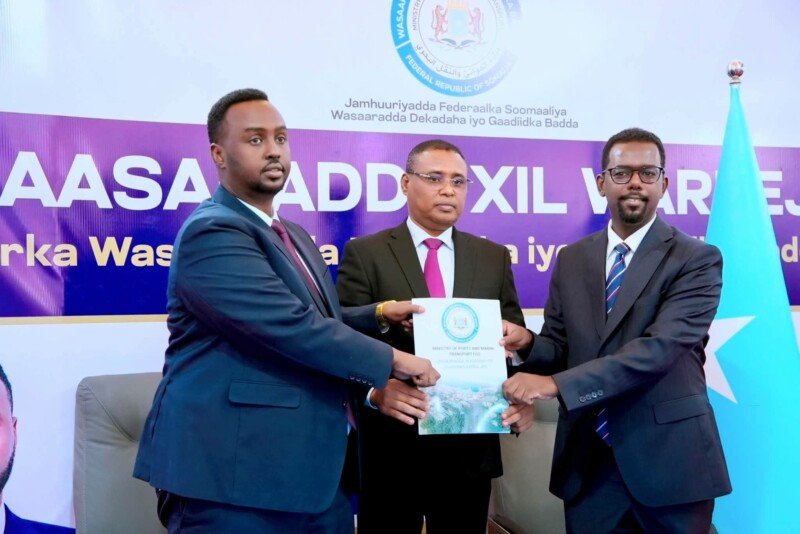
MOGADISHU, Second Deputy Prime Minister Jibril Abdirashid Haji Abdi presided over a handover ceremony at the Ministry of Ports and Maritime Transport this week, formally transferring responsibilities to the new minister, Abdulkadir Omar Macalin, and the acting minister, State Minister Abdulkadir Mohamed.
According to a report on the ceremony, the Deputy Prime Minister said the government’s strategic plan gives significant weight to efforts to improve the administration and services of ports and maritime transport, in order to achieve sustainable development consistent with the interests and priorities of the Federal Republic of Somalia.
He said the outgoing and incoming officials are expected to continue the ministry’s work, strengthening cooperation between government institutions and international partners.
The Context of the Appointment
The handover follows a period of political and procedural complexity. As reported in FTL Somalia’s coverage of Macalin’s appointment, Macalin was appointed on October 17 to fill the vacancy created when Abdulkadir Mohamed Nur was elected Speaker of the House of the People in August. Macalin is himself a federal lawmaker.
That dual role has been a source of contention. The new constitution, which took effect in April, bars cabinet members from holding parliamentary seats, and a six-month transition period ended on October 14. Speaker Nur asked Macalin to choose between his seat and his cabinet post. During a parliamentary session, Macalin publicly agreed that he had relinquished his parliamentary membership. But the Justice Minister later argued that separating lawmakers from the cabinet would create a constitutional vacuum because the government lacks the enabling legislation to fill the posts.
The handover ceremony does not resolve that legal dispute. It simply formalizes Macalin’s assumption of the ministry’s day-to-day responsibilities.
The Ministry’s Portfolio
The Ministry of Ports and Maritime Transport oversees Somalia’s port infrastructure and maritime policy, areas of growing strategic importance. The ministry’s portfolio includes oversight of the Mogadishu port and coordination with international partners on maritime security and fisheries.
The vacancy coincided with a period of heightened activity in Somalia’s maritime sector, including the implementation of the defense and economic cooperation framework with Türkiye, as reported in FTL Somalia’s coverage of the Türkiye-Somalia partnership.
The new minister inherits a docket that demands immediate attention, including the ongoing dispute over port tariffs and the federal government’s efforts to harmonize customs revenue across competing ports. As reported in FTL Somalia’s analysis of the port tariff gap, the ministry is central to resolving a fiscal dispute that costs the federal government millions in lost revenue.
Critical Note
The handover ceremony is a procedural formality, but it closes a gap that had persisted for over two months. During that period, the ministry operated without a permanent minister, while decisions on port policy, maritime security, and the Türkiye partnership continued to be made. The delay was not unusual by Somali standards, but it was consequential for a sector that sits at the intersection of economic development, security, and international partnership.
Macalin’s appointment carries a certain political symmetry. He lost the speakership to the man whose ministerial seat he now inherits. Whether this reflects a consolation arrangement or a genuine assessment of his qualifications is not evident from the public record. What is clear is that the Prime Minister’s Office has filled a vacancy that should not have remained open as long as it did.
The more substantive test will be whether Macalin can advance the ministry’s agenda without the institutional momentum that Nur had built over his tenure. The ports and maritime sector is not a ceremonial portfolio. It requires coordination with international partners, management of competing regional interests, and a clear strategy for revenue collection and infrastructure development. The Deputy Prime Minister’s remarks at the handover were forward-looking, but they did not address the specific challenges the new minister will face.