DJIBOUTI, China and the United States have both moved to deepen their engagement with Djibouti this week, as the two powers pursue parallel but distinct strategies to address the escalating security crisis in the Red Sea and the Bab el-Mandeb Strait.
On Wednesday, Chinese Foreign Minister Wang Yi and his Djiboutian counterpart, Abdoulkader Houssein Omar, issued a joint communique in Beijing expressing “serious concern” over threats to Red Sea shipping and calling for the Horn of Africa to be kept free from geopolitical rivalry. The statement warned that recent tensions pose a “serious threat to the global economy, particularly to economic activities in the Horn of Africa region, including trade, investment, energy, and food security.”
The communique placed the onus for resolving the crisis on the broader Middle East conflict, stating that “easing tensions in the Middle East is key to resolving the security challenges in the Horn of Africa and the Red Sea.” It called on “all parties” to take concrete actions through dialogue and diplomacy, but offered no specific new mechanisms or commitments from either China or Djibouti to facilitate that process.
Washington’s Parallel Initiative
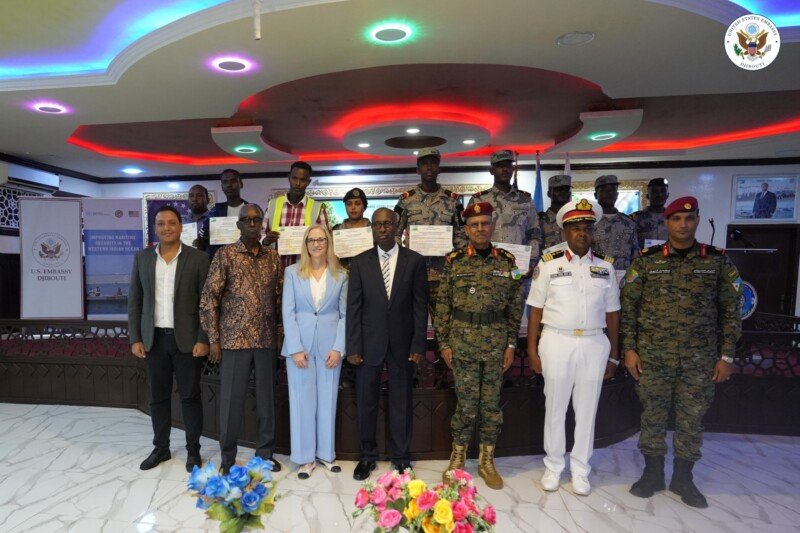
On the same day, the U.S. Embassy in Djibouti announced a different kind of engagement. Ambassador Cynthia Kierscht joined the Djiboutian Coast Guard and the United Nations Office on Drugs and Crime (UNODC) to inaugurate the Maritime Rule of Law Center of Excellence at the Doraleh Coast Guard Training Center.
Funded by the United States, the center is described as a regional training hub designed to strengthen the capabilities of maritime law enforcement forces throughout the Western Indian Ocean. The embassy statement framed the initiative as a contribution to “defending American interests in security and the economy by protecting essential maritime routes, securing American trade, and promoting safe and secure international commercial exchanges.”
A Crowded Military Landscape
Djibouti’s strategic value is perhaps best illustrated by the extraordinary concentration of foreign military power on its soil. The small nation hosts bases from several major powers, often located within a few miles of one another, turning the country into a dense hub of global military infrastructure.
The most prominent presence is the United States, which operates Camp Lemonnier, its largest permanent military base in Africa. Home to over 4,000 personnel and the Combined Joint Task Force-Horn of Africa, it serves as a platform for counterterrorism and crisis response operations across the region. Just miles away sits China’s only formally acknowledged overseas military base, established in 2017. Initially a logistics hub for anti-piracy patrols, it has been significantly upgraded with advanced communications and signals intelligence facilities, giving Beijing a persistent forward node for monitoring the region.
France maintains its largest overseas base outside of its territory, with roughly 1,500 personnel and permanent maritime, air, and land capabilities. Japan operates its only overseas Self-Defense Force facility, focused primarily on counter-piracy and regional information gathering. Italy also maintains a base, while Russia has reportedly sought access for naval logistics and resupply, though it does not have a permanent base there.
Djibouti, for its part, is positioned as the indispensable partner for all of them. Its geography, straddling the Bab el-Mandeb, gives it leverage that few other states possess. As reported in FTL Somalia’s coverage of Djibouti’s regional diplomacy, President Ismail Omar Guelleh has cultivated relationships with China, the United States, France, Türkiye, and Gulf states simultaneously, a balancing act that has allowed the small nation to extract resources and security guarantees from multiple suitors while warning against unilateral actions that threaten regional stability.
The Deteriorating Security Environment
The context for both initiatives is a rapidly deteriorating security environment. The UN Special Envoy for Yemen warned in October that the country has “slid back into full-scale war,” with Houthi forces advancing on Mokha and the Bab el-Mandeb coast before a government counter-offensive retook some areas. Houthi attacks on shipping have continued, and the UK Maritime Trade Operations reported explosions near a vessel off Mocha in early October, as reported in FTL Somalia’s coverage of Red Sea shipping threats.
China’s approach, as reflected in the communique, is diplomatic and declaratory. It expresses concern, calls for dialogue, and positions Beijing as a neutral voice advocating for regional stability without committing new resources or taking operational responsibility for maritime security. China’s direct stakes are substantial: the Red Sea is a vital link for Chinese exports to Europe, and Beijing has invested over $5 billion in Egypt’s Suez Canal Economic Zone and significant sums in Djibouti’s ports and the Addis Ababa-Djibouti railway.
The U.S. approach is operational and capacity-focused. The Maritime Rule of Law Center is a tangible investment in the institutions that enforce maritime security on the water. It builds on Camp Lemonnier and partners with UNODC to provide training that directly addresses the operational gaps that allow piracy, smuggling, and maritime crime to flourish.
What This Means for Somalia
For Somalia, the intensifying competition between China and the United States in Djibouti is not a distant geopolitical spectacle. It is a development that directly affects the country’s economic and security trajectory. The Red Sea crisis has already driven up fuel and food prices in Somali markets, disrupted shipping routes, and revived piracy in Somali waters as international naval assets pivot toward the northern Red Sea.
The new U.S. training center in Doraleh will strengthen maritime law enforcement capabilities in the Western Indian Ocean, but its primary beneficiaries will be Djibouti and the broader regional architecture that Washington is building to secure its own trade interests. As reported in FTL Somalia’s coverage of the U.S.-Djibouti naval training, this collaboration reinforces the security architecture of the Bab el-Mandeb at its narrowest point, while the Somali coastline that opens onto the same corridor remains largely unguarded.
Somalia’s coast guard and navy remain under-equipped and under-resourced, and the country’s coastline, the longest in mainland Africa, continues to be a zone of illegal fishing, arms smuggling, and pirate activity. The asymmetry is stark. Djibouti hosts the largest permanent U.S. military base in Africa and has received sustained international investment in its navy, including patrol boats, radar surveillance systems, and training programmes. Somalia’s maritime-security apparatus operates primarily around Mogadishu, with limited reach beyond territorial waters, and remains reliant on sporadic international support.
The two countries have sought to deepen their partnership in other areas. As reported in FTL Somalia’s coverage of the Mogadishu-Djibouti port partnership, the directors of both ports have held strategic talks aimed at expanding cooperation, improving cargo management systems, and aligning infrastructure development to support faster, more efficient trade. The two nations have also strengthened defense ties through ministerial meetings, with Somalia’s Defense Minister expressing deep appreciation for Djibouti’s contributions to AUSSOM and regional stability, as reported in FTL Somalia’s coverage of the defense talks.
But these partnerships do not close the maritime security gap. Djibouti’s capacity is being reinforced by the United States, the EU, and other partners. Somalia’s capacity remains nascent. Meanwhile, China’s diplomatic communique with Djibouti does not mention Somalia, nor does it offer any new commitments to address the piracy resurgence or the humanitarian impact of the shipping crisis on the Somali economy. The statement’s call for the Horn of Africa to be kept free from geopolitical rivalry is a sentiment Mogadishu shares. But Djibouti, not Somalia, is the venue where these two powers are choosing to coordinate their approach. Somalia is left to manage the fallout without the resources or the strategic attention that its geography and exposure would warrant. As reported in FTL Somalia’s coverage of the regional fallout, the U.S. State Department has already warned of potential escalation beyond the immediate zone of hostilities, with consequences for U.S. interests and institutions worldwide, including in Somalia.
Critical Note
The dueling Djibouti initiatives this week are a microcosm of how the two superpowers approach the Red Sea crisis. China issues communiques and calls for dialogue, positioning itself as a neutral advocate for stability while protecting its commercial interests. The United States funds training centers and builds operational capacity, reinforcing its role as the region’s security guarantor.
Neither approach is sufficient on its own. China’s communique is correct in its diagnosis: the Red Sea crisis cannot be resolved without addressing the Middle East conflict that fuels it, and the Horn of Africa should not become a geopolitical battleground. But diagnosis is not a strategy. The communique offers no mechanism for de-escalation, no commitment of resources, and no accountability for the parties whose actions are destabilizing the waterway.
The U.S. center is a practical investment, but it addresses the symptoms of maritime insecurity, not their causes. Training coast guards to intercept smugglers and pirates is valuable. It will not stop Houthi missiles or resolve the Yemen war that has made the Bab el-Mandeb a front line.
For Somalia, the lesson is one of exposure without leverage. The country’s waters are part of the same security environment that Djibouti is being paid to help manage. But Somalia is not receiving the training center, the diplomatic communiques, or the strategic attention. It is absorbing the costs of a crisis it did not create and cannot control. Djibouti leverages its geography to extract rent and security guarantees from multiple global powers. Somalia, with the longest coastline in mainland Africa, lacks the naval capacity to protect its waters, the economic resilience to absorb sustained shipping disruptions, and the political cohesion to present a unified front on regional security. The competition between China and the United States in Djibouti is not a contest Somalia can influence. It is one whose consequences Somalia will bear.
Recommended Reading On ftlsomalia.com
- US-Djibouti Naval Training Highlights Somalia’s Growing Maritime Security Gap
- Mogadishu and Djibouti Ports Strengthen Partnership for Regional Prosperity
- Somalia, Djibouti Bolster Defense Ties Through Ministerial Meeting in Mogadishu
- Djibouti Warns Israeli Somaliland Base Threatens Regional Stability
- Somalia’s Red Sea Neighbor in Crisis: US Security Alert Highlights Regional Fallout
- Red Sea Shipping Under Threat: Tanker Hit by Unknown Projectile Off Saudi Coast