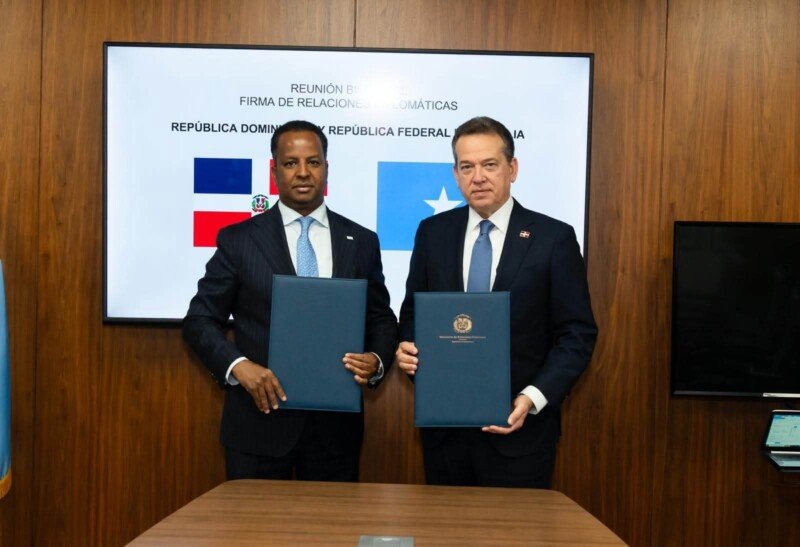
NEW YORK — Somalia and the Dominican Republic formally established diplomatic relations on Wednesday, with foreign ministers from both countries signing a joint communiqué on the sidelines of the 81st session of the United Nations General Assembly in New York.
Somalia’s Minister of Foreign Affairs and International Cooperation, Abdisalam Abdi Ali, and Dominican Republic Foreign Minister Víctor O. Bisonó Haza signed the agreement, which formalizes diplomatic ties in accordance with the Vienna Convention on Diplomatic Relations.
With the agreement, Somalia becomes the 188th country with which the Dominican Republic maintains diplomatic relations.
A Step in Somalia’s Latin American Outreach
The establishment of relations with the Dominican Republic is part of Somalia’s broader efforts to expand its diplomatic footprint beyond its traditional partners in Africa, the Middle East, and the West. According to Somalia’s Ministry of Foreign Affairs, the agreement represents “a new step in Somalia’s efforts to expand its diplomatic relations and cooperation with countries in Latin America and the Caribbean.”
The Dominican Republic, located on the island of Hispaniola in the Caribbean, is one of the region’s major economies, with tourism, services, and trade playing central roles. The establishment of diplomatic relations provides a framework for the two countries to develop cooperation in areas of mutual interest and strengthen political and economic engagement.
Minister Bisonó has emphasized an economic diplomacy approach during his tenure, stating that the Dominican Republic’s foreign ministry would serve as a “representation, support, monitoring, and accompaniment arm for national industry, production, and exports, as well as for seeking new investments.”
Bisonó’s Broader UN Agenda
The agreement with Somalia was one of several bilateral engagements for Minister Bisonó during the UN General Assembly high-level week. He also signed a visa exemption agreement for diplomatic, official, and service passport holders with Indonesia’s Foreign Minister Sugiono, and held discussions on strengthening trade and supply chain cooperation with Greece.
Bisonó also highlighted the Dominican Republic’s priorities at the UN, including the situation in Haiti, strengthening bilateral relations, attracting investment, and boosting exports. He is scheduled to travel to Washington after the General Assembly for meetings with the White House, State Department, and Department of Energy.
For Somalia, this agreement adds to a growing list of diplomatic engagements during the UN General Assembly. As reported in FTL Somalia’s coverage of Qatar’s UNGA address, the Emir of Qatar reaffirmed support for Somalia’s sovereignty, unity, and territorial integrity during the same high-level week. Somalia has also deepened defence ties with Egypt and Türkiye, while expanding economic cooperation with China.
Critical Note
The establishment of diplomatic relations between Somalia and the Dominican Republic is a modest but symbolically significant step in Somalia’s diplomatic outreach. For a country that has spent decades rebuilding its international standing, expanding ties to a Caribbean nation with no historical connection to the Horn of Africa represents a broadening of its diplomatic horizons beyond the traditional spheres of engagement.
However, the practical substance of this new relationship remains to be defined. Diplomatic recognition and formal ties are the first step; the real test will be whether the two countries can identify and pursue concrete areas of cooperation. The Dominican Republic’s focus on trade, investment, and economic diplomacy suggests that commercial and economic links, rather than political or security cooperation, are likely to form the core of the relationship.
For Somalia, the value of this agreement lies in its cumulative effect. Each new diplomatic tie reinforces the narrative of a country re-engaging with the international community, and strengthens Mogadishu’s position in its ongoing dispute over Somaliland’s status. In that context, the number of countries recognizing Somalia’s sovereignty and territorial integrity matters, and this agreement adds one more to that count.