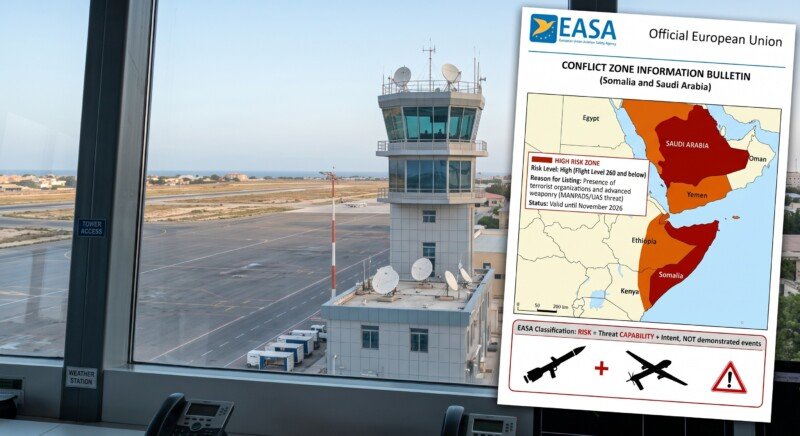
MOGADISHU — The European Union Aviation Safety Agency (EASA) has grouped Saudi Arabian airspace with Somalia’s in its latest conflict zone bulletins, a development that underscores Somalia’s continued failure to convince the EU to remove its airspace from the high-risk list despite years of investment in aviation infrastructure and the absence of confirmed attacks on civil aircraft.
EASA issued a new Conflict Zone Information Bulletin for Saudi Arabia on 30 September 2026, advising operators not to operate within a designated area along the Jeddah Flight Information Region boundary. The advisory, valid until 16 November 2026, cites increased risks of missile and drone attacks, interception activity, and falling debris following Houthi strikes on Saudi territory.
The Saudi bulletin was issued alongside the periodic extension of the Somalia advisory, which was revised on 17 April 2026 and remains valid until 31 October 2026. The Somalia bulletin classifies the risk of operation and overflight below Flight Level 260 as HIGH, citing the presence of terrorist organisations with confirmed anti-aviation weaponry and ongoing military operations.
Somalia’s Aviation Progress
Somalia has made significant progress in rebuilding its aviation sector since regaining full control of its airspace. The Somali Civil Aviation Authority (SCAA) has invested in air traffic management systems, trained local controllers, and expanded revenue generation. According to SCAA Director General Ahmed Moallin Hassan, air navigation services now generate nearly US$20 million annually, with further modernisation expected to increase revenue to approximately US$52 million.
The country’s airspace recovery has been accompanied by a steady expansion of commercial air links. In August 2026, SalamAir launched direct flights between Mogadishu and Muscat, restoring a connection with Oman after more than three decades, as detailed in FTL Somalia’s coverage of the SalamAir launch. In September, Jubba Airways resumed international services to Saudi Arabia, the United Arab Emirates, Uganda, Ethiopia and Kenya. The national carrier, Somali Airlines, is preparing to relaunch after a 35-year hiatus, with two Airbus A320 aircraft acquired for the purpose.
Mogadishu has also successfully reasserted its authority over the Mogadishu Flight Information Region (FIR), a jurisdiction recognised by the International Civil Aviation Organization (ICAO). As detailed in FTL Somalia’s coverage of Somalia’s airspace control, the federal government has warned that any attempt to defy established international aviation protocols could put lives at risk. The SCAA has demonstrated its enforcement capacity, denying overflight permits to Israeli carrier Arkia and issuing warnings to Flydubai and Ethiopian Airlines over visa compliance, as reported in FTL Somalia’s coverage of the airspace dispute.
No Confirmed Attacks on Civil Aviation
Somalia’s argument for removal from the EASA list rests in part on the absence of confirmed attacks on civil aviation in recent years. While airports in Mogadishu and other cities have experienced indirect fire incidents and security breaches at the perimeter, no civilian aircraft has been struck by hostile fire in Somali airspace in the period covered by the current EASA advisory.
EASA’s assessment, however, is based on the presence of terrorist organisations with confirmed anti-aviation weaponry, including possible MANPADS, rather than on a track record of successful attacks. The agency’s criterion is threat capability, not demonstrated intent or success. This distinction is central to Somalia’s inability to shed the high-risk classification: even without an attack, the capability exists, and EASA’s methodology treats that capability as sufficient grounds for the advisory.
FAA Parallel Restriction
The United States Federal Aviation Administration maintains a parallel restriction under Special Federal Aviation Regulation No. 107, which prohibits U.S. air carriers and commercial operators from flying below FL260 in Somali airspace. The regulation, last extended in December 2022, remains in effect until 7 January 2027. The FAA permits overflights above FL260 and allows overwater operations below that level for climbs out of and descents into Djibouti Ambouli International Airport, subject to conditions.
Critical Note
Somalia’s inability to convince EASA to remove its airspace from the conflict zone list is not a reflection of failure in aviation development. The SCAA has rebuilt air traffic control from a standing start, expanded revenue, and attracted new carriers. The return of Somali Airlines after 35 years, the entry of SalamAir and Jubba Airways into the market, and the successful assertion of control over the Mogadishu FIR are concrete achievements.
The problem is the assessment framework. EASA’s methodology does not measure whether an attack has occurred. It measures whether the capability and intent exist. In Somalia’s case, the presence of militant groups with anti-aviation weaponry is documented. The absence of a successful attack does not change that assessment. It is a structural limitation that Somalia cannot overcome through infrastructure investment alone.
What Somalia can do, and has not yet done effectively, is lobby EASA and EU member states for a reassessment based on the actual threat environment as it stands in 2026. The EASA advisory has been extended repeatedly since 2017 without substantive review. The April 2026 revision explicitly states that no changes to the content were made. That suggests a process that is administrative rather than analytical, a periodic extension rather than a genuine reassessment.
Somalia’s aviation authorities have not publicly articulated a strategy for challenging the advisory. There has been no visible diplomatic campaign to present EASA with evidence of reduced threat levels, no engagement with EU member states to question the methodology, and no coordinated effort with carriers like Turkish Airlines, Qatar Airways and Ethiopian Airlines, which operate successfully in Somali airspace, to advocate for a change in classification.
The comparison with Saudi Arabia is instructive. Saudi Arabia was added to the EASA conflict zone list because of a specific, documented escalation in missile and drone attacks. Somalia has been on the list for nine years without a corresponding attack on civil aviation. The fact that both now appear in the same EASA bulletin cycle highlights the gap between Somalia’s actual aviation safety record and its continued classification as a high-risk environment.
Until Somalia’s government and aviation authorities develop a coherent, evidence-based strategy to challenge the EASA advisory, the country’s airspace will remain on the list. The progress in infrastructure and revenue generation is real, but it is not sufficient to change a classification based on threat capability rather than demonstrated incidents. Somalia needs to make the case that the threat has changed. So far, that case has not been made.