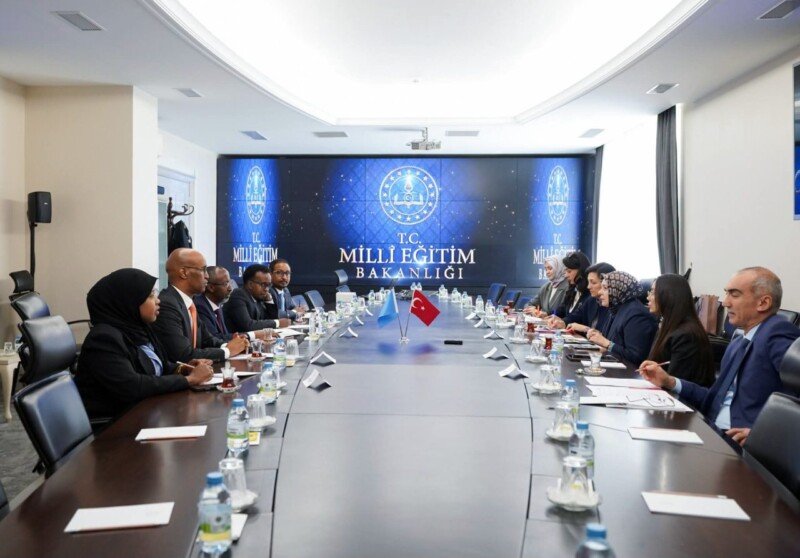
ANKARA — Somalia’s Minister of Education, Culture and Higher Education, Farah Sheikh Abdulkadir, met with Türkiye’s Deputy Minister of Education, Celile Eren Ökten, in Ankara on Wednesday to discuss strengthening cooperation in education and higher learning, according to a statement from the Ministry of Education.
The meeting was also attended by Somalia’s Ambassador to Türkiye, Fathudin Ali Mohamed. The two sides discussed expanding bilateral cooperation in education and higher education, building on a partnership that has deepened significantly over the past decade.
A Growing Educational Partnership
Somalia and Türkiye have developed one of the most extensive educational partnerships in the Horn of Africa. Thousands of Somali students have studied in Turkish universities under the Türkiye Scholarships programme, with many graduates returning to contribute to Somalia’s reconstruction in government, education, healthcare, and engineering.
The meeting followed a graduation ceremony in Ankara in July that honoured over 300 Somali students who completed their studies at Turkish universities for the 2025–2026 academic year, as reported in FTL Somalia’s coverage of the graduation. The graduates specialised in fields including engineering, economics, international relations, and technology.
Türkiye’s educational engagement in Somalia extends beyond scholarships. The Turkish Maarif Foundation operates three schools in Somalia, including a campus in Mogadishu that has been accredited to administer Oxford International examinations, as detailed in FTL Somalia’s coverage of the accreditation. The school offers the International General Certificate of Secondary Education curriculum, providing Somali students with internationally recognised qualifications.
Strategic and Technical Education Focus
The discussions in Ankara also reflect Somalia’s interest in expanding vocational and technical education. Türkiye has been a partner in this area, with ongoing discussions about establishing a vocational school in Somalia to address the country’s skills gaps.
The meeting follows high-level engagements in recent months between Turkish and Somali education officials. In September, the Turkish Higher Education Council hosted Minister Farah Sheikh Abdulkadir and his delegation to explore new steps in higher education cooperation, including the establishment of a vocational school, academic exchange programmes for researchers and faculty, and joint research projects.
Türkiye’s educational engagement in Somalia also includes cooperation on science and technology training. In July, Somali university students studying under the Türkiye Scholarships programme participated in a specialised training programme hosted by TÜBİTAK UZAY, Türkiye’s space technologies research institute, as part of efforts to develop qualified human resources for the spaceport project Türkiye is constructing in Somalia, as detailed in FTL Somalia’s coverage of the training.
Critical Note
The meeting between Somalia’s Education Minister and Türkiye’s Deputy Education Minister is a routine diplomatic engagement, but it reflects a partnership that has produced tangible results over more than a decade. Türkiye’s investment in Somali education, through scholarships, school construction, and institutional partnerships, has helped address a critical gap in Somalia’s human capital development.
The focus on vocational and technical education is particularly significant. Somalia’s economy faces a persistent skills mismatch: too many graduates in fields with limited domestic demand, and too few trained technicians, engineers, and healthcare workers. The discussions about establishing a vocational school represent a step toward addressing that gap, though the effectiveness of such initiatives will depend on whether the curriculum is aligned with labour market needs and whether graduates can find employment in Somalia or abroad.
The broader context of Somalia-Türkiye relations is also relevant. The educational partnership is part of a multifaceted relationship that includes security cooperation, infrastructure investment, and maritime engagement. As Türkiye’s footprint in Somalia expands, the educational dimension helps build long-term goodwill and people-to-people ties that outlast individual projects. Whether that goodwill translates into deeper institutional capacity in Somalia’s education sector, or remains dependent on continued Turkish support, is the question that will determine the partnership’s long-term impact.