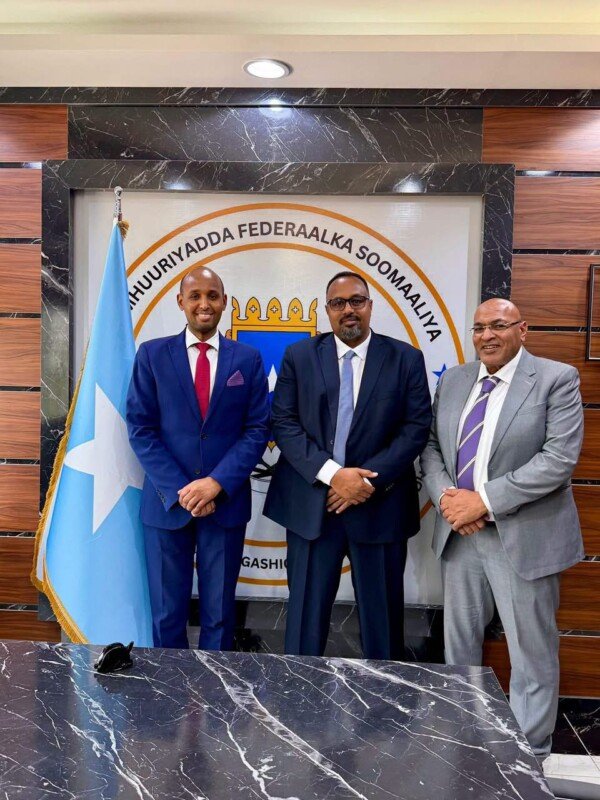
MOGADISHU, The Director General of the Somali Investment Promotion Agency, Faisal Adam Hassan, received a delegation from Zain-al-Abdin Group Africa Limited on Sunday, led by the company’s Chief Executive Officer, Dr. Ashraf Omran, to discuss potential investments in Somalia’s fisheries, agriculture, and livestock sectors.
The visit aimed to explore investment opportunities in the country, particularly in the fisheries and blue economy, agriculture, and livestock sectors, which the agency described as possessing significant potential to contribute to economic growth and job creation.
The Investment Promotion Agency said it played a facilitating role in connecting the delegation with government institutions and the private sector, providing information and guidance on Somalia’s investment environment, and supporting the identification and evaluation of viable projects.
The Investor and the Sectors in Question
Zain-al-Abdin Group Africa Limited is an Egyptian company with a diverse portfolio. The delegation’s focus on fisheries and the blue economy aligns with a broader push by the federal government to attract foreign capital into a sector it estimates could generate billions of dollars annually.
Somalia has the longest coastline in mainland Africa, stretching over 3,300 kilometers, but its fisheries sector remains underdeveloped. The sector contributes an estimated 2-3 percent of GDP, a fraction of its potential, while illegal, unreported, and unregulated fishing by foreign vessels continues to deplete stocks, as reported in FTL Somalia’s coverage of the blue economy sector.
The Director General of the Ministry of Fisheries and Blue Economy, Abdi Dirshe, has emphasized that the country’s maritime resources could generate billions of dollars annually if managed effectively, describing the blue economy as a cornerstone for sustainable growth and national prosperity, as detailed in FTL Somalia’s coverage of the sector’s potential.
The livestock sector, particularly camel and goat exports to Gulf markets, remains Somalia’s largest foreign exchange earner, though it is vulnerable to import bans imposed by Saudi Arabia and other Gulf states over disease concerns. Agriculture, meanwhile, is dominated by smallholder farming and remains susceptible to drought and flooding.
A New Agency with a Broad Mandate
Sunday’s meeting is part of a sustained effort by the Investment Promotion Agency to attract international investors. The agency itself is a recent creation. The Somali Senate approved the new Somalia Investment Law (2025) in late November 2025, establishing the Somalia Investment Promotion Agency (SOMINVEST) under the Ministry of Planning, Investment and Economic Development, as reported in FTL Somalia’s coverage of the investment law.
In recent months, the agency has engaged with Turkish, European, and Gulf firms interested in Somalia’s maritime and agricultural potential. Turkey has been the most prominent partner, launching the joint fisheries company Somtürk in March 2026 in partnership with the Somali Fisheries Company. The venture was formed between the Somali Fisheries Company and Turkey’s OYAK Group, with exclusive authority over fisheries licensing in Somalia’s Exclusive Economic Zone, as reported in FTL Somalia’s coverage of the Somtürk launch.
However, the Somtürk deal has drawn criticism. Puntland issued a formal statement in July 2026 rejecting any Turkish maritime operations off its coastline, barring SOMTURK from conducting fishing activities within Puntland’s territorial waters without prior approval. The administration argued that the Federal Government lacks the legal authority to grant concessions covering Puntland’s seas and land territory.
The Gap Between Promotion and Investment
Fisheries and the blue economy require functioning ports, cold-chain infrastructure, licensed and monitored vessels, and enforcement against illegal fishing. Somalia has none of these at scale. The government’s own maritime conference in August 2026 produced a communique calling for a national maritime strategy, an admission that one does not yet exist.
The political context compounds the economic risk. The federal government is embroiled in a constitutional dispute with Puntland and Jubaland, both of which have rejected the electoral framework and withdrawn from federal processes. Puntland, which hosts significant fisheries infrastructure in Bosaso, has warned that continued confrontation could push Somalia toward disintegration.
Critical Note
The Investment Promotion Agency’s meeting with Zain-al-Abdin Group is a routine investment facilitation exercise, and the agency’s role is to sell Somalia as a destination for capital. But the gap between investment promotion and actual investment in Somalia remains wide, and the sectors being pitched are precisely those where the state’s ability to protect and regulate is weakest.
An Egyptian investor exploring fisheries opportunities will find a coastline rich in fish and poor in the infrastructure needed to extract value from it. The Somtürk precedent, which has already provoked a formal rejection from Puntland, illustrates the risk that any major fisheries deal will become entangled in the federal-state dispute. An investor considering a multi-year commitment would be prudent to ask which authority will regulate their license, protect their assets, and honor their contract in three years’ time.
None of this means the Zain-al-Abdin delegation will not invest. The company may see opportunity in a frontier market where competition is limited and the government is eager. But the meeting itself is not evidence of investment. It is evidence of courtship. The gap between the two is where Somalia’s economic future will be decided, or lost.
Recommended Reading On ftlsomalia.com
- Somali Senators Approve New Investment Law
- Turkish Delegation Launches Blue Economy Committees as SOMTURK Faces Puntland Ban and Federal Tensions
- Somalia’s Blue Economy Holds Billion-Dollar Promise, Says DG Dirshe
- Somalia Establishes Somtürk Fisheries Partnership with Turkey to Enhance Blue Economy
- IFC Makes First Investment in Somalia, Backing KIMS Microfinance with $2.8 Million Sharia-Compliant Package