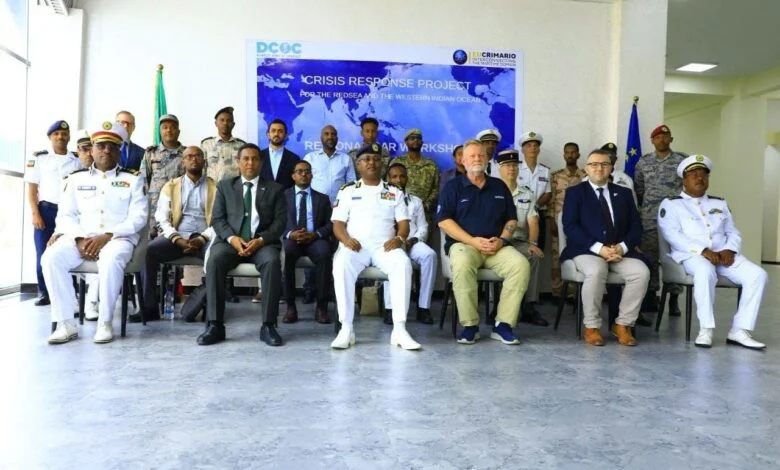
ADDIS ABABA, Ethiopia hosted a four-day regional maritime security workshop in Addis Ababa this week that brought together naval and maritime representatives from Yemen, Oman, Djibouti, Somaliland, and Puntland, but did not include the Federal Government of Somalia, according to statements from the Ethiopian National Defense Force and multiple reports.
The workshop, officially titled the Regional Search and Rescue Workshop, opened on October 26 and concluded on October 29. It was held under the Crisis Response Project for the Red Sea and Western Indian Ocean, with support from the European Union, and event materials displayed the logos of the Djibouti Code of Conduct, EU CRIMARIO, and Expertise France.
Ethiopian Navy Commander Vice Admiral Kindu Gezu attended the opening as guest of honour. In his remarks, he described the maritime region connecting the Gulf of Aden, the Red Sea, and the western Indian Ocean as “one of the busiest and most strategically important corridors in the world,” and said its security challenges require “seamless transboundary communication, command structures and joint operations.”
Gezu also framed the gathering as significant for Ethiopia’s national interests, asserting that the country’s return to the Red Sea was inevitable and characterizing Ethiopia’s loss of its coastline as the result of “political intrigue.”
The Paradox of a Landlocked Host
The most striking feature of the Addis Ababa workshop is that it was convened by a country with no coastline. Ethiopia lost direct access to the sea when Eritrea gained independence in 1993, and its naval force remains nascent, operating without a home port of its own. Yet it gathered naval commanders and maritime authorities from across the region to discuss search and rescue, information sharing, and maritime security coordination.
Analysts have questioned the logic of a landlocked state hosting a naval forum. The questions are both practical and political. Practically, Ethiopia does not patrol the Red Sea, does not conduct search-and-rescue operations in the Gulf of Aden, and does not maintain the maritime infrastructure that the workshop’s agenda presupposes. Its role in regional maritime security has been, until now, largely aspirational.
Politically, the choice of host is a statement. As reported in FTL Somalia’s coverage of the Eritrea-Ethiopia standoff, Ethiopia’s pursuit of sea access has reshaped its relationships with Eritrea, Djibouti, and Somalia. Hosting a maritime security forum positions Addis Ababa as a coordinator of regional efforts, even as it remains outside the waterway’s governance framework.
The EU’s support for the event adds a layer of complexity. The bloc has funded maritime capacity-building across the region, and its involvement lends the workshop technical credibility. But it also means that European resources are being used to convene a forum that excludes the federal government of Somalia while including Somaliland and Puntland.
The Politics of the Guest List
The composition of the forum is politically significant. The Ethiopian National Defense Force’s statement listed participants from Yemen, Oman, Djibouti, Somaliland, and Puntland, but made no mention of Somalia’s federal government. Reports from Somali media confirmed that the Federal Government of Somalia was absent from the conference.
Mogadishu maintains that foreign relations and international agreements concerning Somalia fall under the authority of the federal government. Somaliland declared its independence in 1991 and operates separately but is not widely recognized internationally. Puntland is a federal member state of Somalia. Ethiopia’s decision to invite both regional administrations while excluding the federal government is a departure from diplomatic convention, though the ENDF statement does not establish whether Somalia was invited, declined, or was excluded.
The exclusion must be read in the context of Somalia’s diplomatic posture. As reported in FTL Somalia’s coverage of Somalia’s stated neutrality, Deputy Foreign Minister Hassan Mohamed Ali Nadara told the BBC that Somalia remains neutral in the Ethiopia-Eritrea confrontation. But analysts disputed that characterization, pointing to Somalia’s participation in the Alamein Declaration alongside Egypt, Eritrea, and Sudan. For Addis Ababa, Somalia’s claim of neutrality may ring hollow, and the decision to engage directly with Somaliland and Puntland reflects that reality.
Ethiopia’s Long Campaign for Sea Access
The workshop is the latest front in Ethiopia’s broader campaign to secure reliable access to the sea, a goal Prime Minister Abiy Ahmed has repeatedly described as “existential.”
Ethiopia became landlocked following Eritrea’s independence in 1993. Since then, it has relied on Djibouti for the vast majority of its trade. Abiy has argued that this dependence constrains Ethiopia’s economic development and has called for a national dialogue on the issue, asking publicly, “Who made the decision that caused Ethiopia to lose the Red Sea?”
In January 2024, Ethiopia signed a memorandum of understanding with Somaliland that would have leased a 20-kilometre stretch of coastline for maritime and potentially military purposes, in exchange for moving toward recognizing Somaliland’s independence. The deal triggered a diplomatic crisis with Somalia and drew Egypt and Eritrea into the dispute on Mogadishu’s side. As reported in FTL Somalia’s coverage of the Alamein Declaration, Egypt, Eritrea, Somalia, and Sudan have since formalized a bloc opposing Ethiopia’s maritime ambitions.
The standoff was partially eased in December 2024 through the Ankara Declaration, brokered by Türkiye. Under that agreement, Ethiopia and Somalia reaffirmed their commitment to each other’s sovereignty and territorial integrity, while acknowledging the potential benefits of Ethiopia having reliable access to the sea through commercial arrangements under Somali sovereignty.
But the technical negotiations envisioned in Ankara have not produced a comprehensive port-access agreement. President Hassan Sheikh Mohamud said in October 2026 that Somalia is open to allowing Ethiopia to use its ports, but only through direct negotiations with Mogadishu and under Somali sovereignty. He noted that Addis Ababa had not yet formally approached Mogadishu with a specific proposal.
The Alamein Counterweight
Ethiopia’s regional isolation has been compounded by the formation of a counter-coalition. On October 4, 2026, the leaders of Egypt, Eritrea, Somalia, and Sudan issued the Joint Al-Alamein Declaration, affirming their support for Somalia’s unity and territorial integrity and explicitly rejecting “any recognition of or support for the so-called Somaliland.”
The declaration also stated that governance of the Red Sea is “the exclusive responsibility of its littoral States,” a provision widely interpreted as a rebuke to Ethiopia’s maritime ambitions. The four-nation bloc represents a significant diplomatic setback for Addis Ababa, which has found itself excluded from a framework that claims authority over the very waterway it seeks to access.
Critical Note
The Addis Ababa workshop is a technical forum on search and rescue, and its agenda is practical. But the host is a landlocked state, and the guest list is political. Those contradictions are the story.
Ethiopia’s decision to convene a maritime security forum is an assertion of intent. It is saying, in effect, that it intends to be a maritime power, that it intends to shape the security architecture of the Red Sea, and that it will do so with or without the cooperation of the federal government of Somalia.
Analysts are right to question how a country without a coastline can host such a forum. The answer is that Ethiopia is not hosting it as a coastal state, but as a political actor with regional ambitions. The workshop is less about search and rescue than about positioning. The EU’s support gives it resources and legitimacy. The participation of Djibouti, Oman, and Yemen gives it a regional veneer. The inclusion of Somaliland and Puntland, and the exclusion of Mogadishu, gives it a political edge.
The workshop concluded with certificates and gifts, and participants expressed confidence that the experience gained would translate into effective action. Whether that action includes Somalia, or whether it is designed to work around it, is the question that the forum did not answer.
Recommended Reading On ftlsomalia.com
- Somalia Tells BBC It Is Neutral in Ethiopia-Eritrea Crisis, Analysts Disagree
- Eritrea-Ethiopia Standoff Escalates as Somalia Watches Its Regional Partners Confront Each Other
- Ethiopia Rejects ‘Coercive Measures’ as Egypt, Eritrea, Somalia and Sudan Formalize Bloc
- Somali President Accuses Israel of Seeking Berbera Base to Target Iran