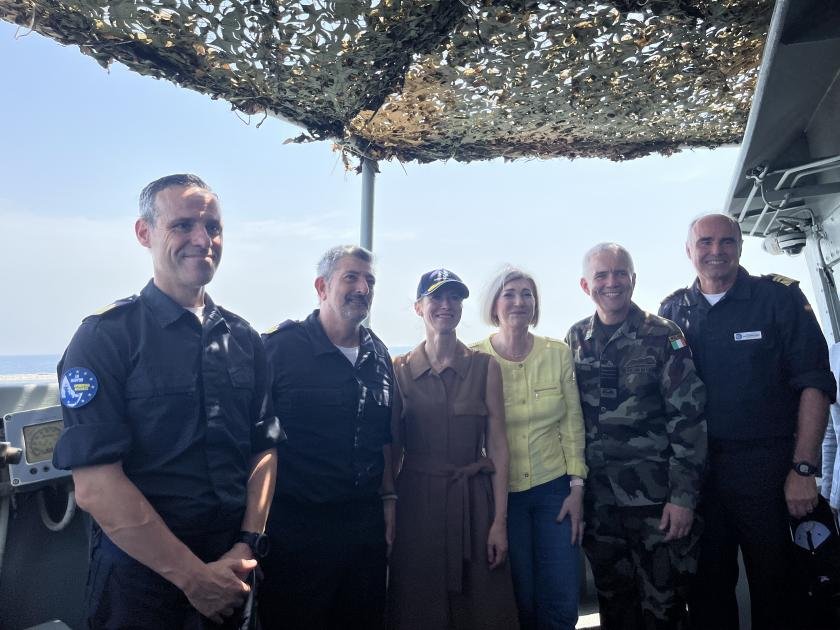
ROME — Italian Defence Minister Guido Crosetto has said the number of European Union warships participating in Operation Aspides is still insufficient to secure commercial shipping in the Red Sea and the strategic Bab al-Mandab Strait.
Crosetto made the statement following a meeting in Rome with the European Union’s High Representative for Foreign Affairs and Security Policy, Kaja Kallas. He welcomed the decision by several EU member states to provide additional support for Operation Aspides but noted that the current capability still cannot guarantee the safe passage of commercial vessels through the region, according to the Italian Ministry of Defence.
Diplomatic sources said Operation Aspides currently has six warships, while Kallas has previously indicated that the mission needs more than ten ships to effectively fulfil its mandate, particularly given the scale of the Red Sea and the threats in the Bab al-Mandab Strait.
Italy has said it is ready to deploy additional ships to the region if joint EU decisions are delayed. According to reports, the Italian government is considering sending up to four ships, including frigates, to the Bab al-Mandab Strait to ensure safe navigation, with other member states expected to share the related costs.
The Gap Between Mandate and Resources
Operation Aspides was launched by the European Union in February 2024 with the objective of protecting commercial vessels from attacks in the Red Sea, particularly those linked to the Houthis in Yemen. The mission operates in a defensive capacity, escorting vessels and reinforcing maritime situational awareness.
Kallas has acknowledged the growing pressure on the mission, stating that the situation is more serious than when Aspides was initially launched. She noted that the EU is receiving an increasing number of requests from commercial vessels for escorts, underscoring the need for additional naval assets. The challenge extends beyond the number of ships: Aspides requires frigates capable of escorting merchant vessels, along with air-defence and mine-countermeasure capabilities, making reinforcement dependent on the type of assets available as well as their number.
Several European countries remain constrained by naval commitments elsewhere, complicating efforts to maintain a sustained presence in the maritime corridor. Belgium is considering deploying an additional frigate, while the Netherlands is expected to respond positively to requests for reinforcement.
Distinction from Operation Atalanta
Operation Aspides differs from the European Union’s Operation Atalanta, which focuses on counter-piracy and maritime security off Somalia, the Gulf of Aden, and parts of the Indian Ocean. While the two operations can cooperate on maritime security and information sharing, they have different mandates and areas of operation.
As reported in the EUNAVFOR Atalanta newsletter, the counter-piracy mission continues to monitor four hijacked vessels held off Somalia’s northeastern coast, maintaining close contact with Somali law enforcement agencies, particularly the Puntland Maritime Police Force. The newsletter also noted that Atalanta forces conducted joint counter-piracy drills with the Republic of Korea Ship Wang Geon in July 2026.
Italy’s warning about the insufficiency of naval assets comes amid a broader deterioration in Red Sea security. The United Nations has warned that escalating fighting in Yemen and around the Bab al-Mandab Strait risks further destabilizing a critical international maritime route. UN Assistant Secretary-General Khaled Khiari told an emergency Security Council meeting that Houthi advances along Yemen’s western coast were adding to market concerns, with at least 125,000 people displaced across Yemen since the beginning of September.
Critical Note
Italy’s assessment that six warships are insufficient to secure the Red Sea is a candid admission that the EU’s naval mission is under-resourced relative to its mandate. The gap between the operational requirement of more than ten ships and the current deployment of six has persisted for months, despite repeated warnings from Kallas and member states. The reasons are not logistical but political: European navies are stretched across multiple commitments, and member states have been reluctant to commit additional assets to a mission that lacks a clear end date.
The implications extend beyond the Red Sea. The Houthi campaign has already forced shipping companies to reroute around the Cape of Good Hope, lengthening voyages and increasing transport and insurance costs. For Somalia, the disruption has compounded existing challenges, including the resurgence of piracy off its coast and the diversion of international naval assets away from counter-piracy operations. As reported in FTL Somalia’s coverage of the Honour 25 killings, pirates have exploited the security vacuum, killing five crew members on a hijacked tanker in September 2026, the first such deaths in more than a decade.
Italy’s offer to deploy up to four ships unilaterally if EU decisions are delayed is a signal of frustration with the pace of collective action. But unilateral deployments, however well-intentioned, are not a substitute for a coherent EU strategy. The Red Sea crisis requires sustained, coordinated naval presence, not episodic reinforcements. Until member states commit the resources the mission actually needs, the security of one of the world’s most important trade corridors will remain precarious.