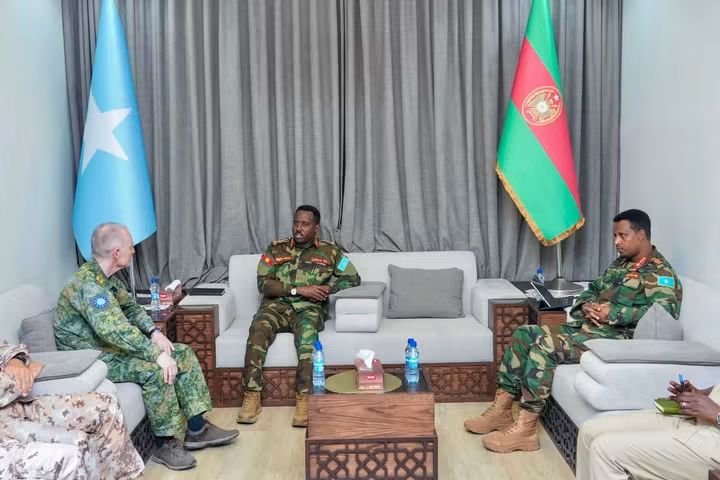
MOGADISHU — The Commander of the Somali National Army, Brigadier General Ibrahim Mohamed Mohamud, accompanied by the Commander of the Land Forces, General Sahal Abdullahi Omar, received Lieutenant General Michiel van der Laan, Director General of the European Union Military Staff (EUMS) and Director of the Military Planning and Conduct Capability (MPCC), at his office on Tuesday.
The meeting focused on strengthening military cooperation, particularly in the areas of training, professionalisation and capacity development for the Somali National Army. The two sides also reviewed opportunities to further develop the knowledge and skills of Somali forces, enhance leadership capacity and military planning, and reinforce EU support for the development of the SNA.
The Commander of the Somali National Army thanked the EU delegation for the visit and for the support the European Union provides to Somalia, stressing the importance of continued cooperation in developing the capabilities of the national army.
The EU’s Role in Training Somali Forces
The visit by the EUMS Director comes as the European Union continues to play a central role in training and professionalising Somali security forces through its military training mission, EUTM Somalia. The mission, now in its ninth mandate, focuses on strategic advice to the Ministry of Defence and the Somali Armed Forces headquarters, specialised military training, and strengthening institutional capabilities, as detailed in FTL Somalia’s coverage of the EU training mission.
EUTM Somalia operates through three lines of effort — advising, training and mentoring — with the aim of building professional, effective and self-sufficient armed forces capable of progressively assuming responsibility for national security. The mission’s work is complemented by the EU’s broader financial support to African Union-led missions in Somalia. In April 2026, the EU confirmed an additional EUR 75 million contribution to AUSSOM, bringing total EU support to successive AU-led missions to almost EUR 2.8 billion, as reported in FTL Somalia’s coverage of the EU contribution.
The EU has also engaged with Somalia on defence reform through the SNA III Project, funded under the European Peace Facility, which focuses on structured training, operational planning support and logistical capacity-building. A Steering Committee meeting on the project was held in Mogadishu in October 2025, where Somali officials emphasised the need for EU-backed training to translate into operational effectiveness on the ground, as detailed in FTL Somalia’s coverage of the defence reform meeting.
Leadership Transition at EUTM Somalia
The meeting coincides with a scheduled leadership transition at EUTM Somalia. Brigadier General Ivan Falasca is set to assume command of the mission on 30 September 2026, succeeding Brigadier General Elio Manes, who has led EUTM Somalia since January 2026. The appointment was confirmed by the EU Political and Security Committee in September 2026.
General Manes’ tenure included a period of intensified cooperation with Somali authorities. In his first remarks as commander, he said his priority would be to consolidate existing training programmes while expanding tailored support to Somali counterparts, with the aim of enabling Somali forces to plan and conduct security operations independently.
Critical Note
The visit by the EU Military Staff Director is a routine engagement that reflects the EU’s sustained commitment to training and capacity building for the Somali National Army. However, the recurring nature of these meetings raises a question about what they achieve beyond the diplomatic. The EU has trained thousands of Somali soldiers over the years, but the SNA continues to face structural challenges: inadequate pay, logistics constraints, and command fragmentation. The test of EUTM Somalia’s impact is not the number of soldiers trained but whether those soldiers can be deployed, sustained, and retained within a coherent security architecture.
The EU’s financial contribution to AUSSOM is significant, and its training mission provides a framework for long-term institutional development. But as Somalia’s security transition enters a critical phase with the African Union mission preparing to draw down, the question is whether the EU and other partners will adjust their support to fill the gaps that emerge. The EU’s continued engagement suggests it is aware of the challenge. Whether it can respond effectively, and whether Somali institutions can absorb and sustain the support they receive, remains an open question.