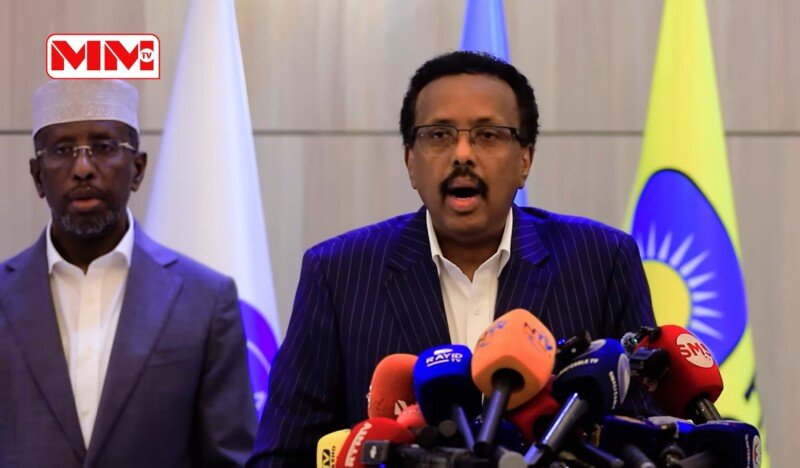
MOGADISHU — Former Somali President Mohamed Abdullahi Farmaajo has issued a sharp rebuke of President Hassan Sheikh Mohamud’s handling of the electoral process, accusing him of sabotaging internationally mediated talks and paving the way for conflict by insisting on elections without political consensus.
In a statement dated 16 October 2026, Farmaajo said President Mohamud’s actions and recent remarks regarding the stalled negotiations and the election agreement demonstrate “a malicious intent aimed at obstructing any peaceful resolution and igniting renewed conflict.”
“The fact that the term-expired President abandoned the talks that the international community was mediating, and rejected the agreement that was reached, which stipulated that federal-level elections could not be held without consensus, clearly shows that he is not ready for dialogue and a unified process that would lead to credible elections,” Farmaajo said.
He called on Somalia’s international partners who are engaged in resolving the electoral dispute not to “again endorse the agenda of the term-expired President, since there is no genuine goodwill or willingness on his part to achieve open, inclusive elections.”
A Worsening Political Crisis
Farmaajo’s statement is the latest intervention in an escalating confrontation between the federal government and a broad opposition coalition over the electoral framework. The dispute has deepened since the National Independent Electoral and Boundaries Commission (NIEBC) announced a federal election timetable on 15 October, setting parliamentary elections for 15 April 2027 and the presidential vote for 15 May 2027.
The announcement was immediately rejected by the Somali Salvation Forum (Madasha Samatabixinta), the opposition alliance that includes Puntland, Jubaland, and several former presidents and prime ministers. Mohamed Adan Jimcaale (Koofi), the Forum’s secretary, accused the government of “election theft” and “power-grabbing,” saying the disease that caused Somalia’s destruction began with a stolen election and the misuse of state power.
Former President Sharif Sheikh Ahmed also condemned the timetable, warning that the unilateral move risks creating parallel elections, political instability, and civil unrest. He filed a petition with the Supreme Court challenging the constitutional amendments that underpin the electoral process. As reported in FTL Somalia’s coverage of Sharif’s statement, the former president said the responsibility for the impending crisis rests with Hassan Sheikh Mohamud, who he described as being in Villa Somalia “beyond his legal mandate.”
The Galmudug Precedent and Credibility Concerns
The political standoff has been compounded by persistent questions about the NIEBC’s credibility, following the Supreme Court’s annulment of the Galmudug elections in August 2026. The court found that the July 30 vote had not been administered in accordance with constitutional and electoral requirements for free, fair and impartial elections, and ordered a rerun.
As reported in FTL Somalia’s coverage of the Supreme Court ruling, the rerun was held on 30 September 2026, but the NIEBC subsequently excluded the Towfiiq party, the very organization that had successfully challenged the July results in court. Towfiiq was left off the ballot without a clear public explanation. The rerun results were ratified by the Supreme Court on 13 October 2026, confirming the allocation of all 89 seats in the Galmudug House of Representatives, with the ruling Justice and Unity Party securing 67 seats.
The chairperson who oversaw the annulled Galmudug election remains in his position and is now tasked with administering federal elections in 2027. The fact that the same chairperson who presided over an election annulled for illegality and irregularity continues to lead the commission raises serious concerns about the impartiality and integrity of the entire electoral process.
Parallel Elections and Limited Federal Reach
The opposition has repeatedly threatened to organize parallel elections and form a rival administration if the government proceeds without a negotiated agreement. As reported in FTL Somalia’s coverage of the opposition’s threat, opposition leaders warned of a potential constitutional vacuum if the political deadlock persisted.
Puntland and Jubaland have both rejected the constitutional amendments and the electoral framework. Puntland has signaled that it may proceed with independent regional elections if no national agreement is reached. The federal government’s ability to organize elections in Puntland and Jubaland is severely constrained, and both states have declined to participate in negotiations mediated by Turkey, questioning Ankara’s neutrality. This means that the NIEBC’s timetable applies, in practice, only to areas under federal government control.
Critical Note
Farmaajo’s statement reinforces the opposition’s unified position that the government’s electoral process lacks legitimacy and that its insistence on proceeding without consensus is a recipe for conflict. His call on international partners not to endorse the government’s agenda is a direct appeal to the same mediators whose efforts he claims the President abandoned.
The crisis is no longer simply about an election timetable. It is about whether Somalia’s political class can agree on the rules of the game. The opposition’s refusal to accept the NIEBC’s process, the government’s refusal to negotiate, and the international community’s inability to bridge the gap have created a deadlock with no obvious exit.
The Galmudug precedent hangs over the entire process. The Supreme Court annulled an election administered by the NIEBC, citing substantial irregularities. The commission then excluded the party that had successfully challenged the vote from the rerun. The chairperson who oversaw this process remained in office and is now tasked with administering federal elections. If the NIEBC cannot explain its decisions in Galmudug, how can it be trusted to administer federal elections impartially?
For Somalia, the 2027 elections represent both an opportunity and a risk. If held credibly and with broad participation, they could mark a historic transition to direct democratic governance. If held amid political division, contested legitimacy, and a compromised electoral commission, they could deepen the divisions they are meant to resolve. Farmaajo’s warning is a reminder that elections cannot be imposed; they must be agreed upon.
Share your story. FTL Somalia is continuing to investigate Somalia’s electoral process and the political crisis surrounding the 2027 federal elections. If you have information or insights to share, contact us at info@ftlsomalia.com. Your identity will be protected.
Recommended Reading On ftlsomalia.com
- Sharif Sheikh Ahmed Condemns Election Timetable, Warns of Parallel Elections and Civil Conflict
- Galmudug Election Finalized as Supreme Court Certifies Rerun Results
- Somalia’s Opposition Accuses Government of ‘Election Theft’ After NIEBC Announces 2027 Timetable
- Somalia President Agrees to Opposition Talks to Avoid Parallel Elections