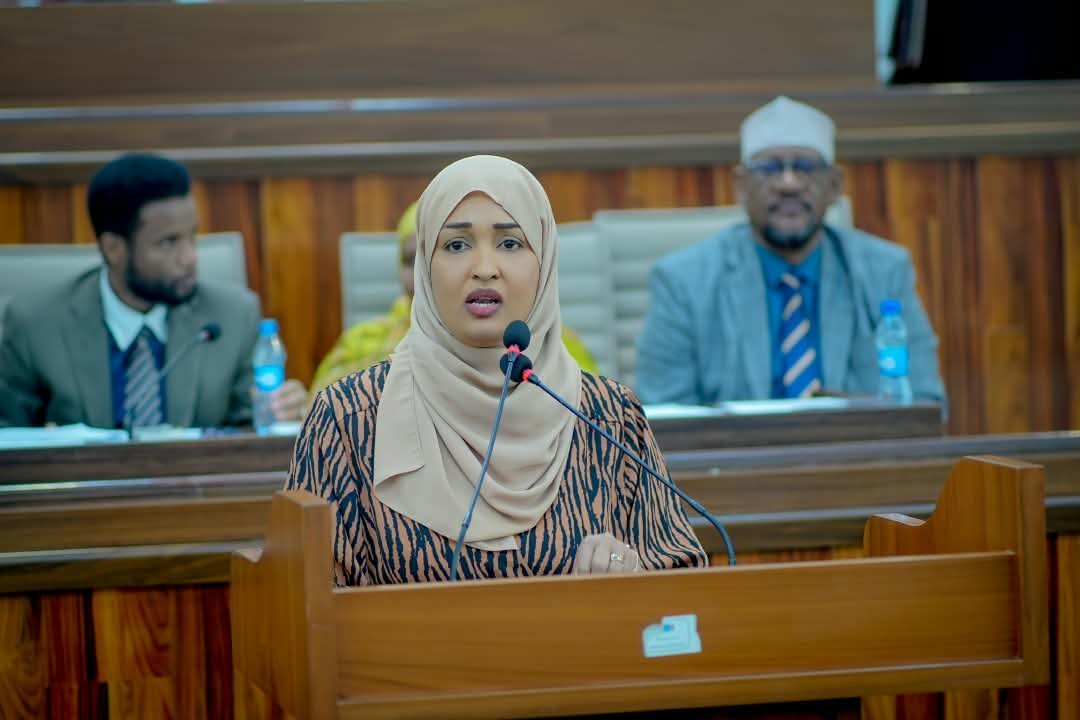
MOGADISHU — Minister of Family and Human Rights Development Khadija Mohamed Al-Makhzoumi presented a bill to the House of the People on Saturday seeking to prohibit Female Genital Mutilation (FGM) in Somalia, calling on lawmakers to establish a clear legal framework to end the practice.
In a statement posted on X, the Minister said she outlined the serious physical and psychological harm caused by Pharaonic FGM and underscored the need to prevent its occurrence and protect the rights, health and dignity of women and girls.
“I call for the Bill to receive due consideration through the legislative process,” Al-Makhzoumi said. She also thanked the leadership and members of the House of the People for their continued cooperation in strengthening legal protection for women and girls in Somalia.
A Long-Awaited Legislative Step
The presentation of the FGM bill marks a significant moment in Somalia’s legislative efforts to address gender-based violence. The practice is widespread in Somalia, which has one of the highest rates of FGM in the world. According to UNICEF, approximately 98 percent of Somali women and girls aged 15 to 49 have undergone some form of the practice.
Despite years of advocacy by civil society organizations, religious leaders, and international partners, Somalia has never had a national law specifically prohibiting FGM. The practice has been addressed only indirectly through the penal code and child protection legislation, which advocates say has been insufficient.
The Minister’s push for the bill follows a broader legislative agenda focused on women’s and children’s rights. As reported in FTL Somalia’s coverage of the sexual offences bill, the House of the People approved the Rape and Sexual Offences Bill in October 2026, with 132 members voting in favour. The bill was welcomed by the Ministry of Family and Human Rights Development as a milestone toward strengthening legal protection, ensuring accountability, and safeguarding victims’ rights and access to justice.
Challenges Ahead
The FGM bill now enters the legislative process, where it will be subject to deliberation and potential amendment before a vote. Its passage is not guaranteed. Previous attempts to legislate against FGM have faced resistance from some religious leaders and community groups who argue that the practice is a cultural tradition, although the Minister specifically referenced “Pharaonic FGM,” the most severe form, which involves infibulation and is widely condemned even by those who defend less invasive practices.
The political context is also challenging. The House of the People has struggled with quorum failures and absenteeism in recent months, delaying legislative work and undermining the institution’s credibility. As reported in FTL Somalia’s coverage of the quorum failures, only 115 members attended a recent sitting against the required 138.
However, the House achieved quorum for the sexual offences vote, with 140 members present, suggesting that high-profile legislation can draw attendance.
Critical Note
The presentation of an FGM bill is a welcome step, but it is only the beginning. Somalia’s lack of a national law against FGM has been a glaring gap in its legal framework, and the Minister’s decision to bring the bill to Parliament is a signal that the government is prepared to address it.
But the bill’s passage is not assured. FGM is deeply embedded in Somali society, and efforts to legislate against it have historically faced resistance. The Minister’s focus on Pharaonic FGM may be a strategic choice, targeting the most severe form of the practice while avoiding a broader confrontation with communities that practice other forms. Whether that strategy will be sufficient to secure passage remains to be seen.
The broader challenge is enforcement. Even if the bill becomes law, Somalia’s judicial and law enforcement institutions are weak, and the practice is often carried out in private by traditional practitioners who operate outside any regulatory framework. A law alone will not end FGM, but it is a necessary foundation for the broader social and cultural change that must accompany it.
The Minister’s effort deserves support. But it will require sustained political will, not just from the government but from Parliament, religious leaders, and communities, to translate this legislative initiative into meaningful protection for Somali women and girls.