MOGADISHU — Fahad Yasin, the former Director of Somalia’s National Intelligence and Security Agency (NISA), has accused President Hassan Sheikh Mohamud of leading the country toward a Sudanese-style collapse, warning that Somalia risks ending up with “two presidents, two governments, and two armies.”
In a post on X on Friday, Yasin claimed that a foreign government had persuaded President Mohamud not to leave office, with the intention of keeping Somalia divided. “God willing, that desire will not be fulfilled,” he wrote.
A Warning of Sudanese Proportions
Yasin’s comparison to Sudan is pointed. The North African nation has been torn apart by a civil war between the Sudanese Armed Forces, led by General Abdel Fattah Al-Burhan, and the Rapid Support Forces (RSF) of Mohamed Hamdan Dagalo (Hemeti). That conflict has produced two competing authorities and rival military forces, a scenario Yasin suggests Somalia could replicate.
The reference is not incidental. Somalia’s Defence Minister, Ahmed Moallim Fiqi, has repeatedly accused opposition figures of meeting with RSF-linked individuals in Abu Dhabi and learning militia tactics. As reported in FTL Somalia’s coverage of Fiqi’s statement, the minister alleged that politicians were being trained to mobilise militias and revive warlord-style politics, warning that they would return with plans to undermine statehood.
Yasin, who served as chief of staff under former President Mohamed Abdullahi Farmaajo, is a polarizing figure in Somali politics. He has been accused of manipulating state institutions for political gain and of relying on foreign financial backing, particularly from Qatar, to influence leadership contests.
The Opposition’s Parallel Election Threat
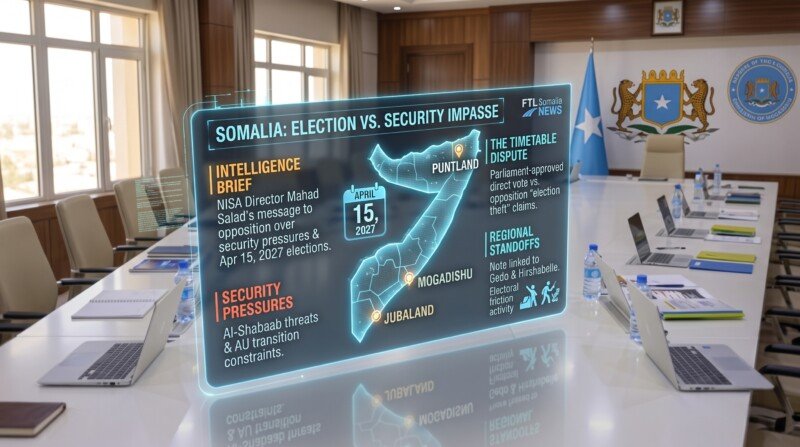
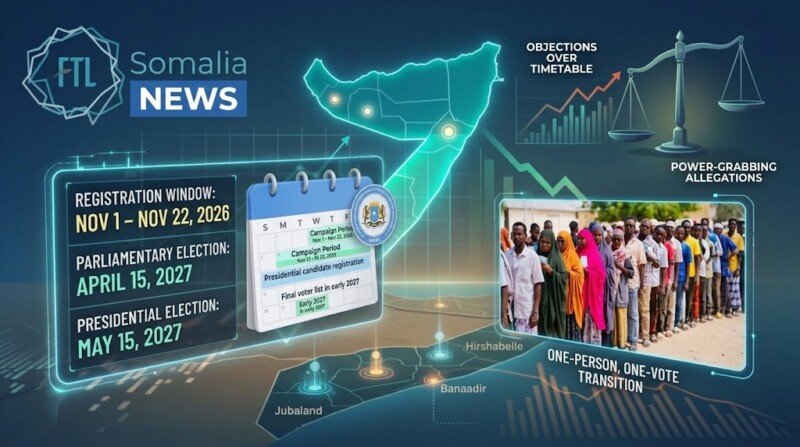
Yasin’s intervention comes as Somalia’s political opposition has escalated its rejection of the federal election timetable announced by the National Independent Electoral and Boundaries Commission (NIEBC) on 15 October. The timetable sets parliamentary elections for 15 April 2027 and the presidential vote for 15 May 2027.
Former President Sharif Sheikh Ahmed has warned that the unilateral process could lead to “parallel elections, political instability, civil unrest, and a threat to the existence of the Somali state.” As reported in FTL Somalia’s coverage of Sharif’s statement, he filed a petition with the Supreme Court challenging the constitutional amendments that underpin the electoral framework, and the court admitted the petition on 12 October.
Former President Farmaajo has also condemned the process, accusing President Mohamud of sabotaging internationally mediated talks and insisting on elections without consensus. As reported in FTL Somalia’s coverage of Farmaajo’s statement, he called on international partners not to endorse the government’s agenda.
The Somali Salvation Forum, an opposition alliance that includes Puntland and Jubaland, has rejected the timetable and accused the government of “election theft,” as detailed in FTL Somalia’s coverage of the opposition’s rejection. Puntland and Jubaland have both refused to participate in the process, raising the prospect that the NIEBC’s timetable will apply only to areas under federal government control.
The El Alamein Framework and Sudan’s Precedent
The opposition’s warnings are not without basis. The El Alamein Joint Declaration, signed by Somalia, Egypt, Eritrea, and Sudan on 4 October 2026, explicitly rejected the establishment of “parallel entities” in Sudan. As reported in FTL Somalia’s coverage of the declaration, the four leaders affirmed support for Sudan’s unity, sovereignty, and territorial integrity, and rejected the establishment of parallel bodies.
The same declaration affirmed support for Somalia’s unity and sovereignty, but the principle it establishes, that parallel authorities are unacceptable, applies equally to the Somali context if the current dispute escalates. The declaration’s language on Sudan was a clear signal that the signatories, including President Mohamud, view the creation of rival administrations as a threat to regional stability. Yet the opposition’s threats of parallel elections suggest that the very scenario the El Alamein Declaration rejects could materialize in Somalia.
Critical Note
Fahad Yasin’s warning is a political statement from a figure with his own controversial history, but it captures a real concern shared by a broad spectrum of Somali political actors. The comparison to Sudan is not merely rhetorical. The conditions that produced Sudan’s collapse, a disputed transition, rival armed forces, and external interference, are present in Somalia in a less advanced but recognizable form.
The government’s insistence on proceeding with elections without the participation of Puntland, Jubaland, and the major opposition figures is the central driver of this risk. A timetable that is rejected by two federal member states and two former presidents cannot produce a nationally legitimate outcome. If the government proceeds anyway, the opposition has both the stated intent and the territorial base to organize a rival process.
The foreign interference dimension that Yasin raises is also relevant. The Defence Minister’s accusations that opposition figures are meeting with RSF-linked actors in Abu Dhabi, however unproven, point to the broader regional competition that has entangled Somali politics. The UAE’s severed relationship with Mogadishu and its reported ties to Puntland and the RSF create a context in which Somali political disputes are increasingly proxies for Gulf rivalries.
For Somalia, the path away from a Sudanese scenario requires a negotiated settlement that includes all major stakeholders. The El Alamein Declaration, which President Mohamud signed, commits Somalia to rejecting parallel entities. The government should apply that principle at home by engaging the opposition and federal member states in genuine dialogue, rather than proceeding with a process that a significant portion of the political class has already rejected.
Share your story. FTL Somalia is continuing to investigate the political crisis and the risk of parallel institutions in Somalia. If you have information or insights to share, contact us at info@ftlsomalia.com. Your identity will be protected.
Recommended Reading On ftlsomalia.com
- Fiqi Links Opposition Meetings in Abu Dhabi to RSF, Warns of Militia Mobilisation
- Former President Sharif Sheikh Ahmed Condemns Election Timetable, Warns of Parallel Elections and Civil Conflict
- Former President Farmaajo Rejects Election Timetable, Warns of Parallel Elections and Calls for Dialogue
- Somalia’s Opposition Accuses Government of ‘Election Theft’ After NIEBC Announces 2027 Timetable
- Alamein Declaration: Egypt, Eritrea, Sudan and Somalia Unite on Red Sea, Nile and AUSSOM
- Galmudug Election Finalized as Supreme Court Certifies Rerun Results