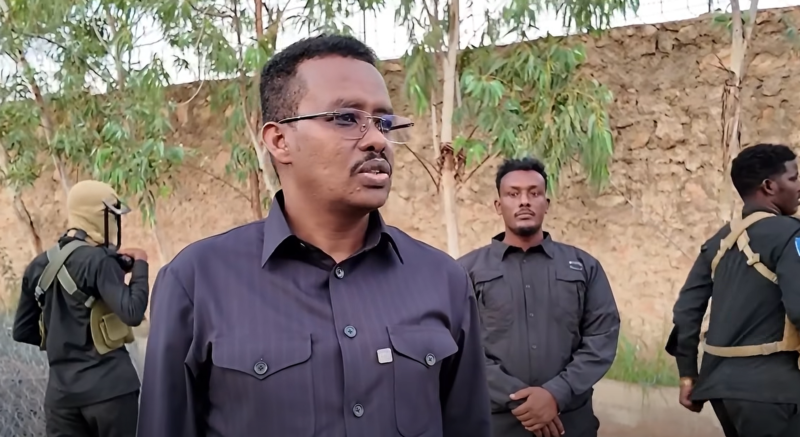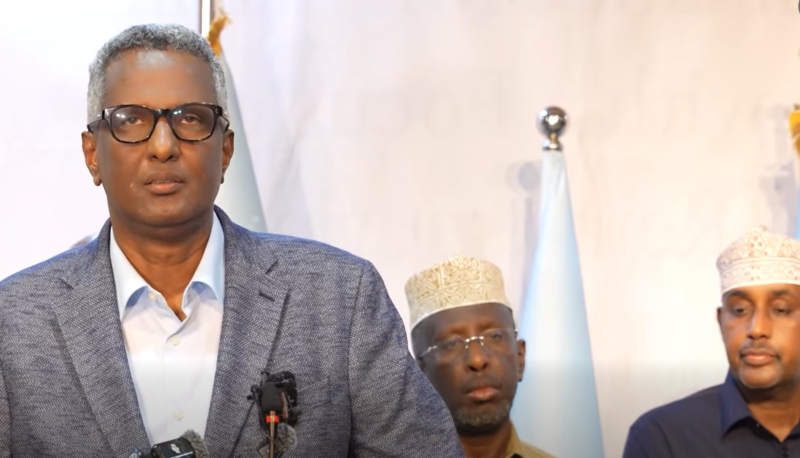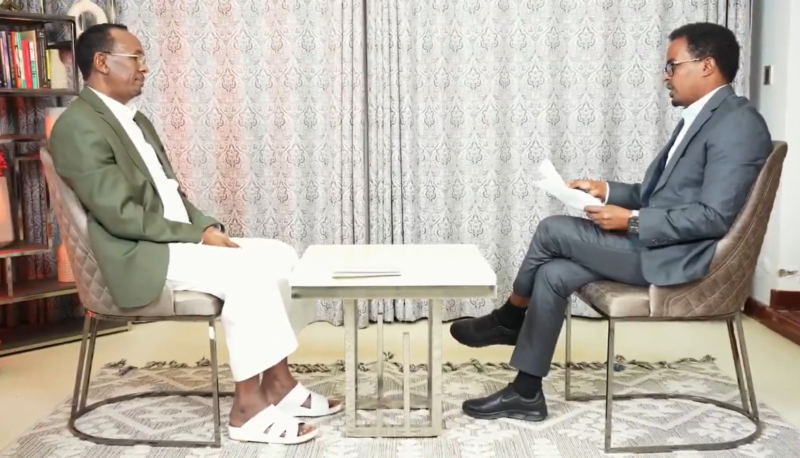
MOGADISHU, Former National Intelligence and Security Agency (NISA) Director Abdullahi Mohamed Ali Sanbaloolshe has claimed that while in the United Arab Emirates, he personally met and held talks with Somaliland President Abdirahman Mohamed Abdullahi “Cirro,” Puntland President Said Abdullahi Deni, Jubaland leader Ahmed Mohamed Islam “Madobe,” and other UAE-linked figures.
Sanbaloolshe alleged that the meetings focused on forming a front aimed at removing Somali President Hassan Sheikh Mohamud from power. According to the former intelligence chief, he discussed with Cirro and Deni how to unite and fight together against Hassan Sheikh’s administration, and he stated that they will become rebels against the federal government. He also indicated that this new alliance could seek support from Ethiopia to achieve its objectives. The claim, which forms part of a Geylan Media interview with Sanbaloolshe that has not yet aired, is circulating on social media and has not been independently verified.
The allegation comes amid a broader escalation of accusations from Mogadishu against Abu Dhabi. Somalia’s federal government has accused the UAE of establishing a group in Somalia similar to Sudan’s Rapid Support Forces (RSF), although it has not publicly presented evidence to substantiate the claim.
The Abu Dhabi Meetings
Sanbaloolshe’s account aligns with earlier reporting that several prominent figures opposed to President Hassan Sheikh Mohamud were in Abu Dhabi for talks. As reported in FTL Somalia’s coverage of the Abu Dhabi meetings, Defence Minister Ahmed Moallim Fiqi accused opposition politicians of meeting with representatives linked to Sudan’s Rapid Support Forces in the Emirati capital, claiming the gatherings were part of a plot against Somali statehood.
Among those reportedly involved were former President Sharif Sheikh Ahmed, Puntland President Said Abdullahi Deni, Jubaland President Ahmed Mohamed Islam (Madobe), Sanbaloolshe himself, and other senior political figures. The meetings were reportedly focused on Somalia’s political situation, the future of the federal government, and disagreements over the electoral process. Some reports claimed discussions included possible strategies to pressure Hassan Sheikh’s administration to leave office, though there has been no independent confirmation of any formal agreement or plan to remove the president.
Fiqi said the politicians were learning methods of organizing militias and warfare from the RSF, describing the Sudanese paramilitary group as a force hired to destroy Sudan. He warned that the politicians would return with plans to undermine Somalia’s statehood, attempting to mobilise militias and revive warlord-style politics.
Sharif Sheikh Ahmed has denied the accusations, stating that his recent visit to the UAE was for family reasons. He accused the federal government of using political differences to justify security operations against the opposition and called for disputes to be resolved through dialogue.
The RSF Allegation and Its Limits
The government’s claim that the UAE is establishing an RSF-like group in Somalia is the most serious accusation in the current dispute. The RSF is the Sudanese paramilitary force that has been accused of widespread atrocities in Sudan’s civil war. Equating Somali opposition activity to the RSF is a rhetorical escalation that carries significant weight.
But the evidence for this claim has not been made public. Fiqi has not presented documentation showing that Somali opposition figures met with RSF representatives or that they are planning militia mobilisation. As FTL Somalia noted in its analysis of the earlier accusations, “the critical issue is the absence of publicly available evidence to support these claims.” The UN report on RSF supply routes through Bosaso provides documented evidence of a logistics network operating through Somali territory, but it does not conclude that Puntland or federal authorities knowingly participated, nor does it connect Somali opposition politicians to that network.
Other reports have claimed that the UAE has transferred troops from Somaliland and Puntland for advanced military training conducted by Israeli officers, including in the use of drones and counter-drone defense systems. These reports have not been independently verified.
The Ethiopian Dimension
Sanbaloolshe’s claim that the new alliance could seek support from Ethiopia adds another layer of complexity to an already volatile regional situation. Ethiopia has its own unresolved dispute with the federal government over sea access, and its relations with Mogadishu have been strained since the January 2024 Memorandum of Understanding with Somaliland.
Ethiopia has historically maintained relationships with Somali regional administrations, including Puntland and Jubaland, and has trained and equipped regional forces in the past. But seeking Ethiopian support for a rebellion against the federal government would be a dramatic escalation, one that could reignite the regional proxy conflicts that have destabilized Somalia for decades.
The federal government has not publicly responded to Sanbaloolshe’s claim about Ethiopian support, but it is likely to view it as further evidence of a foreign-backed conspiracy against Somali statehood.
Sanbaloolshe: A Contested Figure
Sanbaloolshe’s credibility as an accuser is complicated by his own political trajectory. Until recently, he was one of President Hassan Sheikh’s most visible loyalists and a key emissary for the administration’s political agenda, including sensitive negotiations with Jubaland’s Madobe. His abrupt turn against the president has been described by analysts as consistent with a pattern of shifting alliances rather than a rupture of principle.
His political base is in Hiiraan and the Hawadle clan network, and he has deep relationships with both Ethiopia and the UAE built over more than a decade of intelligence cooperation. When Hassan Sheikh severed agreements with the UAE, it was Sanbaloolshe, an MP with no formal portfolio, who was reportedly dispatched to Abu Dhabi to manage the fallout.
His claims about the Abu Dhabi meetings should therefore be read with the skepticism that any unverified allegation from a political actor deserves. But the architecture of an anti-Hassan Sheikh front is real, and Sanbaloolshe’s relationships with Deni, Madobe, and Cirro are documented.
The Broader Political Context
The accusations unfold against a backdrop of profound political crisis. Somalia has been embroiled in instability since May 2026, when President Hassan Sheikh’s original four-year term expired. Parliament passed constitutional amendments in March extending presidential terms to five years, keeping him in office until May 2027. The opposition alliance, including the leadership of Puntland and Jubaland, rejected the extension and has refused to recognize his authority.
The opposition has also rejected the electoral commission’s unilateral announcement that parliamentary and presidential polls would take place in April and May 2027. The political crisis has sparked fierce clashes in Mogadishu and Baidoa, with reports of government forces using drones and fighter jets against opposition-aligned fighters.
Turkey and the UAE are the two most important external actors in this crisis. Turkey is seen as backing the federal government, while the UAE has maintained direct relations with Somaliland, Puntland, and Jubaland, with Emirati firms holding significant interests in port operations. Somalia annulled its defence and security cooperation agreements with the UAE in January 2026, accusing Abu Dhabi of undermining Somali sovereignty.
Critical Note
Sanbaloolshe’s claim is significant because of who he is. A former NISA director is not a marginal figure, and his allegation that he personally met with Deni, Madobe, and Cirro in the UAE carries more weight than anonymous reports. His assertion that he discussed uniting with Cirro and Deni to fight against Hassan Sheikh, that they will become rebels, and that they could seek Ethiopian support, is a direct threat to the federal government’s authority. But it remains an allegation, delivered through an unaired interview, without documentary evidence or independent corroboration.
The federal government’s broader accusation that the UAE is building an RSF-style force in Somalia is a grave charge. If true, it would represent a direct threat to Somali sovereignty and a dangerous escalation of the regional proxy competition. But the government has not presented the evidence to support it. Fiqi’s statements have been rhetorical and repetitive, linking opposition activity to foreign actors without demonstrating the connection. The UN report on RSF logistics through Bosaso is real, but it does not implicate the politicians the government is accusing.
The danger in this dynamic is not that the accusations are necessarily false. It is that they are being deployed as political weapons in a crisis where the government’s own legitimacy is contested. By framing the opposition as foreign-backed militia organisers, the government delegitimises political dissent and justifies security operations against its opponents. Sanbaloolshe’s own claim that he and his allies will become rebels and seek Ethiopian support is a gift to that narrative. Whether it reflects a genuine plan or a rhetorical escalation, it narrows the space for the dialogue that Somalia desperately needs. If the government has evidence of RSF coordination or UAE-backed militia mobilisation, it should present it through the proper channels. If it does not, the accusations risk becoming a self-fulfilling prophecy, driving the opposition further toward external patrons and deepening the very fragmentation the government claims to oppose.
Recommended Reading On ftlsomalia.com
- Fiqi Links Opposition Meetings in Abu Dhabi to RSF, Warns of Militia Mobilisation
- Former Puntland President Faroole: No Legitimate Government in Mogadishu
- Puntland Condemns Airstrikes as Turkey Denies Involvement
- Eritrea-Ethiopia Standoff Escalates as Somalia Watches Its Regional Partners Confront Each Other