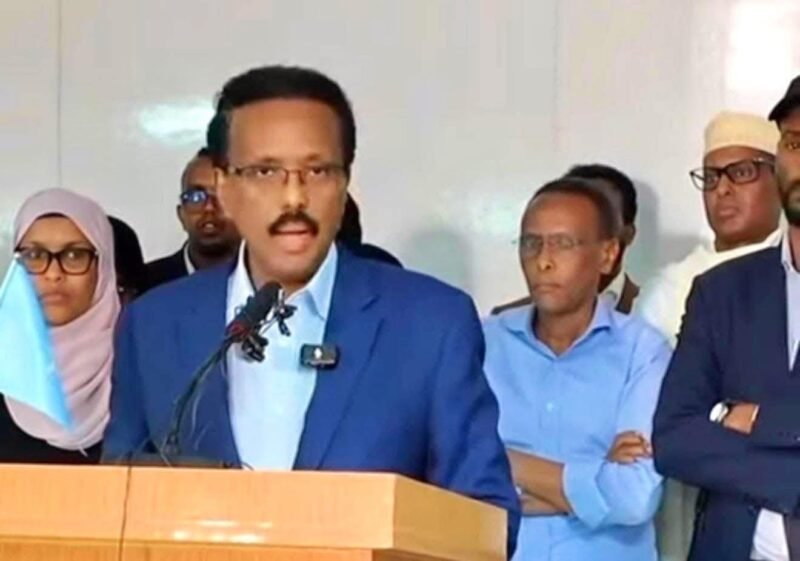
MOGADISHU — Former President Mohamed Abdullahi Farmaajo has issued an open letter to President Hassan Sheikh Mohamud warning that Somalia faces a political crisis that could lead to state collapse, and calling for inclusive elections and a national dialogue based on genuine compromise.
The letter, dated September 24, 2026, was addressed to President Mohamud while he was attending the United Nations General Assembly in New York. Farmaajo, who served as Somalia’s ninth president and now leads the Nabad iyo Nolol (N&N) party, framed the letter as a citizen’s appeal at a critical moment for the country.
Warnings of State Collapse
Farmaajo cited recent letters from Puntland and the Mustaqbal Institute to the UN Secretary-General and Security Council as evidence of the severity of Somalia’s political divisions. He described those letters as “grave warnings” that illustrate the level of conflict and division that has emerged among the Somali people during the four-year mandate.
He identified four pillars that had previously sustained Somalia’s unity: full implementation and protection of a consensual constitution, completion of the agreed federal system, timely and inclusive elections, and dialogue, compromise and political agreement as the path to resolution.
According to Farmaajo, all four pillars have now been undermined. He stated that Somalia currently has two constitutions, a weakened federal system, stalled talks with Somaliland, and federal member states that are on the verge of seceding. There is still no agreed electoral framework, which he said has placed the country in a political crisis that could lead to disintegration.
“The only way Somalia has historically resolved its political problems is through dialogue and inclusive politics,” Farmaajo wrote. “Abandoning the negotiation process based on compromise and inclusive politics shows that the political situation is worsening and could produce outcomes that are not good for the country, and will not place your presidential legacy in a good position in history.”
The Four Recommendations
Farmaajo called on President Mohamud to take four steps:
First, to lead a national dialogue based on genuine compromise to overcome the current impasse, and to prevent foreign interference and decisions imposed on Somalia from outside. This echoes concerns that have been raised by opposition and regional actors, including the Somali Future Council’s call for international mediation.
Second, to reach a political agreement on elections as the basis for continuing a legitimate government and holding agreed elections that remove the country from uncertainty.
Third, to ensure that inclusive elections are held within a short timeframe, and to resolve the current crisis in which institutions with expired mandates remain in office, which he described as a threat to the nation’s existence and statehood.
Fourth, he called on President Mohamud to fulfill his constitutional duty to protect the unity and cohesion of the country.
Context: Expired Mandates and Regional Fractures
Farmaajo’s letter comes as Somalia’s federal institutions operate with expired mandates. The Federal Parliament’s term ended in April 2026 and President Mohamud’s mandate expired in May 2026, but no national elections have been held or scheduled.
Puntland’s September 13 letter to the UN Security Council called for a transitional roadmap and warned that the region might permanently sever ties with Mogadishu. The Somali Future Council, an opposition coalition that includes the presidents of Puntland and Jubaland, has made parallel appeals to the UN for an international mediator and guarantor.
Farmaajo’s letter adds a former head of state’s voice to that pressure campaign. It is notable that Farmaajo, who was defeated by Mohamud in the 2022 election, has chosen to frame his critique in constitutional terms rather than partisan ones, emphasizing expired mandates, the absence of an electoral framework, and the risk of state collapse.
Critical Note
Farmaajo’s open letter is a significant intervention, but its substance must be weighed against his own record. During his presidency from 2017 to 2022, Farmaajo himself was accused of centralizing power, delaying elections, and undermining federal member states. His extension of the federal parliament’s mandate in 2021, which he later reversed under pressure, contributed to the political crisis that his successor inherited.
That does not invalidate the concerns he raises. Somalia’s institutions are operating without a constitutional mandate, the federal system is fracturing, and there is no agreed path to elections. These are real problems that require real solutions. But Farmaajo’s framing of the crisis as primarily the result of Mohamud’s failures is incomplete. The political dysfunction he describes has deep roots, and his own tenure contributed to it.
The letter’s most useful function may be to add weight to the argument that national dialogue and an agreed electoral framework are urgently needed. The alternative, as Farmaajo notes, is the risk of parallel administrations, further fragmentation, and the possibility that federal member states will pursue independence. His call for a short timeframe for inclusive elections is consistent with demands from Puntland, Jubaland, and the Somali Future Council. Whether President Mohamud heeds that call is another question.