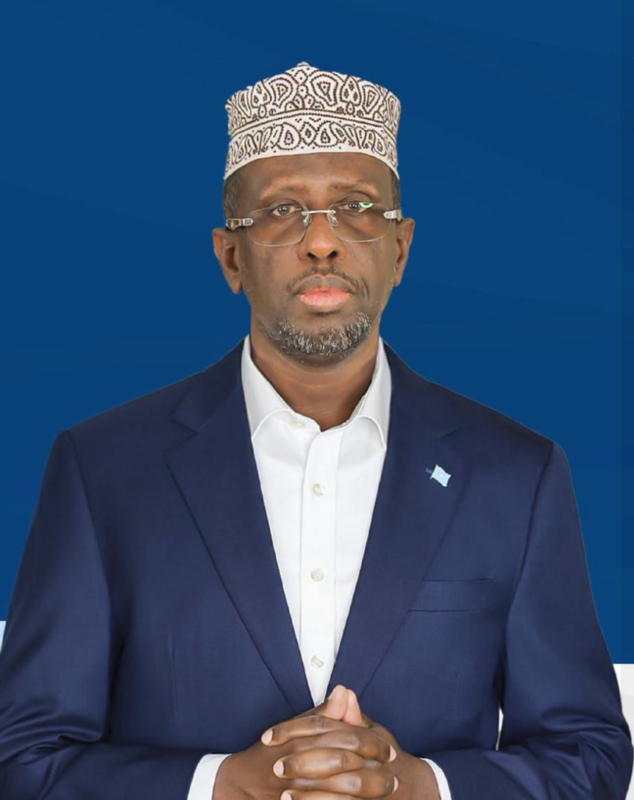
MOGADISHU — Former President Sharif Sheikh Ahmed has condemned the federal election timetable announced by the National Independent Electoral and Boundaries Commission (NIEBC), warning that the unilateral move risks creating parallel elections, political instability, and civil unrest that threaten the existence of the Somali state.
In a formal statement released today (Thursday), Sharif Sheikh Ahmed said he filed a petition with the Supreme Court on 11 October 2026 seeking to challenge the constitutional amendments that underpin the electoral process. The Supreme Court admitted the petition on 12 October.
“The amendment of the Constitution has a set of procedures as outlined in chapter 15 of Somalia’s Provisional Federal Constitution, while also respecting the independence of the existing Constitutional bodies that includes the Oversight Committee for the Review and Implementation of the Provisional Constitution and the Independent Constitutional Review and Implementation Commission,” Sharif said. “Therefore, I reiterate that, in the recent amendment of the Constitution, the correct procedures were not followed. Bypassing the set out procedures makes the resulting amendments null and void.”
He accused President Hassan Sheikh Mohamud of clinging to power beyond his legal mandate and placed responsibility for the impending crisis squarely on the president. “I wish to inform the Somali people that the responsibility for this impending crisis rests with Hassan Sheikh Mohamud who is in Villa Somalia beyond his legal mandate,” he said.
Call for Supreme Court Ruling and National Dialogue
Sharif called on the Supreme Court to independently and impartially hear the constitutional petition and deliver a ruling that protects the supremacy of the constitution and the unity of the nation.
He also urged political stakeholders to engage in genuine dialogue that results in national consensus and a transparent election. “The future of Somalia cannot be decided by a single individual or a political faction, but can only be secured through the Supremacy of the Constitution, consensus and inclusive elections,” he said.
Sharif further called on the international community to support efforts intended to resolve the political deadlock and avert the threat of insecurity and instability for Somalia and the wider region.
The NIEBC Timetable and Opposition Rejection
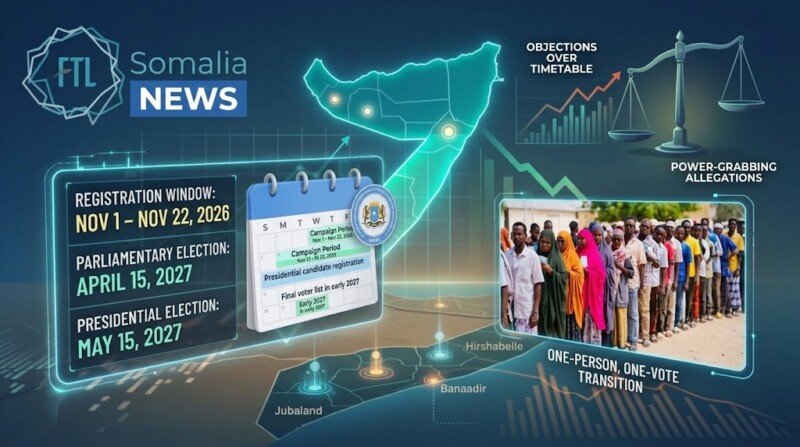
The NIEBC announced the election timetable on Wednesday, setting parliamentary elections for 15 April 2027 and the presidential vote for 15 May 2027. Registration of political parties and voters will reopen from 1 to 22 November 2026, with candidate lists due by 22 November. The provisional voter list will be published on 21 January 2027, and campaigning will begin on 27 February 2027. As reported in FTL Somalia’s coverage of the election timetable, the announcement marks the first time the electoral body has formally scheduled federal elections under the amended constitution.
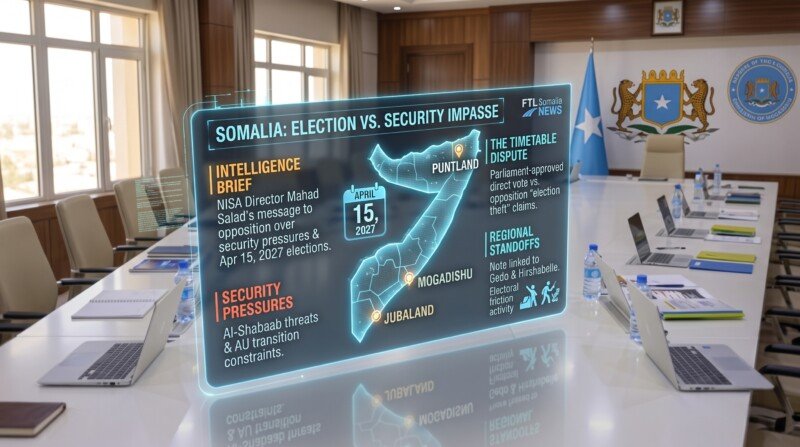
The announcement was immediately rejected by the Somali Salvation Forum (Madasha Samatabixinta), the opposition alliance that includes Puntland, Jubaland, and several former presidents and prime ministers. Mohamed Adan Jimcaale (Koofi), the Forum’s secretary, accused the government of “election theft” and “power-grabbing.” As reported in FTL Somalia’s coverage of the opposition’s rejection, Koofi said forty years later, Hassan Sheikh wants to prescribe the same disease as a cure, and it will not happen.
The Galmudug Precedent and Credibility Concerns
The NIEBC’s credibility has been questioned following the Supreme Court’s annulment of the Galmudug elections in August 2026. The court found that the July 30 vote had not been administered in accordance with constitutional and electoral requirements for free, fair and impartial elections. As reported in FTL Somalia’s coverage of the Supreme Court ruling, the court ordered a rerun, which was held on 30 September 2026.
However, the NIEBC subsequently excluded Towfiiq from the list of organizations cleared to contest the rerun, despite the party having successfully challenged the previous election in court. Former Chairperson Halima Ismail Ibrahim has warned that Somalia should not proceed with any national election unless three critical conditions are met: a political agreement on the election model, a mutually agreed electoral commission, and legally recognized competing political parties.
Parallel Elections and Limited Federal Reach
The opposition has repeatedly threatened to organize parallel elections and form a rival administration if the government proceeds without a negotiated agreement. The Somali Salvation Forum has accused President Mohamud’s administration of unilateral decision-making and failing to build consensus. As reported in FTL Somalia’s coverage of the opposition’s threat, opposition leaders warned of a potential constitutional vacuum if the political deadlock persisted.
Puntland and Jubaland have both rejected the constitutional amendments and the electoral framework. Puntland has signaled that it may proceed with independent regional elections if no national agreement is reached, announcing in February 2026 that it could conduct elections under its own constitutional framework to prevent a governance vacuum.
The federal government’s ability to organize elections in Puntland and Jubaland is severely constrained. Both states have declined to participate in negotiations mediated by Turkey, questioning Ankara’s neutrality. This means that the NIEBC’s timetable applies, in practice, only to areas under federal government control. If Puntland and Jubaland proceed with their own electoral processes, Somalia could face two parallel electoral tracks, one administered by the NIEBC in federally controlled areas and another organized by opposition-controlled states.
Critical Note
Sharif Sheikh Ahmed’s intervention is significant because it comes from a former head of state who has consistently advocated for dialogue and consensus. His decision to file a constitutional petition with the Supreme Court adds a legal dimension to the political dispute, challenging the very foundation of the electoral framework that the NIEBC timetable is built upon.
His warning about parallel elections is not merely rhetorical; it reflects a real possibility given the opposition’s rejection of the NIEBC timetable and the federal government’s limited reach in Puntland and Jubaland. The government’s decision to proceed with the timetable despite the lack of a negotiated agreement risks deepening the divisions it claims to be addressing.
The Galmudug precedent, where the Supreme Court annulled an election administered by the NIEBC and the commission then excluded the party that brought the successful challenge, has raised serious questions about the commission’s impartiality. For Somalia, the 2027 elections represent both an opportunity and a risk. If held credibly and with broad participation, they could mark a historic transition to direct democratic governance. If held amid political division, contested legitimacy, and a compromised electoral commission, they could deepen the divisions they are meant to resolve. Sharif’s call for renewed dialogue and an inclusive process is a reminder that elections cannot be imposed; they must be agreed upon.
Share your story. FTL Somalia is continuing to investigate Somalia’s electoral process. If you have information or insights to share, contact us at info@ftlsomalia.com. Your identity will be protected.
Recommended Reading On ftlsomalia.com
- Somalia’s Electoral Commission Announces Timetable for Parliamentary and Presidential Elections in 2027
- Somalia’s Opposition Accuses Government of ‘Election Theft’ After NIEBC Announces 2027 Timetable
- Galmudug Election Finalized as Supreme Court Certifies Rerun Results
- Somalia President Agrees to Opposition Talks to Avoid Parallel Elections