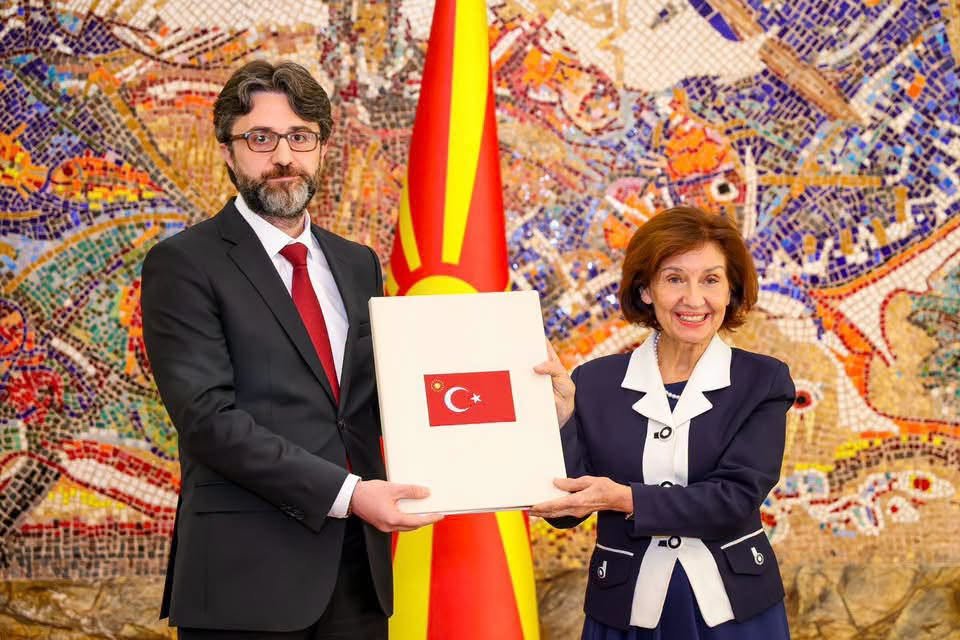
MOGADISHU — Alper Aktaş, who served as Türkiye’s Ambassador to Somalia until September 2026, presented his credentials to North Macedonian President Gordana Siljanovska Davkova on October 6, formally beginning his new assignment in Skopje.
The credential ceremony in North Macedonia’s capital marks the formal conclusion of Aktaş’s diplomatic tenure in Mogadishu, where he served for more than two and a half years during a period of deepening Türkiye-Somalia cooperation across security, energy, and development sectors.
Farewell in Mogadishu
Aktaş’s departure from Somalia was marked by a farewell reception hosted by House of the People Speaker Abdulkadir Mohamed Nur (Jamac) in Mogadishu on September 11, attended by cabinet ministers, lawmakers, diplomats, and Somali alumni who studied in Türkiye.
At the event, Aktaş said he was honored to have served in Somalia and described relations between the two countries as having reached an “exceptional level.” He highlighted cooperation across security, economy, education, healthcare, and infrastructure development.
Prime Minister Hamza Abdi Barre also held a farewell meeting with Aktaş, thanking him for his role in strengthening bilateral ties and describing Türkiye as a “close friend and brotherly country to Somalia.”
Achievements During Somalia Tenure
During his tenure in Mogadishu, Aktaş oversaw a significant expansion of Türkiye’s engagement with Somalia. In April 2026, the Çağrı Bey ultra-deepwater drillship arrived in Mogadishu to begin Türkiye’s first overseas deep-sea drilling operation at the Curad-1 well off the Somali coast, as detailed in FTL Somalia’s coverage of the vessel’s arrival. Aktaş described the project as part of a broader partnership linking security gains to economic development.
The drilling operation progressed ahead of schedule, as reported in FTL Somalia’s coverage of the drilling milestone, with the Somali Petroleum Authority confirming that operations had reached significant depth by late August. The well site itself was selected following seismic surveys conducted by the Turkish vessel Oruç Reis, which collected 3D data across 4,464 square kilometers, as detailed in FTL Somalia’s coverage of the seismic mission.
He also highlighted Türkiye’s training of Somali security forces, including the Gorgor special forces and Haramcad police units, with more than 1,000 personnel trained. Türkiye increased its air assets in Somalia at the request of Somali authorities to support counterterrorism operations.
In May 2026, Aktaş met with Somali President Hassan Sheikh Mohamud at Villa Somalia to discuss the strategic partnership between the two countries and regional developments. The broader trajectory of the relationship was underscored by the Istanbul meeting between President Mohamud and President Recep Tayyip Erdoğan, as reported in FTL Somalia’s coverage of the strategic meeting, which reinforced Ankara’s position as Somalia’s closest external partner.
New Ambassador in Mogadishu
Aktaş’s successor, Ferhat Alkan, presented his credentials to President Mohamud in Mogadishu on October 1, 2026. Alkan began his tenure with a meeting with Somali youth, including alumni who studied in Türkiye, and said the two countries’ primary goal is to strengthen relations between their “friendly and brotherly peoples.”
Alkan’s appointment coincides with the 60th anniversary of Türkiye-Somalia diplomatic relations and the 15th anniversary of President Recep Tayyip Erdoğan’s historic 2011 visit to Mogadishu.
Critical Note
Alper Aktaş’s reassignment to North Macedonia is a routine diplomatic rotation, but it marks the end of a consequential chapter in Türkiye-Somalia relations. During his tenure, Ankara’s engagement with Mogadishu expanded from security cooperation and development assistance into energy exploration, satellite plans, and deeper economic integration.
The transition to Ferhat Alkan comes at a delicate moment. The Çağrı Bey drilling operation is ongoing, with results yet to be announced. Türkiye’s mediation role in Somalia’s political disputes, which Aktaş pursued through meetings with opposition figures including former President Mohamed Abdullahi Farmaajo, remains a sensitive issue. Whether Alkan can sustain the momentum of his predecessor’s engagement while navigating Somalia’s fragmented political landscape will be a key test of his tenure.
For Somalia, the continuity of Turkish support is significant. Türkiye remains Somalia’s most visible external partner, with a military base in Mogadishu, a growing naval presence off its coast, and a flagship energy project in its waters. But the relationship carries risks. If the Curad-1 well comes up dry, or if Somalia’s political crisis deepens despite Turkish mediation, the partnership will face questions it has not yet had to answer. The departure of a seasoned ambassador and the arrival of a new one is a natural moment to take stock of what the relationship has delivered, and what remains unproven.
Recommended Reading On ftlsomalia.com
- Turkish Drillship Arrives in Mogadishu for Somalia’s First Offshore Oil Drilling
- Somali-Turkish Energy Partnership Reaches Milestone as Drilling Progresses Ahead of Schedule
- Turkey Completes 234-Day Seismic Mission in Somali Waters
- Hassan Sheikh Mohamud and Erdoğan Hold Strategic Meeting in Istanbul to Strengthen Somalia-Turkey Alliance