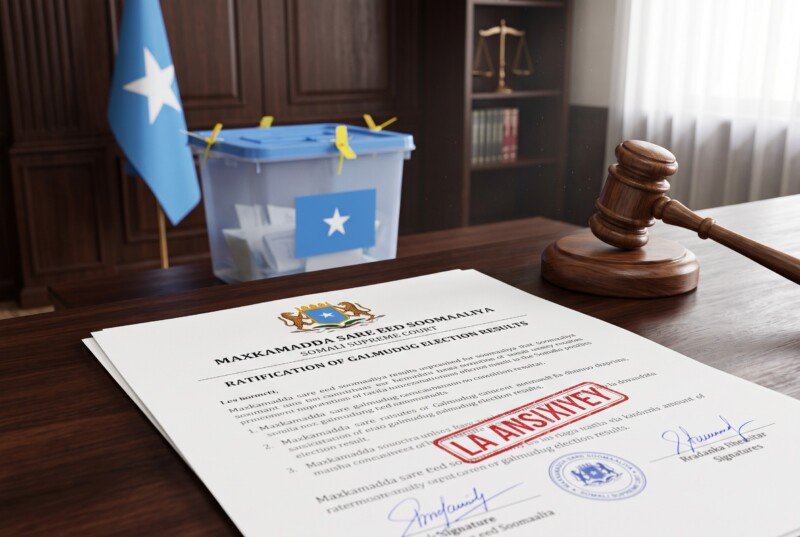
MOGADISHU — Somalia’s Supreme Court has officially ratified the results of the Galmudug parliamentary rerun election held on 30 September 2026, confirming the final allocation of all 89 seats in the Galmudug House of Representatives.
The ruling, issued on 13 October 2026 by a five-judge panel of the Supreme Court’s Election Division, brings to a close a contentious electoral process that began with the annulment of the July 30 vote and the exclusion of the party that had successfully challenged those results.
The Court’s Ruling
The court, composed of Judge Abdiasis Mohamed Yusuf (Chairman), Dr. Abuubakar Ahmed Ali, Dr. Abdulqafar Hussein Isaaq, Mohamed Omar Ahmed, and Haidar Barqash Abiikar, convened on 12 October 2026 to consider a request from the National Independent Electoral and Boundaries Commission (NIEBC) to ratify the rerun election results.
In its decision, the court found that no complaints meeting the requirements of Article 73 of Law No. 28 of 23 November 2024, Somalia’s National Elections Law, had been filed against the results. The court also cited Article 7(1)(f) of the National Elections Law, which provides that the NIEBC shall provisionally announce election results, with the Supreme Court holding the authority for final ratification.
This was the second time the Supreme Court intervened in the Galmudug electoral process. As reported in FTL Somalia’s coverage of the court’s August ruling, the Supreme Court annulled the July 30 election results on 24 August 2026, citing irregularities that violated constitutional principles requiring free, fair and impartial elections.
Key Electoral Statistics
| Metric | Figure |
|---|---|
| Political organizations participating | 12 |
| Districts holding elections | 11 |
| Seats contested | 89 |
| Polling stations | 178 |
| Registered voters | 267,420 |
| Votes cast | 149,475 |
| Valid votes | 146,374 (97.93%) |
| Invalid votes | 3,101 (2.07%) |
The rerun was scheduled after the Supreme Court’s August ruling. As reported in FTL Somalia’s coverage of the NIEBC’s response, the commission formally accepted the ruling and announced it would reschedule the elections.
Final Seat Allocation
| Political Organization | Votes | Vote Share | Seats | Seat Share |
|---|---|---|---|---|
| Cadaaladda iyo Wadajirka (Justice and Unity) | 110,072 | 75.20% | 67 | 75.28% |
| Sincad | 10,895 | 7.44% | 7 | 7.87% |
| Karaama | 10,309 | 7.04% | 6 | 6.74% |
| Madalsan | 4,025 | 2.75% | 2 | 2.25% |
| Ramaas | 3,044 | 2.08% | 2 | 2.25% |
| Dimuqraadiga Soomaaliyeed | 2,283 | 1.56% | 1 | 1.12% |
| Dhalinyarada Talo Qaran | 2,043 | 1.40% | 1 | 1.12% |
| Cadaaladda iyo Midnimada Tiir | 1,085 | 0.74% | 1 | 1.12% |
| Saab | 880 | 0.60% | 1 | 1.12% |
| Muwaadiniinta Soomaaliyeed | 842 | 0.58% | 1 | 1.12% |
| Dan-shacab | 738 | 0.50% | 0 | 0.00% |
| Dadka Soomaaliyeed | 158 | 0.11% | 0 | 0.00% |
| Total | 146,374 | 100.00% | 89 | 100.00% |
The ruling party Cadaaladda iyo Wadajirka secured an overwhelming majority with 67 of the 89 seats, consolidating its dominance in the Galmudug political landscape.
The Towfiiq Exclusion Controversy
The most significant controversy surrounding the rerun was the exclusion of the Towfiiq Party, which had successfully challenged the July 30 election in court. As reported in FTL Somalia’s coverage of the exclusion, the NIEBC released the list of participating parties on 21 September 2026, and Towfiiq’s name was absent.
Towfiiq had participated in the annulled July 30 election, where it secured the second-largest number of votes. The party filed the petition that led the Supreme Court to invalidate the results. According to officials, the commission did not explain whether Towfiiq had failed to submit its candidates or had been excluded for failing to meet other requirements.
Towfiiq Chairman Sheikh Mohamed Shakir Ali Hassan accused the commission of manipulating the vote count and failing to reflect the will of voters. As reported in FTL Somalia’s coverage of Towfiiq’s rejection of the July results, the party had claimed that its representatives documented 53,054 votes in the parliamentary election, while the commission declared the party received only about 26,000 votes.
Federal Interference and Political Tensions
The electoral process was overshadowed by a deep political rift between President Hassan Sheikh Mohamud and NISA Director Mahad Mohamed Salad over who should lead Galmudug. As reported in FTL Somalia’s coverage of the political negotiations, the dispute became public when Salad decided to contest the presidency against the federal government’s preferred candidate, exposing deep fractures within the ruling party.
President Mohamud designated Liban Ahmed Hassan as the sole candidate for the ruling Justice and Solidarity Party (JSP), bypassing internal party competition and raising concerns about the independence of the electoral process. As detailed in FTL Somalia’s coverage of Hassan’s campaign, the candidate pledged to defeat Al-Shabaab within six months and heal clan divisions.
Galmudug President Ahmed Abdi Kariye (Qoor-Qoor) withdrew from the presidential race following talks with federal officials, clearing the way for the federal government’s preferred candidate. The elections in Galmudug were held simultaneously with elections in Hirshabelle. As reported in FTL Somalia’s coverage of the simultaneous elections, more than 420,000 voters cast ballots across 281 polling locations in 21 districts in both federal member states.
National Significance
The ratification of the Galmudug election results marks an important milestone in Somalia’s electoral transition. The rerun election was part of a broader process of direct elections at the federal member state level, a significant shift from the indirect clan-based model that has characterized Somali elections since 2012.
The Galmudug election was closely watched by federal authorities and international partners as a test of the country’s ability to conduct competitive, one-person-one-vote elections. The Supreme Court’s ratification provides legal finality to a process that had faced logistical challenges and political tensions.
The ruling comes amid heightened political tensions in Mogadishu, where the federal government is engaged in a standoff with opposition figures over the electoral framework and the constitutional mandate of current institutions. As reported in FTL Somalia’s coverage of the Marinayo 2.0 crisis, the broader dispute over the timing and modalities of the next federal elections remains unresolved.
Critical Note
The Supreme Court’s ratification of the Galmudug election results is a procedural milestone, but its significance extends beyond Galmudug. For the first time in Somalia’s post-2012 electoral history, a federal member state election has been conducted under a direct voting model, provisionally announced by the electoral commission, challenged in court, annulled, rerun, and formally ratified by the highest court.
This is a positive development. It demonstrates that Somalia’s electoral institutions can conduct competitive elections and that the judiciary can play its constitutionally mandated role in certifying results. The absence of legal challenges meeting the threshold for review suggests that the process, whatever its imperfections, was accepted by the competing political organizations.
However, the result also raises questions. The overwhelming majority secured by a single party, Cadaaladda iyo Wadajirka with 67 of 89 seats, reflects a political landscape in which genuine competition remains limited. In a state where clan dynamics, federal-state relations and access to resources shape political outcomes, the dominance of one party may reflect structural advantages rather than a robust multiparty democracy.
More importantly, the exclusion of the Towfiiq Party from the rerun it helped to bring about remains a stain on the process. The party that successfully challenged the previous election in court was removed from the corrected ballot. The NIEBC has not provided a detailed public explanation for this decision, leaving the impression that it was political rather than procedural.
The Galmudug election has taken place against the backdrop of a national political crisis. The same week that the Supreme Court ratified the Galmudug results, the government was maintaining a security siege around the residence of former President Sharif Sheikh Ahmed and imposing financial sanctions on political opponents. The contrast between the orderly conclusion of Galmudug’s electoral process and the violent confrontation in Mogadishu underscores the uneven nature of Somalia’s political transition.
Share your story. FTL Somalia is continuing to investigate Somalia’s electoral process and the role of the judiciary in ratifying election results. If you have information or insights to share, contact us at info@ftlsomalia.com. Your identity will be protected.
Recommended Reading On ftlsomalia.com
- Supreme Court Overturns Galmudug Election Results
- Towfiiq Party Barred from Galmudug Rerun Despite Having Successfully Challenged Earlier Results
- NIEBC to Reschedule Galmudug Elections After Supreme Court Overturns Results
- Galmudug Delegation Returns to Mogadishu Amid Election Deal Talks
- Galmudug Candidate Pledges to Defeat Al-Shabaab and Heal Divisions in Six Months
- Over 420,000 Voters Cast Ballots in Galmudug and Hirshabelle as Counting Begins