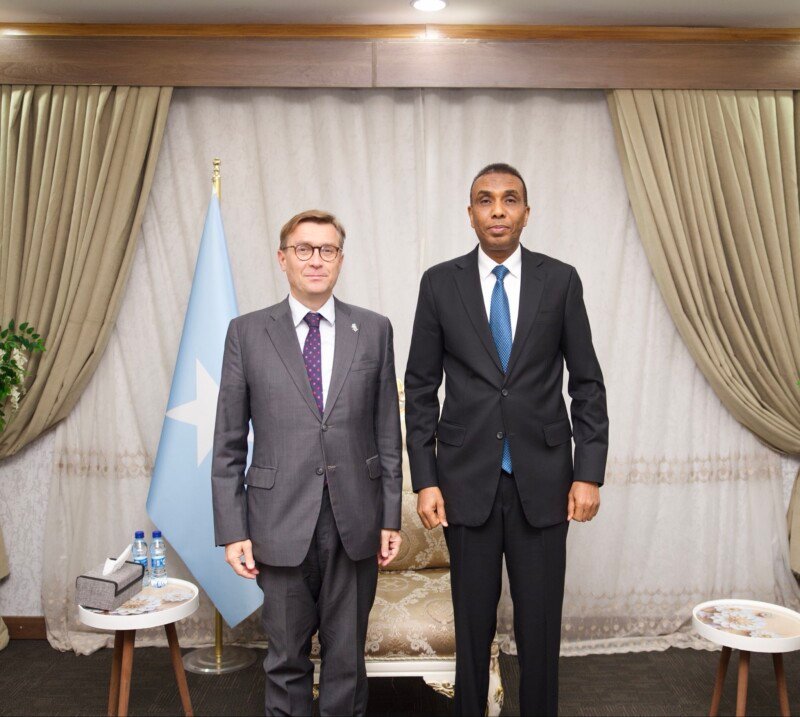
MOGADISHU, Prime Minister Hamza Abdi Barre met with the newly appointed European Union Ambassador to Somalia, László Eduárd Máthé, on Sunday to discuss strengthening cooperation between Mogadishu and Brussels.
In a statement posted on X, Barre said the two discussed “strengthening the relationship and cooperation between Somalia and the European Union.” He thanked the EU for its “continued support standing alongside our country, particularly in the areas of state-building, security, economic development and social services.”
A Seasoned Diplomat Takes the Helm
Máthé, a Hungarian diplomat and historian, assumed his role as EU Ambassador to Somalia in September 2026. He previously served as Hungary’s Special Envoy for the Sahel since May 2023, and has held postings as Consul General in Lendava, Slovenia, Ambassador to Kenya with accreditation to Somalia, and Deputy Head of Mission in both Slovenia and Lithuania.
Máthé presented his credentials to Deputy Foreign Minister Hassan Mohamed Ali in September, as reported in FTL Somalia’s coverage of the credentials presentation. The Deputy Minister thanked the EU for its support of Somalia’s sovereignty, unity and territorial integrity.
The EU’s Extensive Footprint in Somalia
The European Union is one of Somalia’s largest partners, with engagement spanning security, governance, development, and humanitarian assistance. The bloc approved a €75 million contribution to AUSSOM in April 2026, maintaining its position as the largest financial supporter of the AU-led mission, bringing total EU support to successive missions over two decades to nearly €2.8 billion, as reported in FTL Somalia’s coverage of EU security support.
The EU also supports the training and professionalisation of Somali security forces through EUTM Somalia, now in its ninth mandate, and maritime security and policing through EUCAP Somalia. Máthé visited EUTM headquarters in September, where he reaffirmed the EU’s commitment to strengthening cooperation with Somalia on security and institutional development.
On the political front, the EU has been closely engaged with Somalia’s constitutional review and electoral transition. In May 2026, Justice Minister Hassan Moallim Mahmoud met with EU ambassadors to discuss the completion of the provisional constitution and the government’s push toward a one-person, one-vote system, as reported in FTL Somalia’s coverage of the constitutional talks. The EU has allocated over €10 million in budget support tied to progress in key reform areas.
Máthé also attended the Swedish-Somali business forum in Mogadishu in October, signaling the EU’s interest in Somalia’s economic potential in agriculture, trade, and digitalisation, as reported in FTL Somalia’s coverage of the forum.
Critical Note
The meeting between Prime Minister Barre and Ambassador Máthé is a routine diplomatic engagement, but it takes place at a moment of significant strain in Somalia’s relationship with its international partners. The EU has positioned itself as a steadfast supporter of the federal government, funding security missions, training programmes, and budget support tied to governance reforms. That support has not been unconditional. The EU’s Partnership Dialogue framework explicitly links continued engagement to progress on democratisation, rule of law, and inclusive political processes.
The timing of this meeting is notable. It comes days after the National Independent Electoral and Boundaries Commission unilaterally announced an election timetable that the opposition has rejected as “election theft,” and as the Supreme Court prepares to hear a constitutional challenge to the amendments that extended President Mohamud’s term. The EU has publicly called for an inclusive and peaceful process to achieve political agreement on the electoral agenda. Whether that call carries weight in Mogadishu, or whether it is received as one more expression of international concern that the government can acknowledge without acting upon, will become clear in the coming weeks.
The Prime Minister’s statement thanked the EU for its support in state-building and security. That support is real and substantial. But the more consequential question is whether the EU is willing to use its leverage to press for the kind of political consensus that its own statements describe as necessary. A partnership that funds security and governance while remaining silent on the erosion of electoral legitimacy is not a partnership that serves Somalia’s long-term stability. Ambassador Máthé inherits a relationship that is warm in rhetoric and increasingly tested in practice.
Recommended Reading On ftlsomalia.com
- EU Reaffirms Support for Somali Security Forces During Training Centre Visit
- EU and Somalia Advance Constitutional Reforms and Direct Elections
- EU Ambassador-Designate Presents Credentials to Somali Deputy Foreign Minister
- Swedish Embassy Highlights Somalia’s Potential in Agriculture, Trade, and Digitalisation at Mogadishu Forum
- EU Delegation Visits NCRI Return and Reintegration Centre in Mogadishu