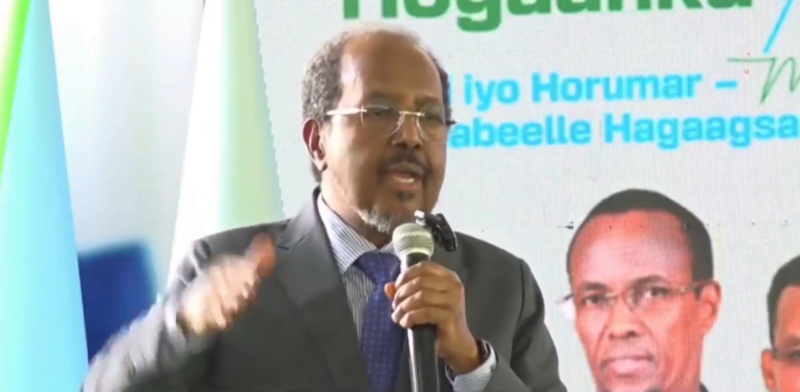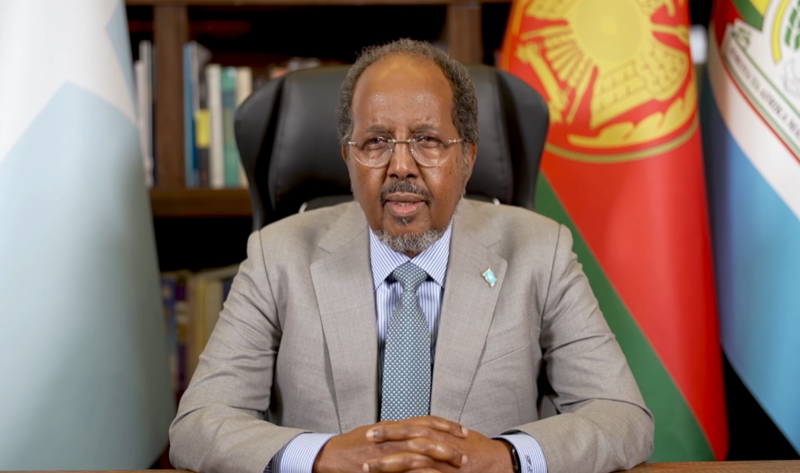
MOGADISHU, President Hassan Sheikh Mohamud delivered a national address, defending his government’s record on security, the electoral process, and political dialogue, while insisting that his administration remains open to negotiations to resolve the country’s divisions.
The president began by addressing the country’s democratisation process, stating that recent elections had been conducted peacefully and that the Somali people had participated in large numbers. He did not specifically mention specifics on the controversial elections in Galmudug and Hirshabelle, where his Justice and Solidarity Party won overwhelming majorities in parliaments that subsequently elected regional presidents.
On the political crisis, Mohamud emphasized that dialogue remains open. “Political dialogue is always open from our end,” he said. “Differences of opinion have a solution through dialogue.”
On security, the president said the war against Al-Shabaab, which he referred to as the Khawaarij, was progressing well. He claimed that the militant group had been removed from many areas and that peace and governance were now being felt in those regions.
A Speech at a Difficult Moment
The president’s address comes at a time of profound political tension. His original four-year term expired in May 2026, and the constitutional amendments passed in March extended his mandate to May 2027. The opposition Somali Future Council, which includes the leadership of Puntland and Jubaland, has rejected the extension and the federal government’s electoral timetable.
Puntland President Said Abdullahi Deni accused Mohamud just before the speech of refusing an agreed election and obstructing dialogue. Deni called on all Somali stakeholders to convene urgently to prevent further deterioration, warning that the country’s statehood was at risk.
The Puntland leader said his administration would not participate in a process it considers illegitimate. The opposition has also rejected the electoral commission’s unilateral announcement that parliamentary and presidential polls will take place in April and May 2027.
The speech also follows former NISA Director Abdullahi Mohamed Ali Sanbaloolshe’s claims that he met with Deni, Jubaland’s Madobe, and Somaliland’s Cirro in the UAE to discuss forming a front against the president, potentially with Ethiopian support. The federal government has separately accused the UAE of backing an RSF-style militia plot, though it has not presented public evidence.
The Security Claim Under Scrutiny
The president’s assertion that Al-Shabaab is on the back foot is a recurring theme of his administration’s messaging. The government has claimed that more than 55 percent of territory previously controlled by militant groups has been liberated, freeing at least 1.5 million people.
But analysts caution that territorial gains do not necessarily translate into durable security. Al-Shabaab has demonstrated a continued ability to conduct complex attacks in Mogadishu and other cities, and to regroup in rural areas when military pressure eases. The group has also exploited political divisions between the federal government and regional states, using the crisis in South West State and the rift with Puntland and Jubaland to expand its room for maneuver.
As reported in FTL Somalia’s coverage of Operation Banooda, the military has launched new offensives in the Bay and Bakool regions, but the long-term outcome of these operations remains uncertain.
Critical Note
The president’s speech was calibrated to project confidence and control. He spoke of progress on elections, security, and dialogue, presenting his government as effective and his opponents as either partners in waiting or irrelevant. But the speech did not address the specific grievances that have driven the political crisis: the exclusion of the opposition from the electoral process, the unresolved disputes over power-sharing in Hirshabelle and Galmudug, and the perception that the federal government is using state institutions to consolidate power.
The offer of dialogue is welcome, but it is not new. The president has repeatedly said that he is open to talks, while his government has proceeded with a unilateral electoral timetable and has accused its opponents of foreign-backed conspiracies. The opposition, for its part, has rejected the process and has threatened to form a parallel administration and establishing an armed rebel group. A dialogue that begins with the premise that one side’s process is legitimate and the other’s objections are illegitimate is not a dialogue. It is a demand for capitulation.
The security claims are similarly incomplete. Territorial gains are real, and the Danab Commandos and other units deserve credit for their effectiveness. But the government’s own political divisions are undermining the counterinsurgency effort. When federal forces are deployed to settle disputes with regional administrations, they are not fighting Al-Shabaab. They are fighting political opnonents. Until the political crisis is resolved, the military campaign will remain constrained by the very divisions the president’s speech sought to downplay.
Recommended Reading On ftlsomalia.com
- Deni Warns of National Crisis, Demands Urgent Talks as President Meets Puntland Elder
- Operation Banooda Launched as Somali Army Targets Al-Shabaab in South West State
- Former Puntland President Faroole: No Legitimate Government in Mogadishu
- Fiqi Links Opposition Meetings in Abu Dhabi to RSF, Warns of Militia Mobilisation