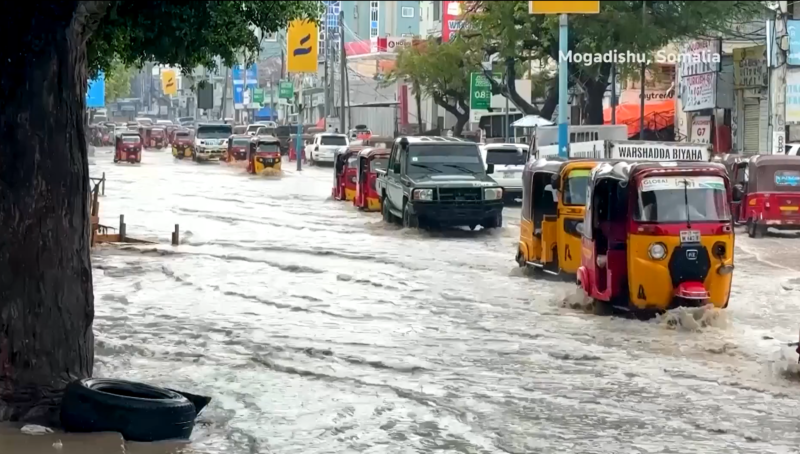
MOGADISHU — Heavy rains flooded roads across Mogadishu on Monday, disrupting schools, businesses and transportation as the capital experiences the onset of the Deyr rainy season under Super El Niño conditions.
Streets and major intersections were submerged, forcing public buses and private vehicles to stall and leaving pedestrians to wade through knee-high water. The flooding blocked one of Mogadishu’s main roads connecting to the KM4 junction and the airport route and Road 30.
Open-air markets in downtown areas were forced to close as water flooded stalls and damaged goods. Small vendors who rely on daily sales lost income, and construction projects across the capital came to a standstill as building sites were inundated with mud.
Super El Niño Behind the Flooding
The flooding is a direct consequence of the Deyr rains that began in early October. Meteorologists have confirmed that 2026 is a Super El Niño year, with forecasts indicating a high likelihood of exceptionally heavy rainfall through December.
Somalia’s National Disaster Management Agency (SoDMA) has placed 29 districts across 14 regions on high alert for riverine and flash flooding, including Mogadishu. The districts span riverine areas, coastal zones and regions with poor drainage infrastructure.
According to the United Nations, projected El Niño rains and severe flooding could affect up to 3.4 million people in Somalia across 16 regions between October and December [citation:4]. SoDMA has warned that between 2.5 and 3.5 million people could be exposed to flooding, with 1 million likely to be displaced.
Mogadishu’s Drainage Crisis
The flooding in Mogadishu has exposed long-standing deficiencies in the city’s drainage infrastructure. Government officials have warned that buildings, rocks and other man-made obstructions blocking natural drainage channels significantly increase flood risk [citation:9].
Environment and Climate Change Minister Bashir Mohamed Jama said barriers erected near the road connecting Aden Adde International Airport and the Turkish Embassy have blocked natural water pathways that historically carried rainwater away from populated areas. He warned that nearly 40 households could be affected if the drainage problem is not addressed.
Banadir Regional Administration Deputy Governor Mohamed Ahmed Diriye said hospitals, universities, government institutions and private property owners have all contributed to the disruption of natural waterways by building structures across former drainage channels.
Shabelle River Breaches Raise Alarm
Beyond the capital, the Shabelle River has breached its banks at 366 critical locations, raising fears of severe riverine flooding. SoDMA Commissioner Mohamud Moallim Abdulle said years of neglect and lack of maintenance had increased the risk, with the river channel not dredged consistently for nearly 40 years.
Officials said insecurity along parts of the river, including areas controlled or influenced by al-Shabaab, makes maintenance and clearing operations difficult. The agency cited the area between Jalalaqsi and Mahadaay as an example, where parts of the river channel had been filled with soil and converted into a roadway.
Humanitarian Funding Gaps
The flooding comes as humanitarian funding for Somalia has fallen sharply. The 2026 Humanitarian Needs and Response Plan sought $852 million to reach 2.4 million people, but it is only 29.7 percent funded as of August, leaving a shortfall of about $599 million.
The World Food Programme can currently support just over 670,000 people compared with more than 4 million in previous crises [citation:19]. Pre-positioned financing stands at approximately $17 million against a credible worst-case scenario in the range of the 2023 floods, which cost $176 million in damages and losses alone.
Critical Note
The flooding in Mogadishu is not a surprise. It was forecast with high confidence weeks in advance. SoDMA issued detailed warnings, identified high-risk districts, and urged residents to clear drainage channels. The rains came anyway, and the city flooded anyway.
What is notable is not the rain itself but the chronic failure to prepare. Mogadishu’s drainage infrastructure has been deteriorating for decades. Officials acknowledge that buildings, barriers and unregulated construction have blocked the natural waterways that once carried rainwater away from the city. These are man-made problems that require man-made solutions, not emergency responses every time it rains.
The Shabelle River’s 366 breaches tell a similar story. Nearly 40 years of neglect have left the river’s embankments fragile and its channel clogged with sediment. Insecurity in riverine areas complicates maintenance, but the fundamental failure is one of governance: the state has not invested in the infrastructure that protects its citizens from predictable, recurring climate shocks.
The humanitarian funding gap compounds the crisis. With only 30 percent of the response plan funded and the WFP able to reach a fraction of those in need, Somalia is entering a dangerous season with limited capacity to respond. The international community has warned of what is coming. Whether it acts before the water rises, or after, will determine how many people suffer.
Share your story. FTL Somalia is continuing to investigate the flooding crisis in Mogadishu and the broader El Niño emergency. If you have information, photographs, or personal testimony about the floods and their impact, contact us at info@ftlsomalia.com. Your identity will be protected.