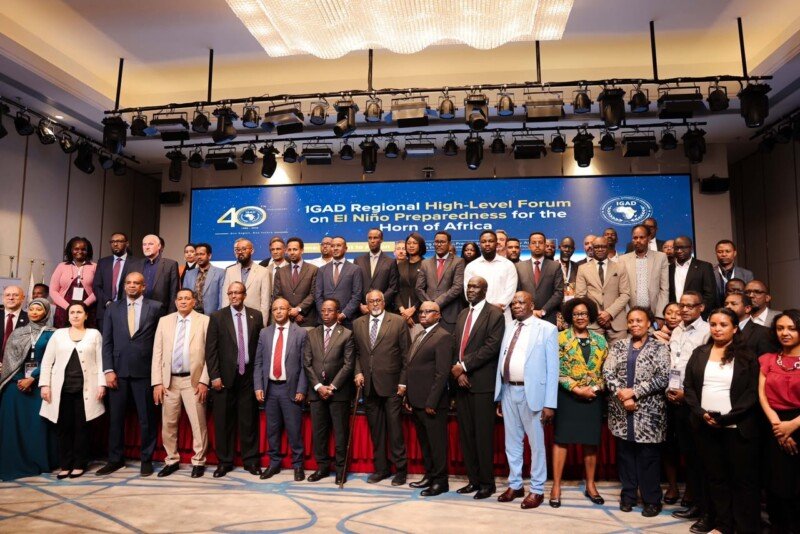
DJIBOUTI — The Intergovernmental Authority on Development (IGAD) has expressed grave concern over the escalation of tensions in northern Ethiopia, including reports of renewed hostilities, the seizure of civilian airports, and the disruption of air services.
In a statement issued Wednesday, the regional bloc called on the parties to cease hostilities, exercise maximum restraint, and refrain from any action that could further imperil civilian lives or undermine the peace process.
“IGAD calls on the parties to cease hostilities, exercise maximum restraint and refrain from any action that could further imperil civilian lives or undermine the peace process,” the statement said.
The Agreement for Lasting Peace through a Permanent Cessation of Hostilities, signed in Pretoria on 2 November 2022, remains the agreed framework for addressing outstanding issues, IGAD said, adding that its commitments must be upheld in full.
Airport Takeovers and Suspended Flights
The IGAD appeal follows the seizure of airports in Mekelle, Axum, and Shire by Tigrayan forces on Wednesday morning. Ethiopian Airlines suspended flights to all three cities “due to the current situation,” without providing further details.
Local residents told the BBC that forces from the Tigray People’s Liberation Front (TPLF) took control of Mekelle airport from federal police, and that no flights were landing. A taxi driver told the Associated Press that a commander ordered him to leave the airport, saying no flights would be landing.
The regional government said in a statement it had instructed its fighters to enter into “defensive war” after federal forces attacked Tigray on Tuesday using drones and heavy artillery.
On Tuesday, a strike in the southern town of Alamata killed at least 14 people and injured 22 others, according to Tigrayan authorities. The town’s mayor told the BBC that more than five drones and one fighter jet had carried out more than 21 strikes beginning at around 03:30.
International Reactions
African Union Commission Chairperson Mahmoud Ali Youssouf called for restraint and immediate de-escalation, expressing concern that the actions risk destabilizing the region and reversing gains made in the 2022 peace agreement. He also condemned the “detention of federal personnel by the TPLF”.
The U.S. Embassy in Addis Ababa issued a security alert confirming that Tigray Defense Forces had taken control of the airports and advising U.S. citizens not to travel to Tigray or Afar regions. The embassy also maintains a standing travel advisory for the Somali region, warning against travel within 50 kilometers of the border with Somalia due to risks of terrorism, kidnapping, and landmines, and advising against travel to the zones of Liban, Afder, Shabele, and Korahe.
The U.S. Ambassador to Ethiopia, Ervin J. Massinga, expressed disappointment over the fighting, calling it a “poor decision” and threatening sanctions.
The U.S. State Department’s Bureau of African Affairs also condemned a drone strike on a Catholic Relief humanitarian assistance convoy in Tigray and called for investigations without stating which side was responsible.
The Pretoria Agreement Under Strain
The renewed hostilities come three days after seven opposition groups, including the TPLF, formed a coalition called the Ethiopian Peoples’ Forces Alliance for Survival, aimed at removing Prime Minister Abiy Ahmed and his government.
The TPLF fought federal forces during a devastating two-year conflict that ended with the signing of the Pretoria Agreement in November 2022. The war killed an estimated 600,000 people, according to the African Union’s mediator.
Tensions have been escalating throughout 2026. In July, Tigray authorities accused the federal government of preparing for renewed war and declared that the Pretoria Agreement had “effectively collapsed” due to what they described as the federal government’s failure to implement its commitments.
The federal government has accused the TPLF of allying with neighbouring Eritrea and other armed groups. Former Tigray lead peace negotiator Getachew Reda, now an adviser to the prime minister, accused the TPLF of attacks in Afar and Amhara and said its takeover of federal-controlled airports had taken “irresponsibility to new heights”.
ONLF Denies Involvement in Alliance
The Ogaden National Liberation Front (ONLF) has denied joining the newly announced alliance, saying its name was used without authorization, as reported in FTL Somalia’s coverage of the alliance. In a statement Monday, the ONLF said it had no involvement in the Ethiopian Peoples’ Forces Alliance for Survival and that individuals associated with a rival faction led by Abdirahman Mohamed Sheikh Mahdi had used the organization’s name.
The ONLF reaffirmed its commitment to a 2018 peace agreement with Ethiopia’s federal government that ended decades of armed insurgency and allowed the movement to pursue its political objectives through peaceful means. The group said its political strategy did not permit alliances with armed groups involved in conflict.
Regional Context and IGAD’s Role
The crisis unfolds as IGAD itself faces significant institutional challenges. Eritrea’s withdrawal from the bloc has reduced its capacity to act as a regional mediator, a development that complicates collective responses to the escalating tensions in Ethiopia. As reported in FTL Somalia’s coverage of IGAD’s emergency ministerial meeting, Somalia has remained engaged with the bloc despite these challenges, ratifying the revised IGAD Treaty in January 2026 to help reach the two-thirds threshold required to operationalise the updated framework.
IGAD has previously demonstrated its willingness to address regional security crises, including through its engagement on the Sudan conflict. However, the bloc’s ability to influence events in Ethiopia remains limited, and its calls for restraint have yet to produce a de-escalation.
What This Means for Somalia
Ethiopia is a major troop contributor to the African Union Support and Stabilization Mission in Somalia (AUSSOM), and renewed conflict in Tigray has direct implications for the mission’s force posture. If Addis Ababa redirects military resources to the northern front, it could reduce the Ethiopian contingent available for operations against Al-Shabaab in central and southern Somalia. Any drawdown of Ethiopian forces would create security gaps that Somali forces and other AUSSOM contributors would need to fill, complicating an already strained mission with chronic funding shortfalls. The crisis also deepens the regional instability that Somalia navigates daily, with the Tigray conflict, the Ethiopia-Eritrea standoff over Red Sea access, and the Sudan war all intersecting in ways that could affect Somali security, trade routes, and diplomatic alignments.
Critical Note
IGAD’s call for de-escalation is timely but carries limited weight. The bloc has already lost one of its most strategically important members, Eritrea, and its authority over the Ethiopian government and the TPLF is questionable. The Pretoria Agreement, which IGAD describes as the “agreed framework,” has been declared collapsed by Tigray authorities and is openly contested by both sides.
The seizure of airports by Tigrayan forces is a significant escalation. Airports are federal infrastructure, and their takeover represents a direct challenge to federal authority. Ethiopian Airlines’ suspension of flights to Mekelle, Axum, and Shire cuts off the region from the rest of the country by air, with no other airlines serving those destinations.
The ONLF’s denial of involvement in the alliance adds a layer of complexity. If the ONLF’s name was used without authorization by a rival faction, it suggests that the coalition’s composition is more fluid and contested than its announcement implied. The ONLF’s reaffirmation of its 2018 peace agreement with Addis Ababa also indicates that not all armed groups in the Somali Region have abandoned political engagement for armed struggle.
The formation of the Ethiopian Peoples’ Forces Alliance for Survival just three days before the airport seizures suggests coordination between the TPLF and other armed groups. If the alliance translates into coordinated military action across multiple fronts, Ethiopia could face a multi-front insurgency that the federal government’s drone-heavy military strategy may not be able to contain.
The timing is also significant for Somalia. Ethiopia is a major troop contributor to the African Union mission in Somalia, and any distraction or reduction of Ethiopian forces would have direct implications for the fight against Al-Shabaab. The regional instability also compounds the challenges facing IGAD as a mediator, with Eritrea’s withdrawal and Ethiopia’s internal conflicts limiting the bloc’s capacity to act.
Recommended Reading On ftlsomalia.com
- ONLF Joins Seven-Group Ethiopian Alliance Against Abiy Government
- US Embassy Issues Security Alert for Somali Region Amid Rising Tensions
- Somalia Attends IGAD Emergency Ministerial Meeting in Djibouti as Regional Crises Mount
- IGAD Youth Summit Charts Bold Path for Peace in Sudan and the Horn of Africa