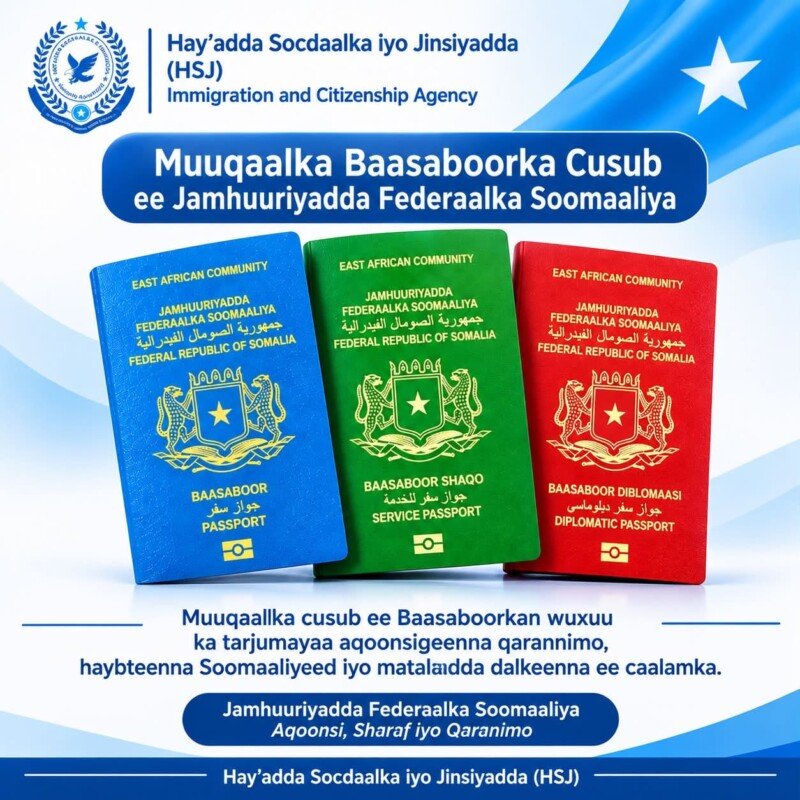
MOGADISHU, Somalia’s Immigration and Citizenship Agency unveiled newly redesigned national passports, introducing distinct color-coded tiers alongside regional insignia to symbolize national identity and cross-border integration. The updated booklets feature ordinary, service, and diplomatic categories issued in blue, green, and red covers, each bearing the federal coat of arms alongside the formal inscription of the East African Community.
Regional Integration and Modernized Document Standards
The redesign marks a tangible step in standardizing domestic travel documents with the protocols of the regional bloc, which Somalia joined as its eighth member state. The rollout follows formal executive action earlier this year, when the Cabinet approved third-generation polycarbonate e-passports to replace older formats, enhance biometric security, and align border controls with global aviation benchmarks.
Officials from the immigration agency noted that incorporating the regional bloc’s name and emblem directly supports broader initiatives to facilitate mobility for Somali traders, students, and officials. The measure coincides with wider diplomatic efforts, including the recent adoption of the national strategy to strengthen economic ties with Africa, which prioritizes common market integration, trade harmonization, and streamlined customs procedures across member states.
Institutional Reforms and Verification Architecture
The introduction of the new travel booklets forms part of an overhaul across civil registration systems. During an operational review earlier this year, authorities emphasized administrative reforms as the deputy premier witnessed the leadership transition at the immigration agency, focusing on linking biometric passports directly to national identification databases to prevent identity manipulation.
Somali delegations have repeatedly highlighted these administrative updates during intergovernmental engagements in Arusha, particularly as Somalia hosted East African Legislative Assembly delegates to push forward legislation governing mutual border protocols and labor mobility.
FTL Critical Note
While the visual redesign and regional branding represent an important symbolic milestone for Somali statehood, altering the physical booklet does little on its own to resolve the severe travel limitations faced by Somali citizens. The Somali passport has persistently ranked among the least powerful globally in international mobility indexes, offering visa-free or visa-on-arrival access to only a negligible handful of destinations.
Furthermore, regional integration remains heavily constrained by bilateral security suspicions. Despite Somalia’s accession to the regional community, neighboring partner states continue to enforce stringent, expensive visa requirements and rigorous screening protocols on Somali passport holders at major entry points. Internally, persistent complaints regarding processing delays, steep official fees, and black-market broker networks around immigration offices highlight that building international credibility requires institutional integrity and accountable civil registries, not merely refreshed booklet covers.
Recommended Reading On ftlsomalia.com
- Somali Cabinet Approves Third-Generation Polycarbonate E-Passport and Reviews Performance Reports
- Somalia Launches National Strategy to Strengthen Economic Ties with Africa
- Deputy Premier Witnesses Leadership Transition at Immigration Agency
- Somalia Hosts East African Legislative Assembly Delegation in Mogadishu
- Somalia’s Passport Ranked the Fifth Weakest in the World
- Arusha Summit Concludes with Key Infrastructure Projects Approved for East African Community