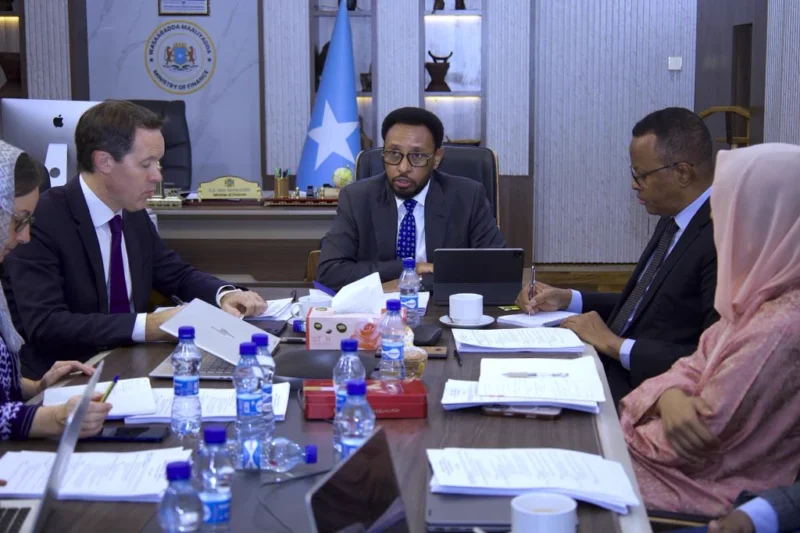
MOGADISHU, Somalia has officially relaunched the International Air Transport Association’s Billing and Settlement Plan (IATA-BSP), restoring a system that had been absent from the country for 35 years, in a ceremony attended by Prime Minister Hamza Abdi Barre and international diplomats.
The event, organized by the Somali Civil Aviation Authority (SCAA), marked the formal return of the global airline ticketing and settlement framework. Transport and Civil Aviation Minister Mohamed Farah Nuh said the ministry had worked for an extended period to restore the system, describing it as an opportunity to support economic growth and strengthen Somalia’s connections with international markets.
Prime Minister Barre said the restoration resulted from institutional reform, the preparation of regulations and policies, and the training of staff capable of taking on air management responsibilities. He noted that Somalia has made progress in various areas, including economic growth, debt relief, joining the East African Community, and the handover of national security.
What the BSP Changes
The IATA-BSP is a global system designed to facilitate financial transactions between IATA-accredited passenger sales agents and airlines. It tracks and manages the sale of air tickets and associated financial settlements between airlines and travel agencies. Somalia’s return to the system means local travel agents can now sell international airline tickets and settle accounts through the same framework used globally, rather than relying on informal or intermediary arrangements.
The rollout follows a pilot phase launched in April 2026, in which four travel agents and several airlines serving the country, including Ethiopian Airlines, participated. The system will open to all airlines and more than 300 travel agents operating in Somalia, as reported in FTL Somalia’s coverage of the BSP pilot phase.
International Praise and Domestic Context
Italy’s Ambassador to Somalia, Pier Mario Daccò Coppi, said Somalia had “achieved progress in aviation” and described the restoration as “a great success,” according to SCAA’s statement. UK Ambassador Charles King said the IATA opening is “a modern system that is a step forward for the country and the Somali people.”
Abdirazak Warsame, Vice Chairman of IBS Bank, said the IATA system is “a success that has come to airline companies, which are able to serve equally within the country and abroad.”
The restoration builds on broader progress in Somalia’s aviation sector. As detailed in FTL Somalia’s long-form analysis of Mogadishu airport’s recovery, Aden Adde International Airport has been transformed from a facility surviving on humanitarian flights and the illicit qaat trade into a hub handling hundreds of thousands of passengers annually. The country regained Class A airspace classification in January 2023, restoring full control of its airspace after more than three decades.
The national carrier, Somali Airlines, is also preparing to resume operations after a 35-year hiatus, with two Airbus A320 aircraft acquired for the purpose. The government has set a September deadline for the flag carrier’s resumption, as reported in FTL Somalia’s coverage of the airline’s revival. New international connections have also been established, including SalamAir’s direct flights between Muscat and Mogadishu, launched in September 2026.
However, the sector continues to face regulatory and safety challenges. The European Union Aviation Safety Agency maintains a HIGH-risk advisory for Somali airspace below Flight Level 260, citing the presence of terrorist organisations with confirmed anti-aviation weaponry, as reported in FTL Somalia’s coverage of the EASA warning. The United States Federal Aviation Administration maintains a parallel restriction under Special Federal Aviation Regulation No. 107, prohibiting U.S. air carriers from flying below FL260 in Somali airspace.
Security incidents have also disrupted operations. In March 2025, a US Embassy warning about a potential imminent attack at Aden Adde International Airport led to immediate flight cancellations by Turkish Airlines and Qatar Airways. More recently, the SCAA was forced to issue a public notice denying reports that the airport would close, as reported in FTL Somalia’s coverage of the denial.
Critical Note
The restoration of the IATA-BSP is a tangible, verifiable step forward for Somalia’s aviation sector, distinct from the more aspirational announcements that have characterized some previous reforms. The system was absent for 35 years. Its return means that Somali travel agents can now operate within the same financial settlement framework as their counterparts anywhere else. That is a concrete integration into global aviation infrastructure, not a rhetorical one.
But the ceremony in Mogadishu, with its ambassadors and prime ministerial speeches, should not obscure the gap between the system’s restoration and its effective operation. The BSP depends on participating airlines, accredited travel agents, and functioning financial settlement mechanisms. The pilot involved four agents and a handful of carriers. The full rollout anticipates more than 300. Whether those agents have the capital, training, and regulatory compliance to operate within IATA’s framework is an open question. The system’s return is a milestone. Its success will be measured in transactions, not statements.
The aviation sector’s progress also sits uneasily alongside Somalia’s broader institutional fragility. The same week that IATA-BSP was relaunched, the government faced a Supreme Court challenge to its constitutional amendments and a rejected election timetable. The EASA advisory remains in place, and the FAA restriction has not been lifted. A country can modernize its ticketing systems while its airspace remains classified as high-risk by international regulators. The BSP restoration is real. It does not resolve the deeper questions about whether Somalia’s aviation sector can overcome the security and governance deficits that continue to constrain its full integration into global air travel.
Recommended Reading On ftlsomalia.com
- Somalia Set to Roll Out IATA BSP Nationwide After Successful Pilot Phase
- How Mogadishu’s Airport Rebuilt Itself From the Ruins of War
- Somali Airlines Returns to the Skies: Government Sets September Deadline for Flag Carrier’s Resumption
- EASA Warns Airlines Over Saudi, Somalia and Mali Airspace Risks
- SalamAir Launches Direct Flights Between Muscat and Mogadishu
- Somalia Denies Airport Closure Amid Ongoing National ID Enforcement