WASHINGTON — Somaliland President Abdirahman Mohamed Abdullahi (Irro) arrived in Washington in early September 2026 seeking to build on Israel’s recognition and advance his campaign for international recognition. The visit produced a lobbying bill, meetings with American Jewish organizations, and a keynote address at the Hudson Institute. It also raised questions about whether the path he is pursuing can deliver the outcome he seeks.
The centerpiece of the visit was an address at the Hudson Institute on September 14, titled “Somaliland as a Strategic Partner in the Horn of Africa.” The event was intended to present Somaliland as a stable, strategically valuable partner for the United States.
The Hudson Institute Appearance
During a fireside chat moderated by Hudson Senior Fellow Joshua Meservey, Irro faced questions about his country’s strategic value. When asked what minerals Somaliland could offer the United States, Irro said he was not a geologist and suggested “maybe everything.” Asked about Somaliland’s coastguard capabilities, he said “I don’t know, our coastguard don’t have any equipment.” On the question of Sudan and regional precedents for secession, he dismissed the topic as “too far” and laughed.
Analyst Cameron Hudson, a senior fellow at the Center for Strategic and International Studies, wrote on X that the event revealed “a frail and aging leader not fully able to deliver the brief that he came here to deliver to a skeptical Washington audience.” He added: “Irro had no strong arguments and gave no neutral observer any reason to back his vision and his leadership.”
Meservey, who moderated the discussion, said afterward that Somaliland has not been able to consistently make the case for why recognition is necessary.
A subsequent analysis published in The Times of Israel acknowledged that “several awkward answers in the fireside discussion became the story” and that “a president asking the United States to make a consequential diplomatic decision must be able to explain, in precise and practical terms, what his country offers and why recognition serves American interests.”
The Israel-Aligned Strategy
In the days following the Hudson event, Irro’s delegation pivoted to a different audience: American Jewish organizations and Israel-aligned Christian groups. The American Jewish Committee (AJC) met with Irro and senior Somaliland officials, discussing “regional security, Somaliland’s strategic importance, and its growing relationship with Israel.”
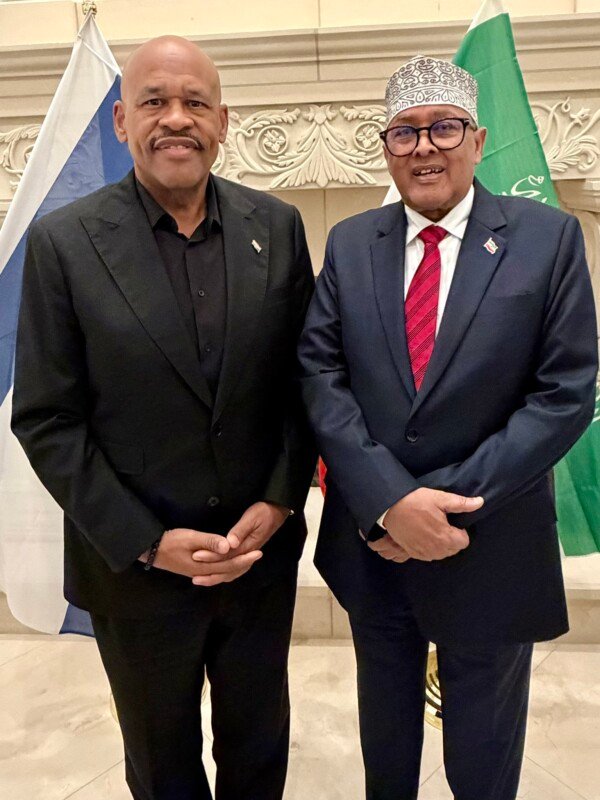
The outreach extended to Black church networks aligned with Israel. The Institute for Black Solidarity with Israel (IBSI) hosted an event at the residence of Israeli Ambassador to the United States Yechiel Leiter, where it celebrated Somaliland’s achievements and urged the US administration to follow Israel’s lead in recognizing Somaliland’s sovereignty, as reported in FTL Somalia’s coverage of the IBSI event.
IBSI founder and CEO Dumisani Washington, a pastor and author, described the organization as dedicated to strengthening the relationship between Israel and the Jewish people, and people of African descent. He was joined by figures including Dr. Michael A. Stevens Sr., a Church of God in Christ pastor and district superintendent who founded the Cosmopolitan Fellowship of Churches International and has spent more than 15 years mobilising African American pastors in support of Israel, including through Christians United for Israel. Stevens said he was “honoured to be invited to the home of Israeli ambassador to the United States, Yechiel Leiter to meet the President of Somaliland,” describing the evening as “very surreal and humbling.”
The logic appears to be that Israel’s recognition, combined with advocacy from American Jewish and pro-Israel Christian organizations, could create political pressure on the White House to follow suit. But the evidence from Washington suggests this strategy faces significant obstacles.
Washington’s Position Remains Unchanged
Despite the diplomatic outreach, the United States has given no indication that it is preparing to recognize Somaliland. A State Department report to Congress in June 2026 reaffirmed that Washington recognizes “the sovereignty and territorial integrity of the Federal Republic of Somalia, which includes the region of Somaliland.”
The report acknowledged Somaliland’s “strategic location near Yemen and the Bab al-Mandab Strait” and said it “positions it as a potential partner on shared security interests.” But it subordinated that strategic value to Mogadishu’s veto, stating that “regional security concerns and the dispute over Somaliland’s status, including its refusal to cooperate with national authorities, present challenges for investment, banking, and trade.”
AFRICOM Commander General Dagvin Anderson has also stated that the United States has no plans to establish a military base in Somaliland, reaffirming Washington’s longstanding policy. President Donald Trump said in December 2025 that he did not back recognizing Somaliland, telling the New York Post “No” when asked about the issue and adding: “Does anyone know what Somaliland is, really?” Trump later indicated that “everything is under study,” but also reacted dismissively when asked about Somaliland’s offer of port access on the Gulf of Aden, saying “Big deal.”
Former Assistant Secretary of State for African Affairs Tibor Nagy, a Somaliland advocate, called the State Department report “blah blah bureaucratic nonsense” and a “total waste.” He told The Africa Report: “There is absolutely nothing in here that is fresh, new, creative [or] thought-provoking.”
A Competing Red Sea Partner Emerges
A more consequential development may have arrived while Irro was still in Washington. On September 19, the United States lifted sanctions on Eritrea’s ruling party, military, and key economic entities, a decision Washington linked directly to its regional interests as the Red Sea assumes heightened strategic importance.
The State Department said President Trump chose not to renew the sanctions “to advance US regional interests.” Analysts linked the decision to Eritrea’s location on the Red Sea, where its more than 1,000 kilometres of coastline sit opposite Saudi Arabia and near the Bab el-Mandeb Strait.
The timing is significant for Somaliland. Hargeisa has spent months pitching Berbera as an alternative Red Sea partner for Washington, arguing that its port and position near the Gulf of Aden make it a natural alternative to Djibouti. Eritrea offers Washington strategic coastline without forcing a decision on Somaliland’s contested status, as detailed in FTL Somalia’s analysis of the Eritrea opening.
Political analysts noted that the Eritrea opening reflects the difficulty of the Israel-led campaign to push for US recognition of Somaliland. Using Eritrea’s Assab port is seen as a cheaper and more logical option for Washington, as Eritrea is already a recognized state and its port sits near the Bab el-Mandeb.
Regional Rejection of the Israel Model
The Israel-first strategy carries additional costs. The African Union, Arab League, Organisation of Islamic Cooperation, and IGAD have all condemned Israel’s recognition of Somaliland. IGAD warned that such actions “risk increasing regional tensions and undermining peace, stability, and cooperation.”
The African Union reaffirmed its “unwavering respect for the sovereignty, unity, and territorial integrity of Somalia” and stated that “any unilateral recognition of Somaliland is null and void.”
Mogadishu has also sent its own delegation to Washington to counter Irro’s visit. In June 2026, State Minister of Foreign Affairs Ali Mohamed Omar (Ali Bal’ad) cited both the North Eastern State and Awdal as evidence that Somaliland does not exercise uncontested authority over the territory it claims.
For Somaliland, alignment with Israel may have opened one door in Jerusalem, but it has complicated outreach to Muslim-majority and Arab states whose support would be valuable for any broader recognition effort.
Critical Note
Irro’s Washington visit was intended to demonstrate that Somaliland is a serious strategic partner worthy of recognition. The Hudson Institute appearance made that case more difficult. A president who cannot answer basic questions about his country’s resources, security capabilities, or regional dynamics may struggle to inspire confidence in Washington, particularly when the ask is a consequential break with decades of US policy.
The Israel-aligned strategy represents an attempt to build a domestic political constituency for recognition. But the evidence suggests this is a difficult path. American Jewish organizations and pro-Israel Christian networks can advocate, but they cannot deliver a presidential decision on recognition. The State Department’s June 2026 report, the AFRICOM commander’s statements, and Trump’s own dismissive remarks all point in the same direction: the United States is not prepared to recognize Somaliland, regardless of Israeli recognition or church-based lobbying.
The Eritrea sanctions decision sharpens the problem. Somaliland’s core argument has been geographic utility, that Berbera offers Washington something no one else can. Eritrea now offers an alternative that does not require Washington to break with Mogadishu, absorb regional backlash, or resolve a contested sovereignty question. The recognition campaign may continue, but the path through Washington appears difficult to navigate. Whether the path through Jerusalem and its American allies can deliver what the Hudson Institute could not remains uncertain.
Recommended Reading On ftlsomalia.com
- Black Pro-Israel Group, IBSI Champions Somaliland Recognition at Washington Event with Cirro
- US Sanctions Move Elevates Eritrea as Strategic Red Sea Partner, Marginalizing Somaliland’s Recognition Pitch
- Somaliland Bans Armed Mobilisation in Awdal and Salal as Tensions Persist
- Israel Alliance Remains Central to Somaliland’s Washington Strategy Despite Diplomatic Stumbles
- No US Base in Somaliland, Says AFRICOM Chief as Berbera Speculation Mounts
- Mogadishu Counters Israel-UAE Campaign to Secure International Recognition for Somaliland