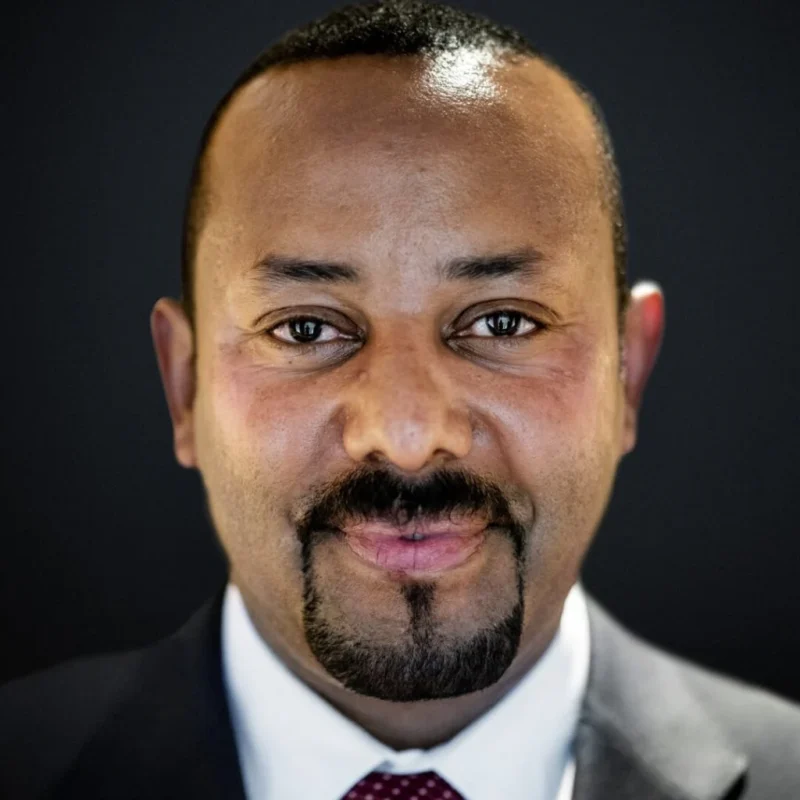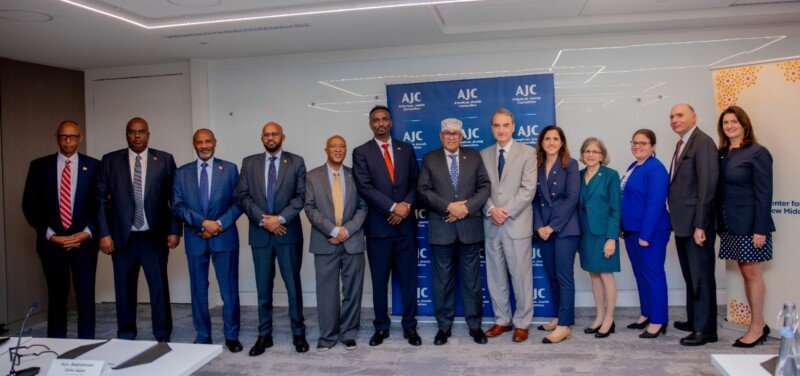
WASHINGTON — The American Jewish Committee (AJC) met with Somaliland President Abdirahman Mohamed Abdullahi (Irro) and senior Somaliland officials during their visit to Washington, discussing regional security, Somaliland’s strategic importance, and its growing relationship with Israel.
The meeting included Foreign Minister Abdirahman Dahir Adan, Minister of Defense Mohamed Yusuf Ali Ahmed, and Speaker of Parliament Yasin Haji Mohamoud, according to a statement issued by AJC. The discussion explored the significance of Israel being the first UN member state to officially recognize Somaliland as an independent and sovereign state, as well as opportunities for deeper cooperation between Somaliland and Israel.
“AJC’s Center for a New Middle East is committed to building trusted partnerships with leaders around the world and fostering dialogue on the issues shaping Israel, the Middle East, and beyond,” the organization said in its statement.
Israel Alliance at Center of Diplomatic Push
The AJC meeting follows Irro’s appearance at the Hudson Institute on September 14, where he presented Somaliland as a strategic partner for the United States. The event, titled “Somaliland as a Strategic Partner in the Horn of Africa,” was moderated by Hudson Institute Senior Fellow Joshua Meservey.
According to social media posts circulating after the event, Irro struggled to answer several questions. When asked why Somaliland lacks international recognition, he reportedly said “I don’t know” and laughed. Asked what minerals Somaliland could offer the United States, he said he was not a geologist and suggested “maybe everything.” When questioned about Somaliland’s coastguard capabilities, he said “I don’t know, our coastguard don’t have any equipment” [citation:7].
Commenting on the Sudan question, Irro reportedly said it was “too far” before laughing, rather than discussing South Sudan’s secession as a precedent for Somaliland’s case [citation:7].
Analyst Cameron Hudson, a senior fellow at the Center for Strategic and International Studies, wrote on X that the event revealed “a frail and aging leader not fully able to deliver the brief that he came here to deliver to a skeptical Washington audience”.
“He did himself and his country a major disservice by being unprepared or incapable of being able to respond convincingly to serious topics that will determine his country’s future,” Hudson wrote. “Irro had no strong arguments and gave no neutral observer any reason to back his vision and his leadership”.
Recognition Campaign Faces Obstacles
Meservey, who moderated the Hudson discussion, said afterward that Somaliland has not been able to consistently make the case for why recognition is necessary.
Washington’s position on Somaliland remains unchanged despite the diplomatic outreach. AFRICOM Commander General Dagvin Anderson has stated that the United States has no plans to establish a military base in Somaliland, reaffirming Washington’s longstanding policy of supporting the sovereignty, unity, and territorial integrity of the Federal Republic of Somalia.
President Donald Trump said in December 2025 that he did not back recognizing Somaliland.
Despite these challenges, the AJC meeting signals continued engagement with American Jewish organizations that have supported closer US-Israel relations and could potentially advocate for Somaliland’s case in Washington.
Domestic Criticism Over Gaza Troop Offer
Irro’s diplomatic outreach has also drawn criticism at home, with the Somaliland opposition party KAAH criticizing his statement that Somaliland is ready to send up to 2,000 troops to Gaza if requested by the United States or Israel.
The party’s spokesperson said Somaliland’s forces are needed more to recover prisoners held in Las Anod, which is now the capital of the North Eastern State administration in Somalia.
Critical Note
The AJC meeting represents a continued effort by Somaliland to leverage its relationship with Israel as a pathway to broader international acceptance, particularly in Washington. American Jewish organizations have established networks and influence in US foreign policy circles, and their engagement with Somaliland could potentially help advance the recognition campaign.
At the same time, the Hudson Institute appearance and the subsequent criticism have exposed weaknesses in Somaliland’s diplomatic strategy. The questions Irro struggled with, the core rationale for recognition, Somaliland’s resource base, its security record, and regional precedents, are the very issues that would need to be addressed convincingly to shift Washington’s position.
The continued association with Israel, while providing Somaliland with its only formal recognition from a UN member state, has also become a source of diplomatic friction. The Arab League, OIC, and African Union have all condemned Israel’s recognition, and Somaliland’s alignment with Israel may complicate its outreach to Muslim-majority and Arab states whose support would be valuable for any broader recognition effort.