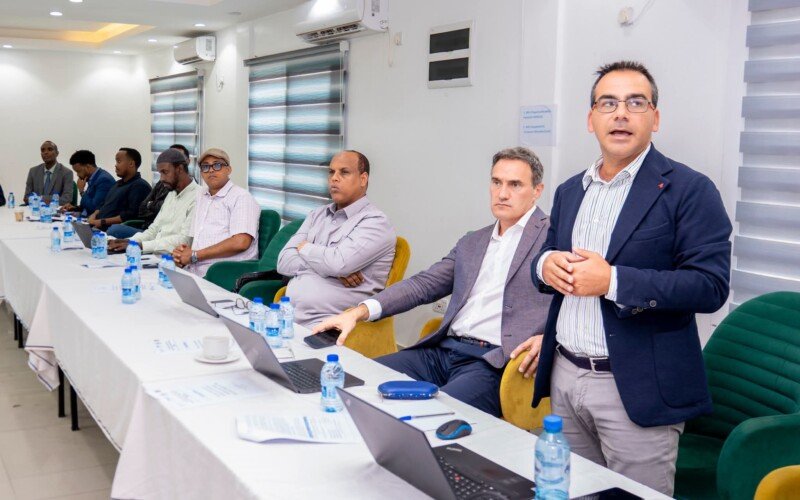
MOGADISHU — The Director General of the Ministry of Planning, Investment and Economic Development, Abdifatah Abdulqadir Farah, participated in a consultative meeting focused on the Shabelle River Water Resources Investment Plan, organized by the Ministry of Energy and Water Resources.
The meeting centered on strategic investments in the Shabelle River, particularly the Jowhar Offstream Storage Programme (JOSP), water resource management, agricultural production development, and strengthening resilience to climate change.
Farah emphasized the importance of aligning Shabelle River investments with the National Transformation Plan (NTP 2025–2029) and the country’s development priorities. He noted that these investments are critical for strengthening food security, improving community livelihoods, and ensuring sustainable development.
The Shabelle River and JOSP
The Sabuun Barrage, built along the Shabelle River, is a central component of JOSP, designed to regulate water flow, divert excess floodwater into storage areas, and support irrigation for thousands of farmers. Rehabilitation work includes restoring the barrage, repairing the diversion canals, and strengthening infrastructure that controls water distribution.
The Shabelle River has historically posed significant flood risks, with water levels exceeding the highest flood risk threshold of 8.5 meters in November 2023, prompting warnings for residents to exercise caution [citation:6].
International Partnership and Investment Framework
The JOSP programme has attracted high-level participation from Somali leaders and international partners, including the Minister of Energy and Water Resources, the Deputy Prime Minister, and the ambassadors of the United States and the United Kingdom.
The National Climate Fund has also approved a $25.8 million rainwater harvesting project and a $232 million Water Investment Programme (WIP) 2026-2030, directed by the Ministry of Energy and Water Resources, to support priority initiatives in water supply, water storage, flood management, groundwater development, irrigation, sanitation, climate resilience, and institutional capacity building.
The African Union Transition Mission in Somalia (ATMIS) has previously joined forces with the Somali National Army to reinforce the banks of the Shabelle River as part of emergency responses to El Niño rains.
Critical Note
The alignment of Shabelle River investments with the National Transformation Plan reflects a broader effort to move Somalia’s development approach from emergency response to long-term, sustainable investment. The JOSP initiative, in particular, represents a shift toward proactive water management that addresses both flood and drought risks, rather than reacting to crises as they occur.
Yet the success of these investments depends on more than funding. Somalia’s water infrastructure has historically suffered from neglect and inadequate maintenance, and the country’s institutional capacity to manage complex water systems remains limited. The involvement of multiple ministries, federal member states, and international partners creates coordination challenges that must be addressed to ensure that projects are implemented efficiently and that benefits reach the communities they are intended to serve.
The Shabelle River’s importance to Somalia’s agricultural economy cannot be overstated, but its potential has long been undermined by poor management and recurrent climate shocks. If the current investments are accompanied by strengthened governance, transparent procurement, and sustained maintenance commitments, they could help transform the river basin from a source of vulnerability into a foundation for food security and economic growth. Without these safeguards, the risk remains that expensive infrastructure will fall into disrepair, repeating a pattern that has plagued Somalia’s development efforts for decades.
Recommended Reading On ftlsomalia.com
- Hirshabelle President Inaugurates Sabuun Barrage Rehabilitation in Jowhar
- JOSP Forum Attracts Top Leaders to Jowhar
- National Climate Fund Approves $25.8 Million Urban Water Project and $232 Million Water Investment Plan
- Shabelle River Rises Beyond Highest Flood Risk Threshold
- ATMIS and SNA Troops Reinforce Banks of Shabelle River