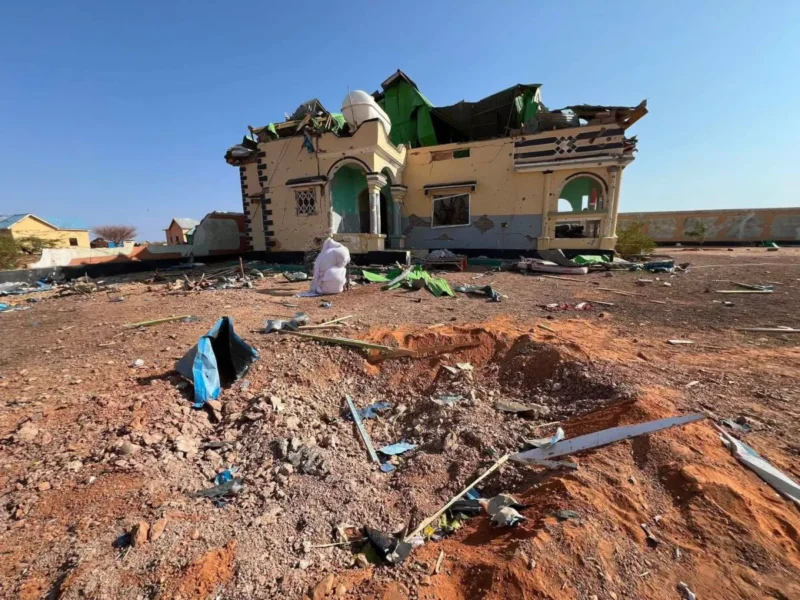
MOGADISHU — A late-night explosion at the residence of former Somali prison service commander Brigadier General Mahad Abdirahman Aden in Doolow district of the Gedo region has sparked sharply conflicting accounts between the federal government and the Jubaland regional administration, with both sides offering competing narratives of what occurred on the night of September 3–4.
Jubaland authorities accused Turkish drones of carrying out the attack, saying the strike specifically targeted General Shub because of his political differences with Somalia’s federal government. The administration said one of two missiles fired hit the residence of the Doolow district governor and that Shub and four civilians were injured in the attack. Jubaland described the strike as a “barbaric attack” and a “war crime,” calling for accountability from what it described as the outgoing federal administration and the Turkish government.
In a separate statement, the Federal Government of Somalia categorically denied involvement in the incident. The government said preliminary information received by security agencies indicated that the explosions were caused by explosives being prepared inside the house. It announced it would appoint a fact-finding committee to conduct a thorough investigation and warned against what it described as false information being circulated.
Conflicting Narratives
According to Jubaland, the attack occurred at approximately 11:40 p.m., with two missiles fired at the residence. The administration said Shub was targeted because he politically opposes President Hassan Sheikh Mohamud’s government and is considered a close ally of former South West State President Abdiaziz Hassan Mohamed Laftagareen, whose forces attacked Baidoa on Thursday morning.
Neither the Turkish government nor the Somali federal government has officially confirmed or denied the allegations regarding a Turkish drone strike. General Shub, who previously served as Commander of the Somali Custodial Corps, was removed from his position following a political dispute between the federal government and the South West administration. He was later placed under house arrest in Mogadishu before leaving the country, according to local reports.
The federal government’s statement said Doolow district is important for security and movement in Gedo region, and that the government prioritizes stability and the safety of civilians.
Some analysts, however, have pointed to the widely shared images of the house after the incident, noting that the scene appears inconsistent with an external missile strike. They have suggested the damage indicates an explosion from inside the structure, possibly caused by explosive material that detonated within the residence, an assessment that would align with the federal government’s account of an accidental blast involving explosives being prepared inside.
Political Context and Escalating Tensions
The incident comes amid deepening political tensions in South West State. General Shub is considered a close ally of former South West State President Abdiaziz Hassan Mohamed Laftagareen, whose forces attacked Baidoa on Thursday morning. The incident suggests that Somalia’s political confrontation may be entering a more dangerous phase—one in which air power and foreign military support could be used in internal disputes.
Jubaland’s statement accused Turkey of abandoning the neutral role it had previously played in Somalia’s affairs and said Ankara would no longer be regarded as neutral. The administration called on the international community to closely examine what it described as interference in Somalia’s internal affairs, including the United Nations, African Union, IGAD, the United States, and the European Union.
Jubaland also urged the UN Security Council to urgently review its decision to lift the arms embargo on Somalia, arguing that weapons should remain under responsible and trusted authority. The UN Security Council lifted the long-standing arms embargo on Somalia in December 2023.
Critical Note
The competing narratives surrounding the Doolow incident highlight the deep mistrust between the federal government and regional administrations, and the difficulty of establishing facts in an environment of political polarization. While Jubaland has unequivocally attributed the attack to Turkish drones operating with federal backing, the federal government has categorically denied involvement and offered an alternative explanation.
The truth of what occurred in Doolow remains unclear, and neither account has been independently verified. If reports attributing the attack to Turkish-operated drones are confirmed, it would mark the first time that foreign military assets have been used to target a domestic political opponent rather than Al-Shabaab militants. If the federal government’s account of an accidental explosion is accurate, it would raise questions about the safety of civilian residences in areas where explosives are being stored.
The incident underscores the risks of Somalia’s growing dependence on foreign military support, which may be used for purposes that extend beyond the stated counter-terrorism mandate. The federal government must ensure that its investigation is transparent and credible, and that its findings are shared with the public. Without accountability, this incident risks further destabilizing an already fragile political situation and undermining the fight against Al-Shabaab.
Recommended Reading On ftlsomalia.com
- Drone Strike Targets Residence of Former Somali Prisons Commander in Doolow
- Baidoa Rocked by Fighting Between Somali Army and Laftagareen-Loyal Militias
- Ousted South West President Rejects Federal Claims Linking His Forces to Al-Shabaab
- “I Remain Lawful President”: Laftagareen Rejects Removal, Vows Political Return
- Forces Loyal to Ousted Southwest Leader Storm Baidoa