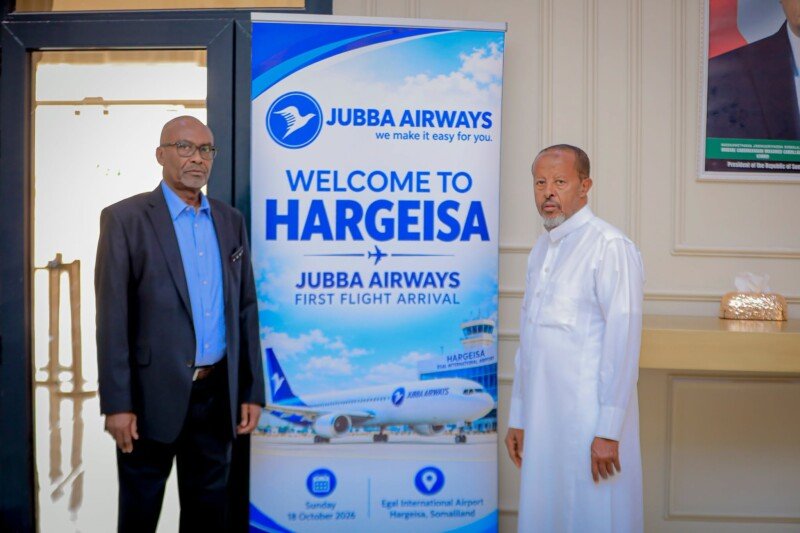
HARGEISA, Jubba Airways resumed its flights to Hargeisa on Sunday, with the airline’s aircraft officially relaunching services at Egal International Airport, according to social media reports from Somali aviation observers.
The resumption marks the return of one of Somalia’s longest-serving private carriers to the Hargeisa route, which the airline had previously served as part of its domestic network. According to the reports, the airline described the restart as a “new beginning” for its flight services, with expectations that it will contribute to facilitating community travel and strengthening aviation connectivity.

A Carrier Rebuilding Its Network
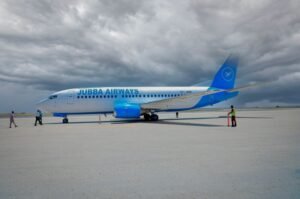
Jubba Airways, established in 1998 by Somali entrepreneurs, has been a fixture of Somali civil aviation for over two decades. The airline is headquartered in Nairobi and maintains branches in Somalia, Djibouti, Uganda, Saudi Arabia, and the United Arab Emirates. It employs more than 300 people and provides passenger, cargo, and charter services, as reported in Dawan Africa’s coverage of the airline’s return.
In September 2026, Jubba Airways announced its return to Somalia’s aviation market following a suspension of operations, with plans to restart domestic and international flights. Mohamed Hidig Ali, the airline’s Mogadishu manager, said at a launch ceremony in Mogadishu that the carrier was returning with greater operational, financial, and administrative capacity. A small aircraft had begun operating, with plans to add two large aircraft and two medium-sized planes to its fleet.
The airline’s first international flight since the relaunch was received at Aden Adde International Airport in Mogadishu with a water salute on September 16, as reported in SONNA’s coverage of the inaugural flight. The carrier resumed routes connecting Somalia with Saudi Arabia, the United Arab Emirates, Uganda, Ethiopia, and Kenya, beginning with two large aircraft and two mid-size planes.
According to its website, Jubba Airways lists Mogadishu, Hargeisa, Bosaso, Galkayo, Garowe, Guriel, Adado, Baidoa, and Kismayo among its domestic destinations, alongside Nairobi, Djibouti, Jeddah, and Dubai internationally.
The Hargeisa Route and Its Significance
The Hargeisa route has been a persistent feature of Jubba Airways’ schedule, though its operational status has fluctuated. Flight tracking data from earlier in 2026 shows scheduled services linking Hargeisa with Bosaso, Galkayo, Mogadishu, Jeddah, and Dubai, suggesting the airline maintained some level of activity on the route before the reported suspension.
The resumption of flights to Hargeisa carries practical significance for travelers in the region. Hargeisa is the largest city in Somaliland and a major commercial hub, but direct connections to other Somali cities and international destinations remain limited compared to Mogadishu. The route’s restoration reduces the need for travelers to transit through Addis Ababa, Nairobi, or Djibouti to reach Hargeisa from other parts of Somalia.
The broader Somali aviation sector has shown signs of recovery in recent months. The country regained Class A airspace classification in January 2023, and the recent relaunch of the IATA Billing and Settlement Plan (BSP) after 35 years is expected to streamline ticketing and financial settlements for airlines and travel agents operating in Somalia.
Critical Note
The resumption of Jubba Airways flights to Hargeisa is a welcome development for travelers who depend on air links between Somalia’s major cities. It restores a connection that had been disrupted and adds capacity to a route that serves both business and family travel. For a country where road travel between regions remains constrained by security and infrastructure challenges, every restored air link matters.
But the announcement, as reported on social media, should be treated with the caution that any unverified operational claim deserves. Jubba Airways has been in a state of restructuring for months, phasing out aging turboprops and acquiring aircraft to rebuild its fleet. The airline’s ability to sustain the Hargeisa route, rather than operate a single ceremonial flight, will depend on demand, aircraft availability, and the regulatory environment in Somaliland, which maintains its own civil aviation authority separate from the federal SCAA.
The deeper issue is one of institutional fragmentation. Jubba Airways operates across a patchwork of authorities: the federal government in Mogadishu, the Somaliland administration in Hargeisa, and the regulatory regimes of Kenya, Djibouti, and the Gulf states. Each has its own rules, fees, and political sensitivities. The airline’s ability to serve Hargeisa is not just a commercial decision. It is a diplomatic and regulatory one. The fact that a Somali carrier can resume this route is a small sign that some of those barriers are manageable. It does not mean they have disappeared..