MOGADISHU — A Somali military court has sentenced a former soldier to death by firing squad for the killing of a civilian in Mogadishu earlier this year, according to a statement from the Armed Forces Court.
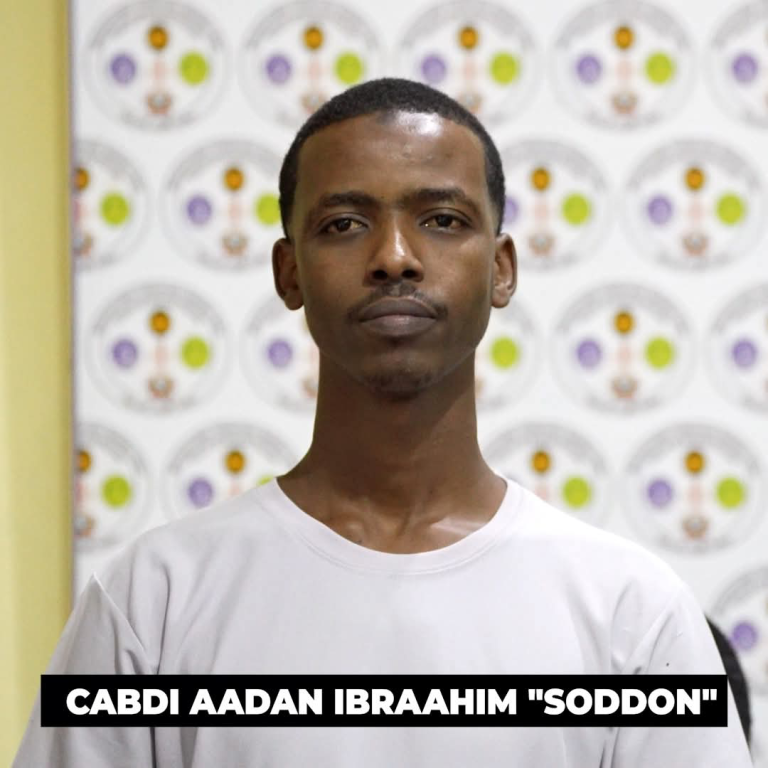
The defendant, identified as former Private Abdi Adan Ibrahim, known by the nickname “Soddon,” was convicted of murdering Yusuf Ahmed Abdi, a construction worker from Faryaamo. The victim was riding a rented bajaj (three-wheeled taxi) on his way home from work on the evening of 26 July 2026 when he was killed.
According to the court’s account, the defendant stopped the bajaj at a road in the Iga-daba-geey neighbourhood of Garsabaaleey district, in an apparent attempt to commandeer the vehicle. When the driver told him he could not take him because they were not travelling in the same direction, the defendant ordered the bajaj to stop, accused the driver of suspicion, and after an argument fired two bullets. One struck the ground, and the other hit the victim in the stomach. He died at the scene.
Arrest and Trial
The defendant attempted to flee and near the scene of the killing. He was arrested after members of the public directed security forces to his location.
The case was investigated by the Military Prosecution Office, which requested to take over the case. The request was approved on 16 September 2026. After a trial in which both sides were given time to present their arguments, the Armed Forces Court handed down the death sentence, describing it as qisas, or retribution under Islamic law.
Colonel Hassan Ali Nuur Shuute, head of the Armed Forces Court of the First Degree, confirmed the verdict to the media.
A Pattern of Military Court Cases
The case is the latest in a series of prosecutions before Somalia’s military justice system involving members and former members of the security forces accused of serious crimes against civilians. In August 2025, a former Haramcad officer was sentenced to death for the unprovoked shooting of an unarmed day labourer in Mogadishu’s Waberi district.
In December 2025, the military court handed down a range of sentences to several defendants accused of murder, injury, and robbery, including a death sentence for a soldier convicted of killing the chairman of the Dayniile District Tourism Department. In March 2026, a former NISA officer was sentenced to death for killing a young man in Afgooye over a mobile phone dispute.
As noted in FTL Somalia’s coverage of a separate case, these prosecutions have ignited debate over discipline and mental health within the Somali armed forces, where soldiers often operate under intense stress in a volatile security environment.
Critical Note
The death sentence for a soldier who killed a civilian is a significant development in a country where impunity for security force abuses has long been the norm. The swift prosecution of the case, from the killing in July to the verdict in late September, stands in contrast to the many cases of alleged extrajudicial killings, forced evictions, and violence against civilians that have gone uninvestigated and unpunished.
However, the case also raises questions about the broader pattern of accountability within Somalia’s security forces. Is this verdict a signal that the military justice system is willing to hold soldiers accountable for crimes against civilians, or is it an isolated case driven by the particularly egregious circumstances and public attention? The Armed Forces Court has jurisdiction over crimes committed by military personnel, but its capacity and willingness to investigate cases that do not attract public scrutiny remains unclear.
The verdict also invites scrutiny of Somalia’s use of the death penalty. The country has carried out executions in recent years, and the death penalty continues to be applied for offences that may not meet the threshold of “the most serious crimes” under international law. Capital punishment remains legal, but its application is uneven and often tied to political and security calculations rather than consistent judicial standards. Whether this sentence is carried out, and whether it is followed by other prosecutions of soldiers who kill civilians, will determine whether it represents a genuine step toward accountability or a symbolic response to a particularly visible crime.