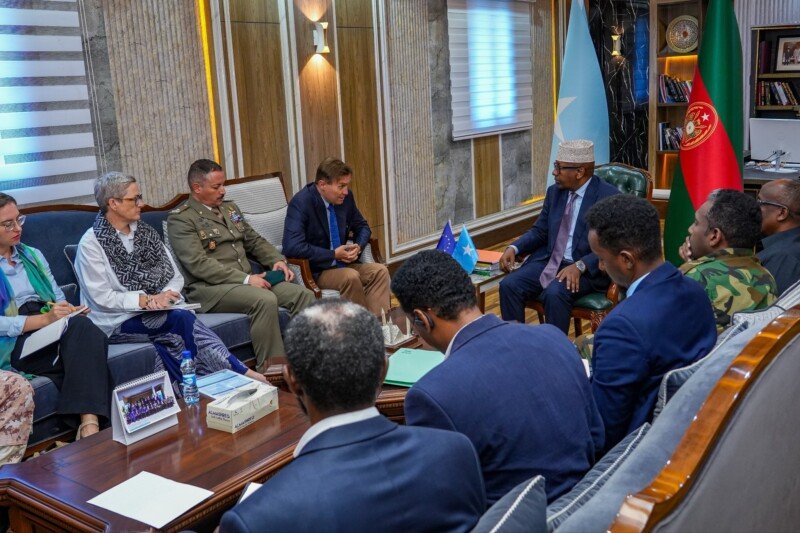
MOGADISHU, Defence Minister Ahmed Moallim Fiqi met with the European Union’s Ambassador to Somalia, László Máthé, on Saturday to discuss strengthening bilateral cooperation in defence, security, and capacity building for the Somali National Army.
According to a statement from the Ministry of Defence, the discussions focused on deepening the relationship between Somalia and the EU, particularly in support of Somali government-led efforts to eradicate terrorist groups in the country. Minister Fiqi expressed his appreciation for the EU’s multifaceted support for Somalia, especially its efforts to develop security institutions and build the capacity of the national army.
Fiqi also emphasized the importance of accelerating international cooperation aimed at strengthening the country’s security and stability. Ambassador Máthé reaffirmed the EU’s commitment to strengthening relations with Somalia and to supporting efforts aimed at ensuring the country’s security and development.
A Comprehensive Introduction to Somali Leadership
Saturday’s meeting is part of Ambassador Máthé’s broader introductory tour of Somali institutions since his arrival in September. The EU envoy has been systematically engaging with the executive, legislative, and security branches of the government to establish a comprehensive relationship with Mogadishu.
He formally presented his credentials to President Hassan Sheikh Mohamud in late September, marking the official start of his mission alongside Türkiye’s new ambassador, as reported in FTL Somalia’s coverage of the credentials ceremony. Prior to that, he presented copies of his letters of credence to Deputy Foreign Minister Hassan Mohamed Ali, where the two discussed peace, security, and governance cooperation, as detailed in FTL Somalia’s coverage of the initial meeting.
This week, Máthé met with Prime Minister Hamza Abdi Barre to discuss state-building, security, economic development, and social services, as reported in FTL Somalia’s coverage of the talks with the Prime Minister. He also engaged with the legislative branch, holding separate meetings with the Speakers of both the House of the People and the Upper House on the same day to discuss parliamentary capacity building and development projects, as detailed in FTL Somalia’s coverage of the parliamentary meetings.
Beyond the political leadership, Máthé has also engaged with Somalia’s economic and civil society sectors. He attended the Swedish-Somali business forum in Mogadishu to signal EU interest in agriculture, trade, and digitalisation, as noted in FTL Somalia’s coverage of the forum. He has also publicly reaffirmed the EU’s long-term security commitment to Somalia, stating the bloc “will be by your side” during a commemorative event, as reported in FTL Somalia’s coverage of the pledge.
The Strategic Context
The meeting comes at a critical juncture for Somalia’s security transition. The African Union mission is evolving, and international partners are increasingly focused on building the Somali National Army’s capacity to assume full responsibility for the country’s security. The EU’s role in this transition, through funding for AUSSOM and training through EUTM, is central to its success.
The EU remains one of Somalia’s most significant security partners, having approved a €75 million contribution to AUSSOM in April 2026, maintaining its position as the mission’s largest financial supporter. The bloc also supports Somali security forces through the European Union Training Mission in Somalia (EUTM-Somalia), currently led by Brigadier General Ivan Falasca.
Critical Note
The meeting between Minister Fiqi and Ambassador Máthé is a routine diplomatic engagement, but it takes place at a moment when Somalia’s security partnership with the EU is being tested on multiple fronts. The EU is funding the mission that protects Somali cities, training the soldiers who will eventually take over that responsibility, and paying for the political and governance reforms that are meant to make the whole enterprise sustainable.
Ambassador Máthé’s comprehensive tour of Somali institutions, from the President and Prime Minister to the parliamentary speakers and now the Defence Minister, reflects the breadth of the EU’s engagement. But this engagement is not unconditional. The EU’s budget support is tied to progress on democratisation and governance, and its patience with Somalia’s political crisis is not unlimited. The bloc has called for de-escalation and dialogue on the electoral dispute, and it has warned that its continued engagement depends on progress in key reform areas.
The EU’s security support is substantial, but it is also transitional. The bloc wants to see the Somali National Army take on a greater share of the burden, and it wants to see the political conditions in place that will allow its investments to endure. The meeting on Sunday was a reaffirmation of partnership. Whether that partnership produces a capable, accountable, and self-sufficient Somali security sector, or a permanent dependency on external funders, is the question that Fiqi and Máthé did not address in their public statements.
Recommended Reading On ftlsomalia.com
- President Hassan Sheikh Receives Credentials from New Turkish and EU Ambassadors
- Hamza Abdi Barre Holds First Talks with EU Envoy László Máthé
- Ambassador Máthé Meets Speaker Abdi Hashi: EU Commits to Federal and State Development Projects in Somalia
- EU Pledges Long-Term Security Support as Somalia Marks Nine Years Since Zobe Bombing
- Swedish Embassy Highlights Somalia’s Potential in Agriculture, Trade, and Digitalisation at Mogadishu Forum