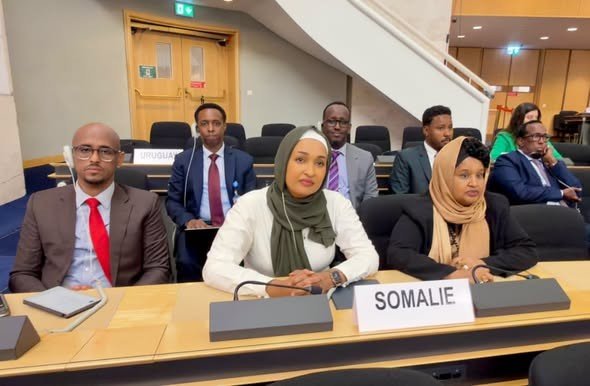
GENEVA — Somalia’s Minister of Family and Human Rights Development, Ambassador Khadija Mohamed Al-Makhzoumi, addressed the 63rd session of the UN Human Rights Council in Geneva on Thursday, outlining Somalia’s human rights commitments and calling for strengthened international support.
Her remarks were part of the interactive dialogue on the report of the Office of the UN High Commissioner for Human Rights (OHCHR) on Somalia, submitted pursuant to Human Rights Council resolution 60/28. The OHCHR report covers the period from October 9, 2025, to June 30, 2026.
Somalia’s Human Rights Progress
Minister Al-Makhzoumi stated that Somalia is ready to lead a new phase, fulfil its obligations, and work openly with the Council. She noted that the National Independent Human Rights Commission has secured leadership and members, and emphasised the need to strengthen its capacity and outreach to the public.
The Minister highlighted ongoing efforts to advance the rights of women, children, and families, including the ratification of key international treaties that Somalia has not yet joined and the completion of important legislative bills. As noted in the OHCHR report to the Council, Somalia has made progress in submitting initial reports under the Convention on the Rights of the Child, the Convention against Torture, the International Covenant on Economic, Social and Cultural Rights, and the International Covenant on Civil and Political Rights.
Somalia has also advanced constitutional, legislative, and institutional reforms. The report notes the launch of Somalia’s first national justice sector strategy, expanded legal aid and alternative dispute resolution systems, upgraded detention infrastructure, and human rights training for police, custodial officers, and prosecutors. The approval of the national anti-FGM bill in 2025 was cited as an important step, though the report acknowledges that progress depends on community engagement and shifting deeply rooted social norms.
UPR Commitments and OHCHR Support
Minister Al-Makhzoumi stated that Somalia has supported 259 of the recommendations from the fourth cycle of the Universal Periodic Review (UPR) and that efforts will be coordinated to follow up and implement them. The UPR Working Group reviewed Somalia on May 8, 2026, with the delegation led by Minister Al-Makhzoumi herself.
She called for the OHCHR office in Mogadishu to be fully operationalised and for support to be provided to protection institutions and services. The OHCHR report similarly requests continued international support, including concrete assistance to implement the host country agreement signed between OHCHR and the Somali government, to make the National Independent Human Rights Commission fully operational, and to continue strengthening the capacity of national institutions.
As reported in FTL Somalia’s coverage of Somalia’s human rights engagement in Geneva, Minister Al-Makhzoumi has previously met with the UK’s Ambassador for Human Rights, Eleanor Sanders, to discuss expanding collaboration on institutional reform. The UK delegation commended the establishment of the National Independent Human Rights Commission and praised the bilateral agreement finalised between the Somali Ministry and OHCHR.
Somalia committed to being open to cooperation and accountability, with progress measured by results that reach the people.
Critical Note
Minister Al-Makhzoumi’s address to the Human Rights Council reflects Somalia’s ongoing engagement with the international human rights system. The government has taken concrete steps in recent years, including the establishment of the National Independent Human Rights Commission, the approval of the anti-FGM bill, and the submission of overdue treaty body reports. These are not insignificant achievements for a country that has faced decades of conflict and institutional collapse.
However, the gap between commitments and implementation remains wide. The OHCHR report to the Council notes that poverty, food insecurity, displacement, and climate shocks continue to affect millions of Somalis. Justice sector gaps persist, along with challenges in detention safeguards, access to water and housing, services for persons with disabilities, women’s representation, and civic space. Violence against women and girls remains widespread, and harmful practices continue despite legal prohibitions.
The government’s pledge to support 259 UPR recommendations is a positive signal, but the real test is whether those recommendations translate into measurable improvements in the lives of ordinary Somalis. The call for the OHCHR office in Mogadishu to be fully operationalised is a recognition that international support and monitoring remain essential. The question is whether Somalia can sustain the momentum it has built and address the structural challenges that continue to undermine human rights protection across the country.