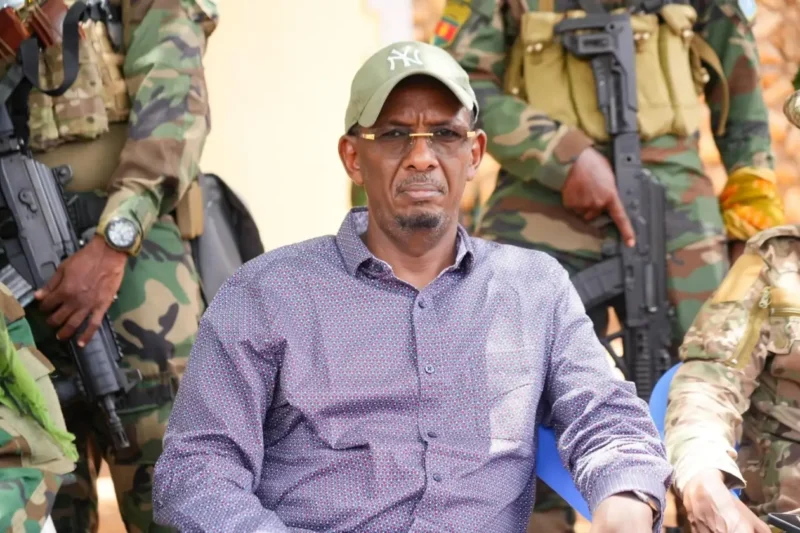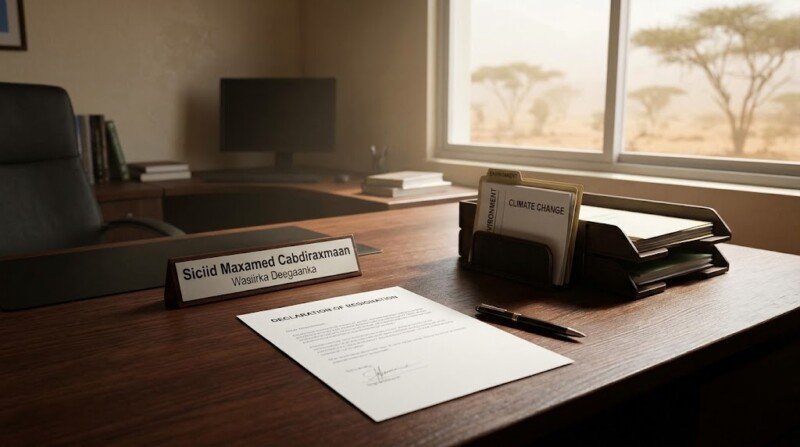
MOGADISHU, The Minister of Environment and Climate Change for the North Eastern State administration, Siciid Maxamed Cabdiraxmaan, announced on Friday that he has resigned from his ministerial post, according to a statement posted on his personal social media account.
The resignation, dated October 31, 2026, was announced without explanation. “Today, 31/10/2026, I hereby declare that I have officially resigned from the ministerial position of the North Eastern State administration,” the statement read. No reason was given for the decision, and no successor has been publicly named.
The departure is the latest signal of fragility within the newly formed federal member state, which was formally recognized by the Federal Government of Somalia in 2025 and has been working to establish its institutions amid contested territorial claims and internal political tensions.
A Cabinet Still Finding Its Footing
The North Eastern State, formerly known as SSC-Khaatumo, was declared Somalia’s sixth federal member state in July 2025 following a constitutional conference in Las Anod. President Abdikadir Ahmed Aw-Ali Firdhiye unveiled a 21-member cabinet in October 2025, describing it as “a cabinet of service, reform, and responsibility.” The environment portfolio held by Cabdiraxmaan was part of that inaugural team.
The state’s formation was a significant moment in Somalia’s federal trajectory, but it has also been marked by political instability. In July 2026, a member of the North Eastern State parliament, Fahiima Yuusuf Abdullahi Quuje, resigned and defected to Somaliland, renouncing the cause of Somaliweyn she had previously championed. As FTL Somalia reported, her defection underscored “the fragility of the North Eastern State’s political institutions, which are still in their infancy.”
The state has also faced external pressure. Somaliland and Puntland both claim the Sool, Sanaag, and Cayn regions that comprise the North Eastern State, and have rejected its creation. Somaliland has described the state as a “unilateral fait accompli” and has criticized UN engagement with Las Anod.
The Environment Portfolio in a Climate-Stressed Region
The resignation comes at a time when the North Eastern State faces significant environmental pressures. The region has been severely affected by the ongoing drought crisis and now by El Nino, and the environment ministry’s mandate includes climate adaptation and natural resource management in a territory that is both arid and contested.
In September 2026, the state’s Minister of Energy and Water Resources, Abdi Hassan Hijar, led a delegation to assess the Qabribayax water catchment, highlighting the administration’s focus on water infrastructure and rehabilitation. The environment ministry, now without a minister, would ordinarily play a role in such efforts.
The federal government has also been engaged in the region. Prime Minister Hamza Abdi Barre visited Las Anod in August 2026 for the first anniversary of the state’s founding, and federal ministries have delivered medical aid and other support. The resignation of a state minister does not directly affect federal programs, but it adds to the perception of administrative instability in a region the federal government has invested political capital in.
Critical Note
A single ministerial resignation is not a crisis. Cabinet reshuffles and departures happen in every government, and the absence of a stated reason does not necessarily imply scandal or breakdown. But in a state that is less than two years old, with institutions still being built and political loyalties still being tested, every departure carries more weight than it would in a consolidated democracy.
The North Eastern State was created with federal backing and international attention, but its political foundation remains shallow. The defection of a parliamentarian to Somaliland in July, and now the resignation of a minister without explanation, suggest that the administration’s internal cohesion is not yet assured. The state’s opponents in Hargeisa and Garowe will read these developments as evidence of weakness.
The federal government has invested in the North Eastern State as a counterweight to Somaliland’s claims and as a demonstration of Mogadishu’s commitment to the federal project. But building a state requires more than recognition and a cabinet list. It requires institutions that can retain their officials, manage disputes internally, and deliver services under pressure. On that measure, the resignation of Cabdiraxmaan is a small data point in a larger question: whether the North Eastern State can mature into a functioning federal member, or whether it will remain a project sustained by external support and vulnerable to the centrifugal forces that have shaped Somali politics for decades.
Recommended Reading On ftlsomalia.com
- Somaliland Welcomes Defection of North Eastern State MP Who Once Fought Against Hargeisa
- Firdhiye Unveils 21-Member Cabinet for Somalia’s Northeastern State
- North Eastern State Officials Assess Qabribayax Water Catchment for Rehabilitation
- President Hassan Sheikh Mohamud Declares North East State Full Federal Member