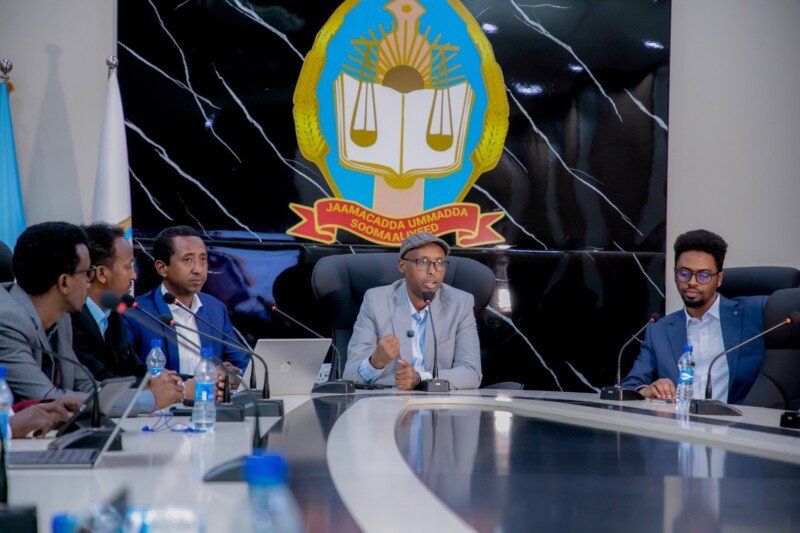
MOGADISHU — The Somali National Artificial Intelligence Centre (SNAIC) at the Somali National University hosted a debate in Mogadishu this week on the future of artificial intelligence in Somalia, bringing together representatives from universities, technology companies, and other institutions to discuss strengthening the country’s AI foundation and developing coordinated approaches.
The debate focused on five priorities for developing Somalia’s AI sector: establishing dedicated AI centres or offices; developing policies to guide responsible AI use; advancing AI knowledge and literacy; producing high-level Somali experts; and developing local solutions based on AI applications in health, agriculture, education, and trade.
Dr. Mohamed Sheikh Adam Isaaq, Director of the Somali National AI Centre, emphasized the priorities needed to strengthen Somalia’s AI foundation. “To build the future of our country’s AI, we need to invest in developing high-level experts, strengthen AI knowledge, and encourage its responsible use,” he said. “It is also important that institutions develop solutions that respond to Somalia’s needs and priorities.”
Professor Fuad Mire Hassan, Vice President for Planning and Development at Somali National University, opened the meeting and spoke about the importance of establishing a coordinated system and strong cooperation among key stakeholders.
“Developing our country’s AI requires coordinated effort. Universities, government, businesses, and other institutions each have an important role, and it is essential to strengthen cooperation between them to raise existing capacity, strengthen institutions, and develop the solutions needed for the future of Somalia’s AI,” Professor Fuad said.
Key Themes and Outcomes
During the debate, participants discussed the role of universities in producing experts skilled in AI and encouraging universities and companies to establish dedicated AI centres or offices. They also addressed the need for a campaign to expand AI knowledge and teach the public about appropriate and responsible use, emphasising the importance of institutions having policies to guide AI use, including data protection, ethics, and accountability.
The debate concluded with recommendations and the identification of stakeholder responsibilities, which will form the basis of a policy brief to be shared with the Federal Government of Somalia, higher education institutions, other institutions, and businesses. SNAIC will coordinate the follow-up on the recommendations from the meeting.
Somalia’s Growing AI Ecosystem
The debate reflects Somalia’s broader push to build domestic capacity in artificial intelligence and digital transformation. The Somali National University officially launched the Somali National Artificial Intelligence Centre in July 2026 as a Centre of Excellence for AI research, education, innovation and capacity building.
The Centre’s establishment followed a series of high-level engagements signalling Somalia’s growing commitment to artificial intelligence. At the East Africa Science and Technology Commission summit, Somalia presented a comprehensive plan for AI adoption, positioning itself as a key innovator in the East African Community’s digital transformation strategy.
In July 2026, Minister of Communications and Technology Mohamed Adam Maalim (Soomaali) led Somalia’s delegation to the International Dialogue on AI Governance in Geneva, where he called for strengthened international cooperation to ensure that all nations benefit equitably from AI’s potential. It was the first time Somalia participated in a global AI governance forum.
The private sector has also been active. Hormuud Telecom and the German Agency for International Cooperation (GIZ) signed an agreement in March 2026 to develop an inclusive digital economy, including AI training programs tailored to boost youth employment.
President Hassan Sheikh Mohamud has also warned the UN Security Council of AI’s dual edge on global security, stressing that unregulated use of AI and other emerging technologies could exacerbate instability, while noting that weaker states are especially vulnerable.
Critical Note
The AI debate at Somali National University reflects a growing recognition that Somalia cannot afford to be a passive consumer of artificial intelligence technologies developed elsewhere. The five priorities identified, from establishing dedicated AI centres to producing local experts and developing homegrown solutions, address the core challenge: building a domestic AI ecosystem that responds to Somali needs rather than importing solutions designed for different contexts.
The emphasis on responsible AI use, including data protection, ethics, and accountability, is particularly important. Somalia’s digital infrastructure is still developing, and the governance frameworks needed to protect citizens from AI-related harms, including surveillance, disinformation, and algorithmic bias, are not yet in place. The National Artificial Intelligence Policy launched earlier this year is a positive step, but its implementation will determine whether Somalia adopts AI in a way that serves the public interest or enables new forms of abuse.
The practical challenge is resources and expertise. Somalia’s AI sector remains nascent, and the country faces a significant skills gap. The commitment to producing high-level Somali experts is essential, but it will require sustained investment in education and training, as well as opportunities for graduates to apply their skills domestically. Without those pathways, Somalia risks losing its best talent to emigration, a pattern that has plagued other sectors. The debate is a necessary first step. Whether it translates into a coherent national AI strategy with the funding and institutional backing to succeed remains to be seen.
Recommended Reading On ftlsomalia.com
- Somali National University Launches National Artificial Intelligence Centre to Drive Digital Transformation
- Somalia Leads AI Integration in East African Community
- Somalia’s Communications Minister Calls for Inclusive AI Governance at UN Summit in Geneva
- Hormuud Telecom and GIZ Sign Agreement to Boost East Africa’s Digital Economy
- Somali Leader Warns UN of AI’s Dual Edge on Global Security
- Somalia Makes Major Digital Transformation Advances