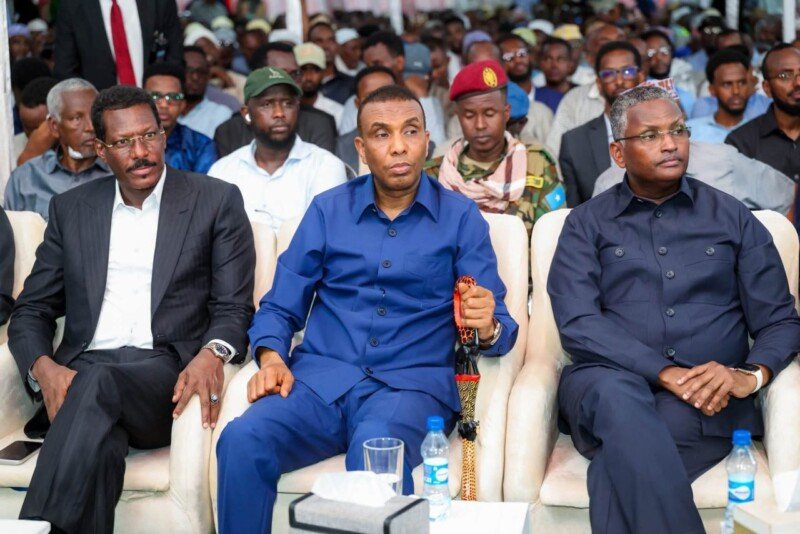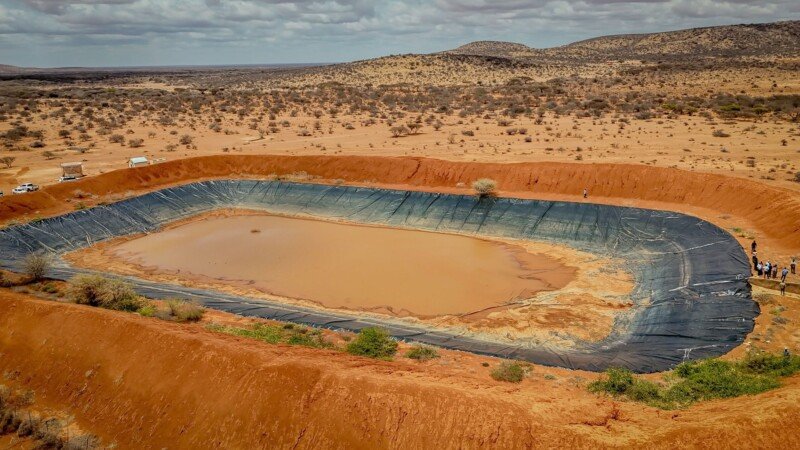
QABRIBAYAX — The Minister of Energy and Water Resources of the North Eastern State, Abdi Hassan Hijar, led a delegation to the Qabribayax area on Thursday to assess the condition of the Qabribayax water catchment and identify maintenance and rehabilitation requirements.
The delegation included the Deputy Minister of Environment and Climate Change, Abbas Yaqub, and the Director of the Technology and Public Relations Department at the Ministry of Water, Hana. Also participating were the Head of the Alight organization, Mohamed Abdullahi Haji, and the Area-Based Coordinator, Mawlid Abdirahman.
The purpose of the visit was to evaluate the water catchment’s current state and determine what interventions are needed to restore its functionality. According to the delegation, the facility is of great importance to the local community, as it plays a vital role in water storage and meeting the community’s needs, particularly during periods of water scarcity.
Water Infrastructure in the North Eastern State
The assessment visit reflects the regional administration’s focus on strengthening water infrastructure in a region that has faced significant humanitarian challenges, including drought, displacement, and food insecurity. SoDMA Commissioner Mahamuud Moallim Abdulle inaugurated the North Eastern State Emergency Response Center in Laascaanood in August 2026, a newly completed facility designed to accelerate humanitarian response and strengthen disaster preparedness in the region. The facility was fully constructed with support from SoDMA and the Chinese government.
The inauguration came at a critical time for the North Eastern State, which has faced significant humanitarian challenges including drought, displacement, and food insecurity, with over 280,000 people displaced since February 2026.
Water catchments, sometimes referred to as water pans, are essential infrastructure in arid and semi-arid regions of Somalia. They collect and store surface runoff during rainy seasons, providing a reliable water source for communities and livestock during dry periods. Unlike large dams, these catchments are typically community-scale facilities designed to serve local needs.
Contested Territory and Regional Dynamics
The North Eastern State, formerly known as SSC-Khaatumo, was formally declared as Somalia’s sixth federal member state in July 2025 following a Grand Constitutional Conference in Las Anod. The National Consultative Council officially recognized SSC-Khaatumo as a Federal Member State, emphasizing that the process must adhere to the framework outlined in the Provisional Constitution.
The Federal Government of Somalia officially recognized SSC-Khaatumo as an interim federal member state in October 2023, acknowledging its authority over the Sool, Sanaag, and Cayn regions. This recognition followed a four-day visit by Prime Minister Hamza Abdi Barre to Las Anod.
The state’s formation has drawn strong opposition from both Somaliland and Puntland, who claim the Sool, Sanaag, and Cayn regions as part of their respective territories. Somaliland has described federal engagement in the region as “a provocative step” that threatens regional stability, and has called on the African Union, IGAD, and the United Nations to intervene against what it describes as unilateral actions by the Federal Government.
The North Eastern State administration relies heavily on qat tax revenue to sustain its limited operations, and a growing dispute between qat traders and the administration over taxation and security has threatened to escalate into wider violence. The administration faces a difficult balancing act in maintaining revenue streams while addressing the legitimate security concerns of traders.
The Minister of Security for the North Eastern State, Senior Colonel Abdirazak Farah, has met with senior officials from the United States Africa Command (AFRICOM) to strengthen security cooperation and coordination, focusing on capacity building and intelligence sharing.
Critical Note
The assessment of the Qabribayax water catchment underscores the importance of maintaining community-level water infrastructure in Somalia’s water-scarce regions. While large-scale projects attract significant international funding and attention, smaller catchments serving pastoralist and rural communities often receive less investment, despite their critical role in daily survival.
The involvement of the Alight organization in the assessment suggests that humanitarian partners are engaged in supporting these efforts. However, the long-term sustainability of such facilities depends on clear maintenance responsibilities, community management structures, and adequate funding. Without these, water catchments risk falling into disrepair again after rehabilitation, leaving communities vulnerable to future water shortages.
The North Eastern State administration’s attention to this infrastructure is a positive signal. Whether the assessment translates into concrete rehabilitation work will depend on resources being mobilized and a clear plan being established for ongoing maintenance. For a region facing significant humanitarian challenges, including drought and displacement, investment in water infrastructure is both a practical necessity and a measure of the administration’s capacity to deliver services to its constituents.
Recommended Reading On ftlsomalia.com
- New Emergency Response Center Launched in North Eastern State to Boost Disaster Preparedness
- North Eastern State Security Minister Engages U.S. AFRICOM on Counterterrorism Efforts
- NCC Recognizes SSC-Khaatumo as a Federal Member State
- Somali Government Officially Recognises SSC-Khaatumo as a Federal Member State
- PM Hamse’s Las Anod Visit Draws Public Support and Somaliland Condemnation