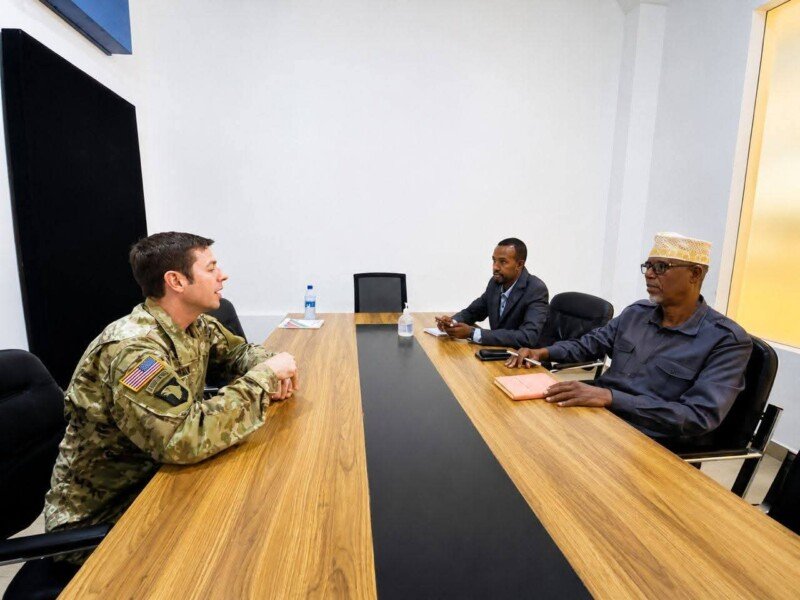
MOGADISHU — The Minister of Security for the North Eastern State administration, Senior Colonel Abdirazak Farah, held a meeting in Mogadishu with senior officials from the United States Africa Command (AFRICOM), focusing on strengthening security cooperation and coordination between the two sides.
The meeting, which took place in the Somali capital on September 5, 2026, centered on enhancing regional security and specifically discussed ways to advance collaboration and coordination of efforts to counter security threats in the region.
Focus on Capacity Building and Intelligence
Both sides discussed elevating their partnership and exchanging expertise, with a view to strengthening the capabilities of the North Eastern State security forces and addressing existing security challenges. The discussions underscore the shared interest in building institutional capacity to manage and mitigate complex security environments.
The North Eastern State administration stated that the talks are part of broader efforts to strengthen ties and security cooperation between the regional state and international partners. The meeting also comes amid a broader push by Washington to deepen security ties with Somalia’s regional member states, a strategy that has previously included direct military dialogue with regional administrations.
A State in the Making
The North Eastern State, formerly known as SSC-Khaatumo, was formally declared as Somalia’s sixth federal member state in July 2025 following a Grand Constitutional Conference in Las Anod attended by 417 delegates representing traditional elders, civil society, political leaders, and community groups from across the region. The state’s formation was officially recognized by the Federal Government of Somalia on July 31, 2025, with Las Anod as its capital.
The new state’s leadership has been actively working to establish its institutions and secure its place within Somalia’s federal framework. Prime Minister Hamza Abdi Barre visited Las Anod in August 2026 for the first anniversary celebrations of the state’s founding, marking a significant moment in the federal government’s engagement with the region and signaling its commitment to integrating the North Eastern State into the federal system. The visit included the rollout of public service and development initiatives in the region.
SoDMA Commissioner Mahamuud Moallim Abdulle also visited Laascaanood in August to bolster humanitarian response efforts and oversee the launch of a new drought relief programme targeting vulnerable families across the region, which has been severely affected by the ongoing drought crisis.
Contested Territory and Regional Opposition
The North Eastern State’s formation has drawn strong opposition from both Somaliland and Puntland, who claim the Sool, Sanaag, and Cayn regions as part of their respective territories. The dispute stems from overlapping claims by Somaliland (resulting from colonial-era borders), Puntland (on clan-based grounds), and the federal government of Somalia.
Somaliland has firmly rejected the creation of the North Eastern State on territories it considers under its jurisdiction, viewing it as a unilateral fait accompli that bypasses dialogue and an attempt by Mogadishu to exert political influence through tribal affiliations. In a rare moment of cooperation, Somaliland and Puntland have reached a rare agreement to jointly oppose the creation of the North Eastern State, a move they both view as destabilizing.
Puntland similarly perceives the move as a direct threat to its territorial integrity and political authority, accusing the Federal Government of Somalia of complicity in fragmenting the country. Somaliland has also criticized UN visits to Laascaanood, insisting that engagements in politically sensitive areas should be conducted through established diplomatic channels with prior coordination with authorities in Hargeisa.
The fragility of the North Eastern State’s political institutions was highlighted by the defection of parliamentarian Fahiima Yuusuf Quuje to Somaliland in July 2026, a significant propaganda victory for Hargeisa that underscored the fluid nature of political allegiances in the region.
Strategic Implications of AFRICOM Engagement
The meeting between the North Eastern State Security Minister and AFRICOM officials carries significant strategic implications. For the North Eastern State, direct engagement with the United States military command provides an opportunity to bolster its security capabilities and demonstrate its viability as a federal member state.
For the Federal Government of Somalia, which has actively supported the North Eastern State’s formation as part of its strategy to consolidate control over disputed northern territories, the engagement with AFRICOM reinforces Mogadishu’s sovereignty claims over the contested Sool, Sanaag, and Cayn regions.
However, for both Somaliland and Puntland, any cooperation between the North Eastern State and AFRICOM represents a further cementing of the political loss of territories they claim. The engagement could be viewed as international validation of the new state, undermining Somaliland’s secessionist narrative and Puntland’s territorial claims.
The direct security cooperation between the North Eastern State and AFRICOM also raises questions about the future of U.S. engagement in the region and its implications for the broader struggle over Somalia’s territorial integrity.
Critical Note
The meeting between the North Eastern State’s Security Minister and AFRICOM officials represents a significant step in deepening security cooperation between the newly formed regional administration and the United States. By engaging directly with AFRICOM, the North Eastern State is seeking to bolster its security capabilities and demonstrate its viability as a federal member state.
However, this direct engagement with a regional state may also be viewed with suspicion by both Somaliland and Puntland, which have rejected the North Eastern State’s formation as illegitimate and an infringement on their territorial claims. The engagement could be interpreted as international validation of the new state, undermining Somaliland’s secessionist narrative and Puntland’s territorial claims.
The North Eastern State’s formation was part of the federal government’s strategy to consolidate control over disputed northern territories and counter separatist movements. The U.S. engagement with the North Eastern State could be seen as supporting this strategy, further inflaming tensions with Somaliland and Puntland. The Biden administration has maintained its support for Somalia’s sovereignty and territorial integrity, but direct security cooperation with regional states complicates this policy and raises questions about the future of U.S. engagement in the region.
For the North Eastern State, the road to full integration into Somalia’s federal system remains fraught with challenges. The region’s political institutions are still in their infancy, its governance capacity is untested, and it faces ongoing opposition from both Somaliland and Puntland. Without inclusive dialogue and a broader reconciliation process that addresses the concerns of all stakeholders, the North Eastern State’s long-term viability remains uncertain.
Recommended Reading On ftlsomalia.com
- Prime Minister Hamse Arrives in Las Anod for North Eastern State Anniversary Celebrations
- SoDMA Chief Arrives in Laascaanood as North Eastern State Faces Severe Drought Crisis
- Somaliland Criticises UN Delegation’s Visit to Las Anod Amid Territorial Dispute
- Somaliland Welcomes Defection of North Eastern State MP