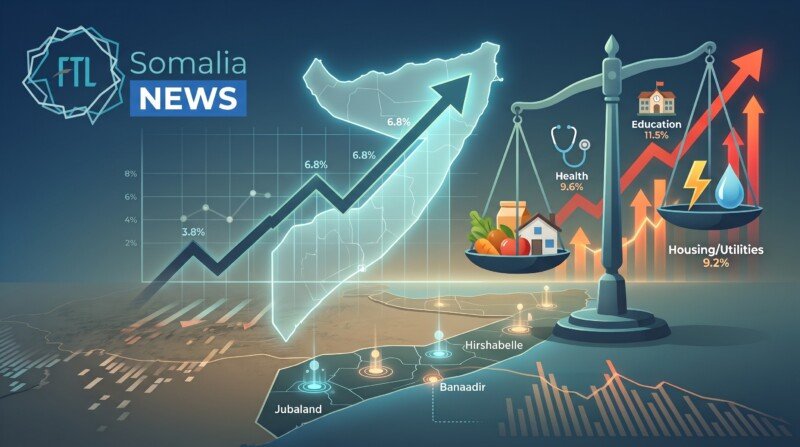
MOGADISHU, Somalia’s year-on-year inflation rate stood at 6.8 percent in September 2026, according to the latest Consumer Price Index report from the Somali National Bureau of Statistics, a figure that masks sharp differences in which prices are rising, where they are rising fastest, and what it means for households across the country.
The headline number is virtually unchanged from August, when annual inflation was 6.9 percent, and July, when it was 6.7 percent. On a monthly basis, prices rose 0.5 percent in September, following increases of 0.4 percent in August and 0.6 percent in July. The stability at the national level, however, conceals a more volatile picture beneath the surface.
The Services Squeeze: Where Prices Are Rising Fastest
The steepest annual price increases were not in food or fuel, but in services. Recreation, sport, and culture recorded the highest annual increase at 14.3 percent, driven by higher costs in cultural and recreational activities. Restaurants and accommodation services rose 13.7 percent. Education services climbed 11.5 percent, and health costs rose 9.6 percent.
Housing, water, electricity, gas, and other fuels, the category that most directly affects household budgets, rose 9.2 percent over the year. The increase reflects both higher utility costs and the knock-on effects of the electricity tariff hikes announced by Mogadishu’s power providers in late October, as reported in FTL Somalia’s coverage of the tariff increase.
Only one category recorded an annual decline: alcoholic beverages, tobacco, and narcotics, which fell 0.4 percent.
The Monthly Picture: Food Is Back on the Rise
While the annual figures are dominated by services, the monthly data shows food prices beginning to climb again. Food and non-alcoholic beverages rose 1.0 percent in September, the second-largest monthly increase after personal care and social protection, which rose 1.2 percent. Health costs rose 0.9 percent month-on-month, and restaurants and accommodation rose 0.7 percent.
These monthly increases were partially offset by declines in information and communication (-0.7 percent), education services (-0.7 percent), housing and utilities (-0.3 percent), and recreation and culture (-0.3 percent). The monthly data suggests that the inflationary pressure is rotating between categories rather than easing overall.
One Country, Six Price Realities
The national average conceals significant differences between federal member states. In September 2026, Jubaland recorded the highest monthly inflation at 1.1 percent, reflecting price increases across several consumption divisions. Hirshabelle followed at 0.7 percent, supported by increases in transport and other household expenditure categories. South West State rose 0.6 percent, Puntland 0.4 percent, and Banaadir 0.2 percent. Galmudug recorded no monthly change at all.
| State | July 2026 | August 2026 | September 2026 |
|---|---|---|---|
| National Total | 0.6% | 0.4% | 0.5% |
| Banaadir | 2.9% | -0.8% | 0.2% |
| Puntland | 0.6% | 0.6% | 0.4% |
| Galmudug | 1.2% | -0.2% | 0.0% |
| Hirshabelle | -1.1% | 4.1% | 0.7% |
| Jubaland | 0.3% | -1.8% | 1.1% |
| South West State | -0.8% | 1.3% | 0.6% |
The divergence is not new. Over the past three months, Banaadir saw a sharp spike of 2.9 percent in July before falling 0.8 percent in August and rising 0.2 percent in September. Hirshabelle recorded a decline of 1.1 percent in July, then a surge of 4.1 percent in August, followed by a 0.7 percent rise in September. Jubaland moved from 0.3 percent in July to -1.8 percent in August and then 1.1 percent in September. The volatility across states suggests that local supply conditions, security incidents, and transport costs are driving prices at least as much as national monetary conditions.
Why Students Are Protesting
The CPI figures offer a partial explanation for the student protests that erupted in Mogadishu and several regional capitals in recent days. Students took to the streets to demand lower tuition fees, and new fees that the FGS Minister of Education has allegedly proposed, arguing that the cost of education has become unaffordable for ordinary families.
The data supports their case. Education services recorded an annual price increase of 11.5 percent, one of the steepest rises in the entire index. Combined with the 9.2 percent increase in housing and utilities, and the 1.0 percent monthly rise in food prices, students face a cost-of-living squeeze that affects every aspect of their daily lives. The protestors’ demand for fee relief is not a political slogan. It is a direct response to the arithmetic of the CPI, which shows that the cost of studying, eating, and sheltering has risen faster than most household incomes.
The Broader Economic Context
The CPI data comes amid a broader slowdown. The IMF has cut Somalia’s 2026 growth forecast to 2.3 percent, below the population growth rate, meaning real GDP per capita is contracting, as reported in FTL Somalia’s coverage of the IMF forecast. The World Bank has warned that rising inflation and weaker agricultural activity will erode household purchasing power, slowing poverty reduction.
President Hassan Sheikh Mohamud told the UN General Assembly in September that the Hormuz disruption had caused Somalia’s customs revenue to drop by approximately 40 percent, compounding the fiscal pressure on a government already stretched by security and humanitarian obligations, as reported in FTL Somalia’s coverage of the revenue decline.
Critical Note
The September CPI report is, on its face, a story of stability. Inflation at 6.8 percent is lower than it was earlier in the year, when the annual rate hovered above 8 percent. But stability at the national level is not the same as stability for households. The categories that are rising fastest, recreation, restaurants, education, and health, are the ones that matter most for urban middle-class families. And the housing and utilities category, which affects everyone, is up 9.2 percent.
The student protests are a reminder that inflation statistics are not abstractions. A 11.5 percent rise in education costs is not just a line in a table. It is the reason a student in Mogadishu cannot afford to register for the next semester. A 1.0 percent monthly rise in food prices is not a rounding error. It is the reason a family cuts back on meals. The CPI measures prices, but it does not measure the choices that people are forced to make when prices rise and incomes do not.
The state-level divergence is the most politically significant finding. Jubaland’s 1.1 percent monthly increase and Hirshabelle’s 0.7 percent are not just statistical variations. They reflect different local economic conditions, different levels of security, and different degrees of integration with national markets. A national inflation rate that averages these differences may satisfy the Central Bank, but it does not describe the experience of a family in Kismayo or Beledweyne.
The report’s most important limitation is that it measures prices, not purchasing power. A 6.8 percent inflation rate in an economy where per capita GDP is contracting, according to the IMF, means that households are being squeezed from both directions. Prices are rising while incomes are stagnant or falling. The CPI does not capture that dynamic, but the students in the streets do.