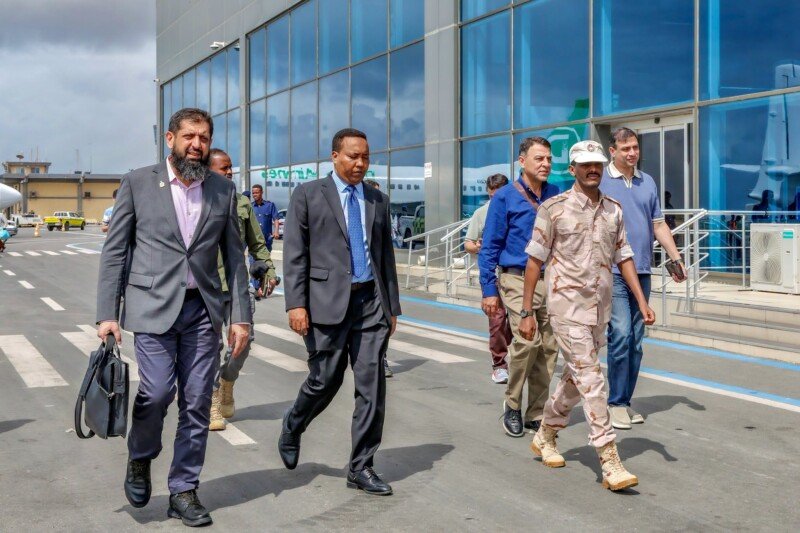
MOGADISHU — A senior delegation from the Pakistan Air Force has returned to Islamabad after a five-day working visit to Somalia focused on rebuilding and developing the Somali Air Force.
The delegation held meetings with national leaders and with the Somali Air Force command on developing institutional and professional capability and on strengthening cooperation between the two sides. The Commander of the Somali Air Force, Brig. Gen. Abdirisak Mahmoud Haji, and the Commander of the Joint Operations Command, General Mohamed Ali Bariise, saw the delegation off at Aden Adde International Airport.
High-Level Engagements
The visit followed a series of high-level meetings in Mogadishu. On September 19, President Hassan Sheikh Mohamud received the delegation at the Presidential Palace, accompanied by Defence Minister Ahmed Moallim Fiqi, Somali National Army Commander Brig. Gen. Ibrahim Mohamed Mohamud, and Somali Air Force Commander Brig. Gen. Abdirisaaq Mahmoud Haji.
Prime Minister Hamza Abdi Barre also met the delegation, discussing the development of the Somali Air Force, enhancing its capabilities, and improving the training and quality of its personnel.
At the Somali Air Force headquarters, the delegation held talks focused on priorities for rebuilding and developing the force, including organizational structure, leadership and professional capabilities, specialized training programmes, and the exchange of expertise. The two sides discussed building sustainable institutional capacity aligned with Somalia’s security needs and establishing mechanisms for ongoing cooperation.
A Framework Already in Place
The visit follows a Memorandum of Understanding on defence cooperation signed in August 2026 between Somalia and Pakistan’s defence ministries. That agreement provides a framework for cooperation in counterterrorism, military training, exchange of military expertise, defence capability development and broader security cooperation.
During an August 2026 visit to Islamabad by a Somali defence delegation led by Minister Fiqi, discussions at Air Headquarters focused on bilateral defence cooperation, professional collaboration, and capacity building. The Chief of the Air Staff reaffirmed the Pakistan Air Force’s commitment to supporting institutional cooperation with the Somali Air Force.
Somalia is also in advanced negotiations with Pakistan to purchase up to 24 JF-17 Thunder Block III fighter jets in a potential $900 million agreement, as reported in FTL Somalia’s coverage of the fighter jet negotiations. The deal, if finalized, would mark Somalia’s most ambitious military procurement since the collapse of the state in 1991.
Critical Note
The five-day visit marks a practical step in implementing the August defence agreement and signals Pakistan’s willingness to support Somalia’s air force rebuilding efforts over the long term. The engagement is part of a broader pattern of expanding defence cooperation between Mogadishu and Islamabad, which has accelerated since late 2025.
The visit also underscores Somalia’s strategy of diversifying its security partnerships. While Türkiye remains the most visible external actor in Somali security, with its TURKSOM base and training programmes, Somalia has been actively cultivating relationships with other partners including Egypt and Pakistan. As reported in FTL Somalia’s coverage of Somali commandos training in Egypt, each partnership brings different capabilities and different political considerations.
The potential JF-17 acquisition remains the most consequential element of the Pakistan relationship. If finalized, it would give Somalia a credible air combat capability for the first time in decades. But the challenges are significant: financing the $900 million deal, building the infrastructure to operate and maintain a modern fighter fleet, and training pilots and technicians to sustain it. Pakistan’s track record of providing embedded training and support for JF-17 exports to Nigeria and Myanmar offers a model, but Somalia’s institutional capacity is far weaker than those countries.
For now, the visit is a signal of intent rather than a deliverable. The framework is in place, the political will appears to exist on both sides, and the operational cooperation is beginning. Whether that translates into a functioning Somali air force capable of defending its own airspace remains years away.
Recommended Reading On ftlsomalia.com
- Pakistan Air Force Delegation Arrives in Mogadishu for Air Defence Talks
- President Hassan Sheikh Receives Senior Pakistan Air Force Delegation at Villa Somalia
- Somalia Advances $900M Deal for Pakistani JF-17 Fighter Jets to Rebuild Air Force
- Somali Commandos Return from Egypt After High-Level Military Programme