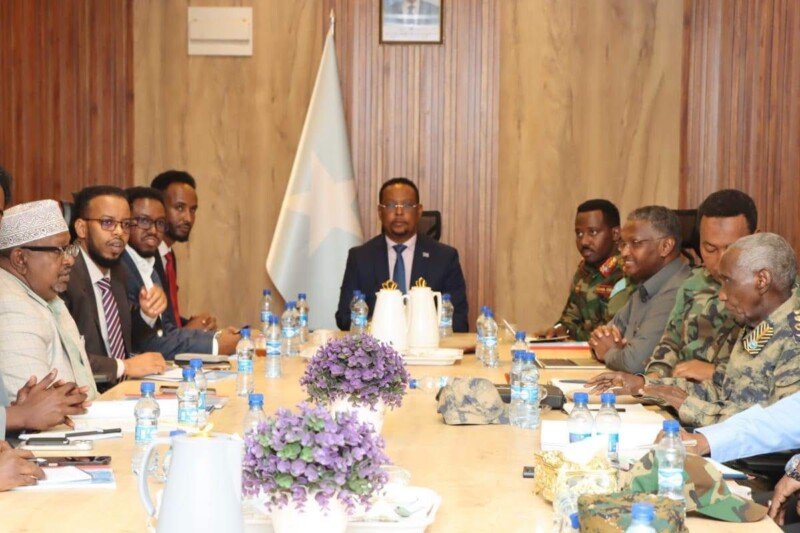
MOGADISHU, The Defence Committee of the House of the People met with security service commanders on Sunday at Villa Hargeisa, agreeing to incorporate the commanders’ recommendations into the draft National Defence Bill currently before Parliament.
The meeting was chaired by committee chairman MP Yusuf Geele Ugaas and attended by Somali National Army Commander Brig. Gen. Ibrahim Mohamed Mahmoud, along with National Intelligence and Security Agency Director Mahad Mohamed Salad and senior armed forces officers. The commanders presented suggestions on the draft legislation, which the committee accepted for inclusion, citing the bill’s importance to national defence.
A Bill Years in the Making
The National Defence Bill has been under development for several years. The Council of Ministers approved an earlier version in December 2025, as reported in FTL Somalia’s coverage of the Cabinet approval [citation:4]. The legislation is intended to replace statutes inherited from the previous military government and establish a modern legal framework for the armed forces.
The commander attending Sunday’s meeting, Brig. Gen. Ibrahim Mohamed Mahmoud, was appointed in January 2026 as part of a deliberate shift toward professionalization. Mahmoud is regarded as a “scholar-soldier” with master’s degrees from the Turkish National Defense University and prior experience as Commander of the SNA Sustainment Command. His appointment was framed as an effort to build a professional, non-partisan national army.
NISA Director Mahad Mohamed Salad, who also attended the meeting, has been a central figure in Somalia’s security architecture. He recently concluded a visit to the United States for high-level talks with CIA and FBI officials aimed at expanding intelligence-sharing, as reported in FTL Somalia’s coverage of NISA’s activities.
The Broader Reform Context
The Defence Committee’s consultation with commanders is part of a wider security sector reform effort. In April 2026, Defence Minister Ahmed Moallim Fiqi participated in a Security Sector Governance Review with the World Bank and international partners, focusing on accountability, institutional reform, and the legal framework governing the armed forces. The Minister emphasised that the Defence Bill is a key component of this reform agenda, as reported in FTL Somalia’s coverage of the governance review.
The reform process also includes a nationwide force census and biometric registration, with the Ministry moving toward a monthly personnel verification system linked to payroll and duty station presence. These measures are intended to address long-standing challenges of ghost soldiers and financial mismanagement within the security sector.
Critical Note
The Defence Committee’s consultation with military commanders is a routine legislative step, and incorporating their input into a bill that governs their own institution is sensible practice. But the timing and context of this consultation invite scrutiny that the committee’s brief statement does not address.
Somalia’s political crisis has raised fundamental questions about civilian control of the military. The opposition has accused the federal government of using security forces to consolidate power, and the army commander’s own movements have been the subject of political speculation. A National Defence Bill that claims to prevent the military from being used for political purposes is, in this environment, not merely a technical piece of legislation. It is a statement of intent that will be measured against the government’s actions.
The specific recommendations submitted by the commanders have not been made public. Whether those recommendations strengthen civilian oversight or expand military autonomy is a question the committee has not answered. The bill’s passage through Parliament will be the first test of whether it serves as a genuine framework for professional, accountable armed forces, or as a legal veneer for the existing power arrangements. The commanders who advised on the bill will be among those governed by it. In the complicated Somalia context, that is a conflict of interest that the legislative process should acknowledge, not obscure.
Recommended Reading On ftlsomalia.com
- Somalia Cabinet Approves Defense, Finance, and Social Welfare Bills
- General Ibrahim Mohamud Named New Somali Army Commander
- Defence Minister Joins Security Sector Governance Review, Highlights Accountability and Institutional Reform
- NISA Chief, Former President Discuss Security Ahead of June 4 Protests