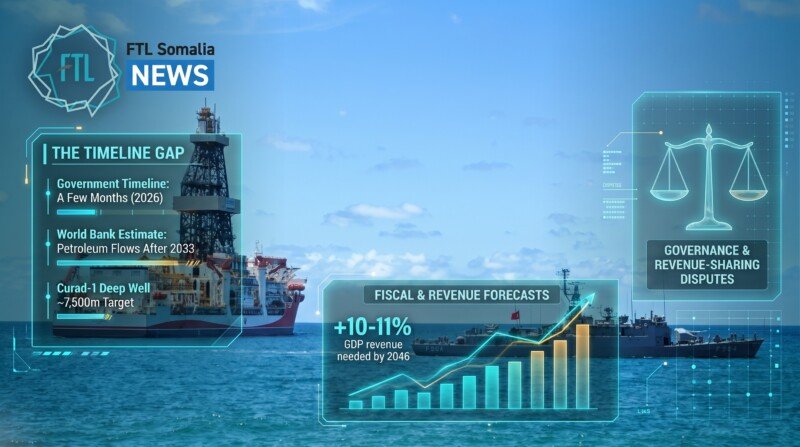
MOGADISHU, Somali officials have spent the past year promoting the country’s offshore oil potential as a transformative economic opportunity, with President Hassan Sheikh Mohamud visiting the Turkish drillship Çağrı Bey in October to receive a briefing on exploration progress. Prime Minister Hamza Abdi Barre was even more direct at the vessel’s arrival ceremony in April, stating: “God willing, in a few months we will celebrate the first oil extraction.”
But the World Bank’s 2026 Public Finance Review offers a sobering corrective to that timeline. The report models petroleum revenues as a long-term prospect, assuming oil begins flowing only after 2033, based on comparator country experience. Even under this optimistic scenario, the report estimates that Somalia would need an additional 10 to 11 percentage points of GDP in revenue by 2046, mostly from petroleum, to reach peer levels.
A Decade of Difference
The gap between the government’s rhetoric and the World Bank’s modeling is not a matter of months. It is a matter of years, and the difference has profound implications for how Somalia should approach its fiscal crisis.
In April 2026, Turkey’s Energy Minister Alparslan Bayraktar announced that offshore drilling could lead to oil production within six to nine months, contingent on maritime and weather conditions. The Somali government amplified this message, presenting the Curad-1 well as the threshold of an economic transformation. The nine-month projection became the government’s headline.
The World Bank’s 2033 date reflects a more sober assessment of what it takes to move from a single exploration well to a producing field. Even if Curad-1 confirms a commercial discovery, the path to revenue requires appraisal drilling to determine the size of the reservoir, development planning to design production infrastructure, export logistics to move the oil to market, and a fiscal and regulatory framework that can withstand political scrutiny. None of these steps can be compressed into months.
Only two exploration wells have ever been drilled along Somalia’s roughly 1,000-kilometer offshore margin, and none have produced a commercial discovery. The Curad-1 well is a single test in a vast, underexplored basin, one of the deepest offshore wells ever attempted globally, targeting a total depth of around 7,500 meters, as detailed in coverage of the Petroleum Minister’s attendance at the Riyadh energy forum.
The Governance Gap
The timeline is not the only source of uncertainty. The governance framework for managing oil revenues remains contested and incomplete. The 2018 Baidoa Agreement and 2020 Petroleum Law establish a derivation-based revenue-sharing formula that allocates substantial shares to producing federal member states, with smaller portions to non-producing states. But the 2026 constitutional amendments have not yet been operationalized, and Puntland has rejected the federal process entirely.
Transparency watchdogs have already raised concerns and called on federal authorities to immediately disclose oil contracts, warning that severe risks stem from improper resource management. Opposition figures have characterized the exploration pact with Turkey as “profoundly imbalanced,” and Senator Abdi Ismail Samatar has alleged that the agreements have not been scrutinized or endorsed by Parliament.
The production-sharing agreement itself grants TPAO exclusive rights to explore three offshore blocks, with terms allowing the company to recover up to 90 percent of production after royalties capped at 5 percent. Somalia is accepting lower early revenues to reduce exploration risk, a deliberate strategy to attract investment to a frontier basin. But the fiscal returns, even in a best-case scenario, will be modest in the early years.
The government has emphasized that all future revenues will be allocated to public services and infrastructure, a commitment detailed in broader analysis of Somalia’s oil discovery and its regional dynamics. Those commitments are welcome. They are not a substitute for a credible fiscal plan in the interim.
Critical Note
The political appeal of oil is easy to understand. Somalia’s domestic revenue is among the lowest in the world, its budget is propped up by declining external grants, and its security transition is unfolding amid a funding crisis. In that context, the promise of offshore riches offers a narrative of future salvation that no politician wants to complicate with talk of painful tax reforms.
But the gap between the Prime Minister’s “few months” and the World Bank’s 2033 is not a technical disagreement. It is a political problem. If the public is told that oil is imminent, the pressure to reform domestic tax collection weakens. If the public expects salvation in months, the case for austerity, for expenditure discipline, for the difficult work of building a tax base, becomes harder to sell.
The World Bank’s data is unambiguous. Petroleum revenues are more than a decade away, and even the most optimistic projections depend on assumptions about reserves, production capacity, and global prices that remain unproven. The Curad-1 well may find nothing. The revenue-sharing framework may collapse under political pressure. The contracts may be challenged or renegotiated. None of these outcomes would be surprising.
What is certain is that Somalia cannot wait until 2033 to fix its fiscal problems. Domestic revenue mobilization, expenditure efficiency, and fiscal federalism reform are the tasks that will determine whether the state can function in the interim. Selling the public on a distant petroleum future, while neglecting the immediate work of building a tax base and a credible budget, is not economic strategy. It is a political fantasy that postpones the reckoning.
Recommended Reading On ftlsomalia.com
- Somalia’s Petroleum Minister Attends Riyadh Energy Forum as Offshore Drilling Advances
- Turkey: Somali Offshore Drilling May Produce Oil Within 9 Months
- President Hassan Sh. Mohamud Briefed on Curad-1 Drilling Progress Aboard Çağrı Bey
- Somalia’s Oil Discovery Transforms Global Energy and Regional Dynamics
- The Temporary Republic: Somalia’s UN Handover Rests on a Project-Funded State