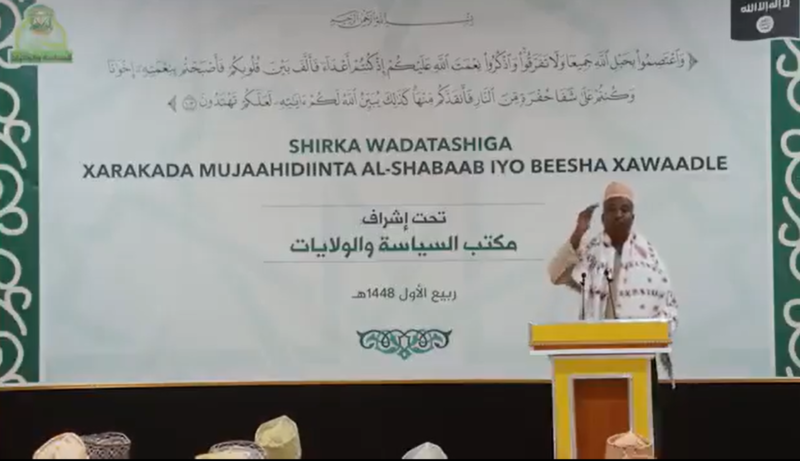
MOGADISHU — Traditional elders from the Hawadle clan and Al-Shabaab have reportedly signed an agreement in Maxaas district, Hiiraan region, aimed at ending years of hostilities between the group and the community, according to a statement circulating on social media.
The reported agreement was published on the same day that the National Independent Electoral and Boundaries Commission (NIEBC) announced the final results of the Hirshabelle elections, which produced a landslide victory for the Justice and Solidarity Party (JSP). The timing is notable. As the federal government and its allies celebrated an electoral win, news emerged of a deal that suggests Al-Shabaab is consolidating its position in Hiiraan while the government’s political attention was focused elsewhere.
The statement, read by Nabadoon Cabdishakuur Muuse Cilmi Ugaas, announced that the two sides had reached an understanding following a consultation meeting. A video of the meeting was posted on Facebook pages associated with Al-Shabaab. The footage could not be independently authenticated, and no official confirmation has been issued by Somali federal or Hirshabelle authorities.
A Landslide Win for the JSP
In Hirshabelle, 114,633 voters cast ballots across 10 districts, with 112,466 valid votes and 2,167 rejected votes. As reported in FTL Somalia’s coverage of the election results, the JSP won 158 of the 222 local council seats and 78 of the 99 House of Representatives seats, consolidating its dominance across both chambers.
The vote proceeded despite significant political opposition from the Hawadle community in Hiiraan. As detailed in FTL Somalia’s coverage of the electoral dispute, Xawaadle leaders declared they would not accept any election held without a prior political agreement, and armed Macawiisley fighters seized voter registration centres in Beledweyne in early September.
The Fall of Maxaas and the Collapse of the Hawadle Campaign
Maxaas was captured by Al-Shabaab on July 27, 2025, following an assault involving suicide bombings and a ground attack. The town had been under government control for over a decade and served as a key logistical hub. Former Prime Minister Hassan Ali Khaire called the loss a “national disgrace” and accused the federal government of abandoning the Hawadle Macawiisley fighters who had been defending the town.
The Macawiisley militia, composed primarily of Hawadle clan fighters, emerged in 2022 as a grassroots self-defense force against Al-Shabaab. Their uprising compelled militants to abandon checkpoints that had been under their control for more than a decade. However, the federal government failed to capitalize on these gains, and by 2024, all districts recaptured by Hawadle fighters had fallen back into Al-Shabaab’s hands.
Multiple sources confirm that the Hawadle fighters did not receive sufficient government support to sustain their campaign. The International Crisis Group reported that the Hawadle militias held out the longest but eventually deserted their posts as Al-Shabaab increased pressure, and many fled to Beledweyne and Bulo Burte. Disputes over tax revenues and unpaid militia members further weakened cooperation between Hawadle forces and government troops.
Al-Shabaab’s Strategic Adaptation
Al-Shabaab has a documented history of negotiating local agreements with clans under military pressure. In late December 2022, a similar agreement was reached with parts of the Saleban clan, resulting in Al-Shabaab releasing 67 prisoners and agreeing not to carry weapons in their areas, in exchange for the clan’s neutrality and non-cooperation with the government.
The group has also adapted its approach to local communities, using more incentives and fewer coercive measures. It replaced its Middle Shabelle governor early in the uprising, bringing back a commander from the Abgal clan who leveraged his ties to persuade some sub-clans not to join the government’s campaign. It also replaced the commanders of its army and intelligence services, and Somali security officials credited the new intelligence head with playing a central role in the tactical changes behind the group’s battlefield gains.
Critical Note
The publication of the reported Hawadle-Al-Shabaab agreement on the same day as the Hirshabelle election results is not necessarily a coincidence. For the federal government and the JSP, the election results represent a political victory that reinforces their narrative of democratic progress. For Al-Shabaab, the agreement in Maxaas represents a strategic gain that undermines that narrative. Both developments are real, and they are happening simultaneously.
The Hawadle were the most committed and effective local force against Al-Shabaab in Hiiraan. Their decision to negotiate with the group, if confirmed, would reflect a profound loss of confidence in the federal government’s willingness or ability to support them. The government failed to hold territory after the Hawadle cleared it, failed to pay or equip the militias that did the fighting, and allowed political disputes over elections and revenue to undermine the coalition. When the Macawiisley needed ammunition, they got statements. When they needed reinforcements, they got political interference.
The implications extend beyond Hiiraan. If the Hawadle are seen to have accommodated Al-Shabaab, other clans that have been resisting the group may draw the lesson that the government will not stand with them either. Al-Shabaab’s strategy of exploiting political divisions and filling governance vacuums is working. The government’s counterinsurgency campaign, which began with such promise in 2022, has been undone not by a single military defeat but by a thousand political failures.