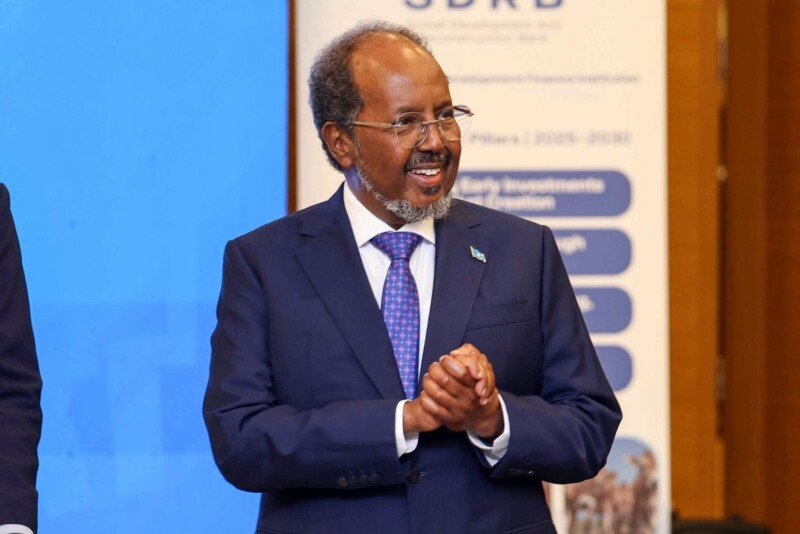
MOGADISHU — President Hassan Sheikh Mohamud held a meeting with members of both chambers of the Federal Parliament, particularly MPs belonging to the Justice and Solidarity Party (JSP), on Wednesday night to discuss strengthening cooperation, the role of MPs in state-building, and preparations for one-person, one-vote elections.
The President told the parliamentarians that the government’s commitment is to hold direct elections based on a multi-party system, and that every citizen should be able to present their political vision to the public for support. “Everyone who wants to govern the country should present their views, and once they do, the goal is for many people to follow them,” the President said.
President Mohamud emphasised that it is not possible to return to indirect elections, which have been used in Somalia for more than two decades. “We welcome and listen to the views of anyone who comes to us with a reasonable idea that can be seen as bringing progress,” he said.
A Government Under Pressure Over Its Electoral Plans
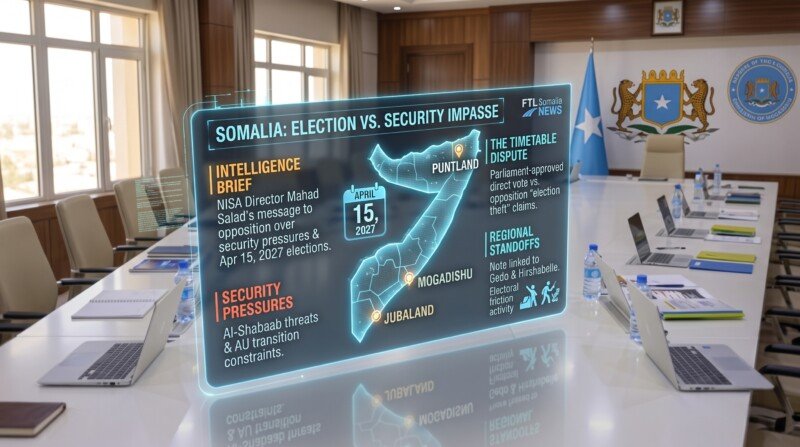
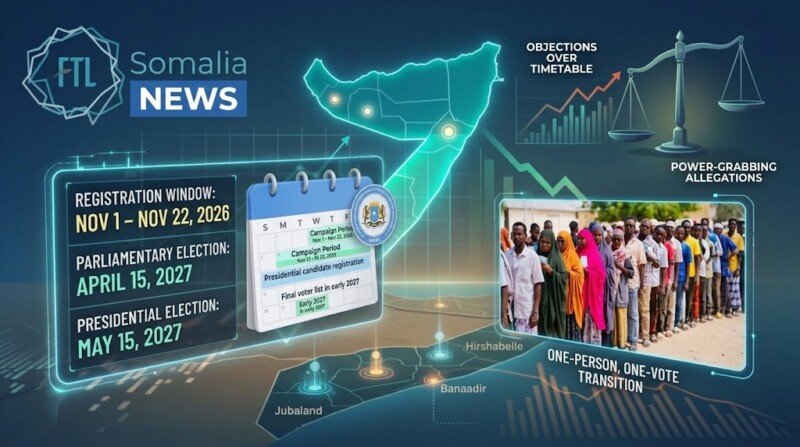
The President’s remarks come as the government faces mounting opposition to the election timetable announced by the National Independent Electoral and Boundaries Commission (NIEBC) on Wednesday. The timetable sets parliamentary elections for 15 April 2027 and the presidential vote for 15 May 2027, with voter registration reopening from 1 to 22 November 2026.
The announcement was immediately rejected by the Somali Salvation Forum (Madasha Samatabixinta), the opposition alliance that includes Puntland, Jubaland, and several former presidents and prime ministers. Mohamed Adan Jimcaale (Koofi), the Forum’s secretary, accused the government of “election theft” and “power-grabbing.”
Former President Sharif Sheikh Ahmed also condemned the timetable, warning that the unilateral move risks creating parallel elections, political instability, and civil unrest. He said he had filed a petition with the Supreme Court on 11 October challenging the constitutional amendments that underpin the electoral process, and that the court had admitted the petition on 12 October.
Former President Mohamed Abdullahi Farmaajo also opposed the timetable, calling for renewed dialogue and an inclusive process to resolve the electoral dispute. He warned of a potential leadership vacuum and said the lack of consensus could further destabilize the country.
The NIEBC Timetable and Opposition Rejection
The full timetable was published by the NIEBC and reported in detail by FTL Somalia’s coverage of the election timetable. Candidate lists for both chambers must be submitted by 22 November 2026, the provisional voter list will be published on 21 January 2027, and the final voter list on 15 March 2027. Campaigning will begin on 27 February 2027.
The opposition’s rejection was documented in FTL Somalia’s coverage of the opposition’s response, which noted that Koofi accused the government of seeking to prescribe the same disease that caused Somalia’s destruction forty years ago.
The Galmudug Precedent and Credibility Concerns
The NIEBC’s credibility has been questioned following the Supreme Court’s annulment of the Galmudug elections in August 2026. As reported in FTL Somalia’s coverage of the Supreme Court ruling, the court found that the July 30 vote had not been administered in accordance with constitutional and electoral requirements for free, fair and impartial elections, and ordered a rerun.
However, the NIEBC subsequently excluded Towfiiq from the list of organizations cleared to contest the rerun, despite the party having successfully challenged the previous election in court. Former Chairperson Halima Ismail Ibrahim has warned that Somalia should not proceed with any national election unless three critical conditions are met: a political agreement on the election model, a mutually agreed electoral commission, and legally recognized competing political parties.
Parallel Elections and Limited Federal Reach
The opposition has repeatedly threatened to organize parallel elections and form a rival administration if the government proceeds without a negotiated agreement. As reported in FTL Somalia’s coverage of the opposition’s threat, opposition leaders warned of a potential constitutional vacuum if the political deadlock persisted.
Puntland and Jubaland have both rejected the constitutional amendments and the electoral framework. Puntland has signaled that it may proceed with independent regional elections if no national agreement is reached. The federal government’s ability to organize elections in Puntland and Jubaland is severely constrained, and both states have declined to participate in negotiations mediated by Turkey, questioning Ankara’s neutrality.
Critical Note
President Hassan Sheikh Mohamud’s meeting with JSP parliamentarians is a political rallying effort at a moment when his electoral plans face unprecedented opposition. By reaffirming his commitment to one-person, one-vote elections and ruling out a return to indirect elections, the President is drawing a clear line: the government will proceed with its electoral agenda, with or without opposition consensus.
But the President’s assertion that he welcomes “anyone who comes with a reasonable idea” sits uneasily alongside the reality that two former presidents, two federal member states, and a broad opposition alliance have all rejected the process as illegitimate. The gap between the government’s rhetoric of inclusivity and its unilateral actions is widening.
The government’s decision to proceed with the NIEBC timetable despite the lack of a negotiated agreement risks deepening the divisions it claims to be addressing. The Galmudug precedent, where the Supreme Court annulled an election administered by the NIEBC and the commission then excluded the party that brought the successful challenge, has raised serious questions about the commission’s impartiality. With Puntland and Jubaland unlikely to participate, the 2027 elections could produce a partial outcome that lacks national legitimacy.
For Somalia, the coming months will determine whether the 2027 elections mark a historic transition to direct democratic governance or a deepening of the political crisis. The President’s commitment to direct elections is admirable in principle. But elections cannot be imposed, they must be agreed upon. Without a negotiated framework that includes all major political stakeholders, the electoral process risks producing not a government of the people, but a government of one faction.
Share your story. FTL Somalia is continuing to investigate Somalia’s electoral process. If you have information or insights to share, contact us at info@ftlsomalia.com. Your identity will be protected.
Recommended Reading On ftlsomalia.com
- Somalia’s Electoral Commission Announces Timetable for Parliamentary and Presidential Elections in 2027
- Somalia’s Opposition Accuses Government of ‘Election Theft’ After NIEBC Announces 2027 Timetable
- Galmudug Election Finalized as Supreme Court Certifies Rerun Results
- Somalia President Agrees to Opposition Talks to Avoid Parallel Elections